 Whatcom County
 Building Decks for Columbia's Marine Climate
Columbia sits close enough to the water and the weather patterns that come off it that a deck here lives a different life than one built fifty miles inland. Whatcom County gets a long wet season, salt-laden air moving in off the bay, and enough overcast, low-sun days each year that anything shaded stays damp far longer than homeowners expect. A deck that isn't built with that in mind will show it early — soft spots in the decking, rusted fasteners bleeding through the boards, moss creeping across the surface by the second or third winter.
None of that is inevitable. It's a function of material choice, framing detail, and drainage — the same three things we look at on every custom deck we build in this area. This page is about what that actually looks like for a deck built in Columbia specifically, not a generic rundown of deck types.
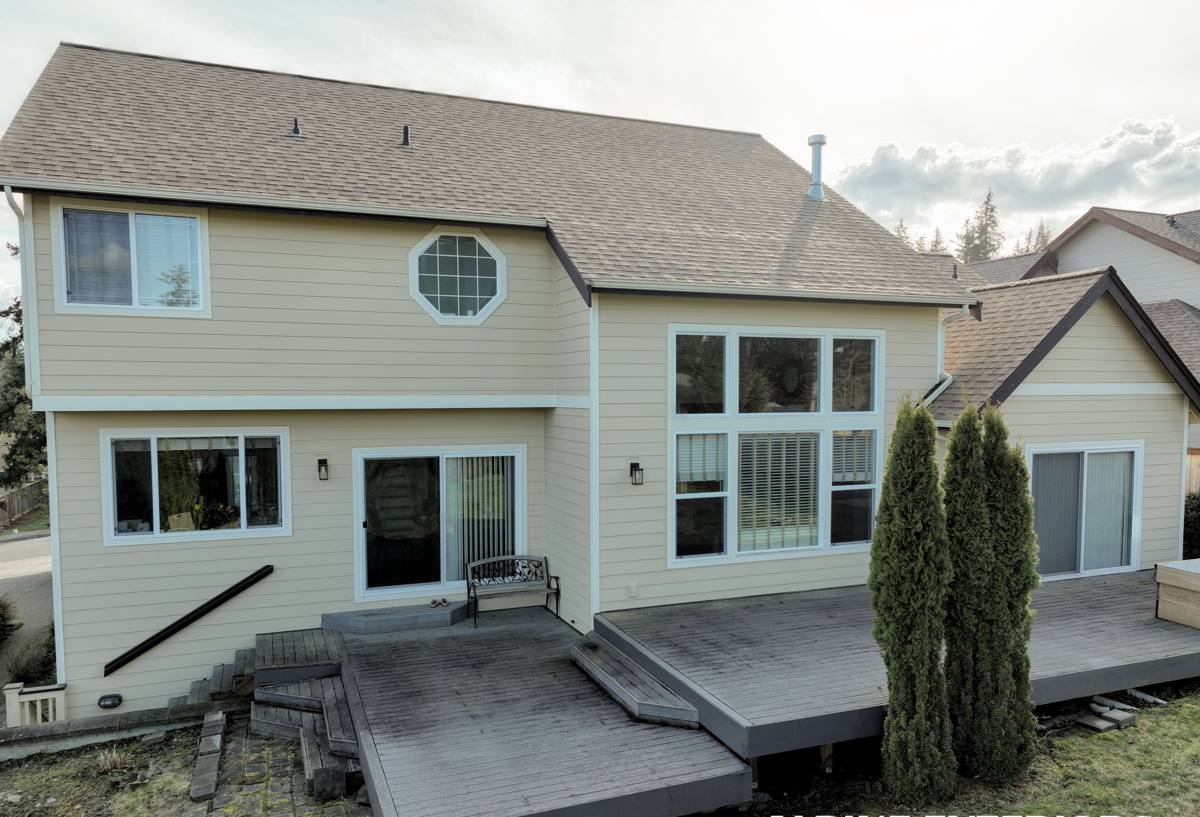
What Local Homes in Columbia Need From a Deck
Most of the deck problems we get called out to repair in this part of Whatcom County trace back to the same handful of causes, and they're almost all climate-driven rather than random bad luck:
- Ledger boards attached to the house without proper flashing, letting water track behind the siding during driving rain
- Decking installed tight against the house or fence lines with no airflow, so it never fully dries between storms
- Standard carbon-steel or coated fasteners used where salt air accelerates corrosion, leading to staining and eventual fastener failure
- Shaded, north-facing decks with no thought given to moss and algae growth from day one
- Footings set too shallow or not sized for our saturated clay-heavy soils, leading to movement over a few wet seasons
A correctly built deck in Columbia addresses every one of these from the design stage, not as an afterthought or a repair three years later.
Choosing the Right Decking Material
There's no single "best" decking material — there's a best material for a given deck's exposure, budget, and how much upkeep the homeowner actually wants to do. Here's how the common options hold up under our conditions specifically:
| Material | How It Handles Our Wet Season | Maintenance | General Cost Range |
|---|---|---|---|
| Pressure-treated fir/pine | Fine if sealed and re-sealed regularly; prone to checking and moss without upkeep | Annual cleaning and re-sealing | Lowest upfront |
| Cedar | Naturally rot- and insect-resistant, but still needs sealing to fight graying and moisture uptake | Sealing every 1–2 years | Mid-range |
| Composite decking | Excellent — doesn't absorb water or feed rot the way wood does; some boards can still host surface moss in deep shade | Periodic washing, no sealing | Mid to upper |
| PVC decking | Best moisture performance of the group; fully synthetic, doesn't take on water | Occasional washing | Highest upfront |
For a Columbia deck under trees or on the shaded side of the house, we usually steer homeowners toward composite or PVC — not because wood is a bad product, but because the maintenance burden of keeping natural wood clean and sealed through a Whatcom County winter is real, and most people don't stay on top of it. If the look and feel of real wood matters more than low maintenance, cedar with a proper sealing schedule is still a solid, honest choice — we just make sure homeowners know what that commitment looks like before we start.
Framing Material Matters Too
The decking is the part everyone sees, but the frame underneath is what determines whether the deck is still solid in ten years. We build the structural frame with pressure-treated lumber rated for ground contact where it's in contact with soil or masonry, and we use corrosion-resistant fasteners and structural hardware throughout — not just at the ledger. In a marine-air environment, the difference between standard coated hardware and stainless or heavy hot-dip-galvanized hardware shows up as rust streaks and weakened connections years before it should.
Framing and Structure: What a Correct Job Involves
A custom deck is a structure, not just a surface. The parts that don't get seen are the parts that determine whether it's safe and sound years from now. On every deck we build in Columbia, that means:
- Proper ledger flashing where the deck attaches to the house, so rain is directed away from the wall assembly rather than behind it
- Footings sized and set to local frost and soil conditions, not just poured to a generic depth
- Joist spacing and beam sizing calculated for the actual span and load, including snow load where relevant
- Corrosion-resistant structural connectors — joist hangers, post bases, and fasteners rated for the exposure
- Proper gapping between deck boards for drainage and airflow, sized for the material being used
None of this is exotic — it's just the difference between a deck that's built to hold up in this climate and one that was built to look right on installation day.
Moss, Mildew, and Drainage: Designing for the Long Rainy Season
Whatcom County's moss season isn't a minor annoyance — it's most of the year on any deck that doesn't get regular direct sun. We can't change how much rain Columbia gets, but we can design a deck so moss and standing moisture aren't a constant fight:
- Orienting and spacing boards to maximize drainage and airflow underneath the deck, not just across the surface
- Keeping the deck surface a few inches below door thresholds and siding, both for code and to stop water from wicking into the house
- Avoiding tight enclosures under low decks that trap moisture — skirting gets venting built in rather than sealing the space shut
- Recommending decking finishes and materials suited to the amount of shade a specific deck will actually get, not a one-size answer for every yard
A deck built without this thinking will grow moss no matter what material it's made of. A deck built with it still needs occasional cleaning, but it won't be fighting a losing battle every winter.
Our Process for a Columbia Deck Project
Every custom deck we build follows the same process, adjusted for the specific lot and how it's used:
1. On-Site Assessment
We walk the site, check sun and shade exposure, look at drainage patterns, and talk through how the space will actually get used — entertaining, grilling, a quiet spot off a bedroom, whatever it is.
2. Design and Material Selection
We lay out the deck footprint, framing plan, and material options with honest trade-offs for each, based on the exposure we just assessed — not a generic sales pitch toward whatever has the best margin.
3. Permitting
Most custom decks above a certain height or attached to the house require a building permit in Whatcom County jurisdictions. We handle that paperwork so it isn't left for the homeowner to sort out.
4. Build
Footings, framing, decking, railing, and finish work, built to the standards above — not shortcuts hidden under a nice-looking surface.
5. Final Walkthrough
We walk the finished deck with the homeowner, cover how to care for the specific material chosen, and answer questions before we consider the job done.
Maintenance Checklist for Whatcom County Decks
Whatever material a deck is built from, a little seasonal attention goes a long way in this climate. We give every customer a version of this list specific to their deck:
- Sweep debris (leaves, needles, moss spores) off the deck regularly through fall and winter
- Clean the surface at least once a year with a deck-safe cleaner, more often in heavy shade
- Check and re-seal wood decking on the schedule appropriate to the product — don't wait for visible graying
- Inspect fasteners and hardware annually for rust staining, especially near the ledger and stairs
- Keep gutters and downspouts near the deck clear so runoff isn't dumping directly onto or under it
- Trim back overhanging branches to cut down on shade, debris, and moss buildup
Permits and Local Considerations
Deck permitting requirements vary depending on the specific jurisdiction within Whatcom County, deck height, and whether it's attached to the house. Setback rules and lot coverage limits can also come into play depending on the property. We handle the permit process as part of every project rather than leaving it to the homeowner, and we build to current code rather than to whatever's cheapest to get past inspection.
Why a Local Crew Matters
A deck design that works in a dry inland climate can fail here within a few seasons — not because it was built carelessly, but because it wasn't built for driving rain, salt air, and a moss season that runs most of the year. Working in Columbia and the surrounding Whatcom County area means we're specifying materials, fasteners, and drainage details based on what actually happens to decks here, not on a generic regional average. That's the difference between a deck that needs real repair work in year four and one that's still solid a decade in.
If you're planning a new deck or replacing one that's showing its age, we're happy to come take a look and walk through the options — no pressure, no obligation. Use the form below to request a free estimate.