 Whatcom County
 Why Color Choice Matters More Here Than Most Places
Picking a siding color feels like the fun part of a project, and it is. But in Whatcom County, color choice is also a performance decision, not just a design one. Between the salt air rolling in off Bellingham Bay and the Strait of Georgia, driving rain off the Pacific for half the year, and a moss and mildew season that can stretch from October into May, the finish on your siding gets tested constantly. A color and coating system that looks good on a spec sheet in Arizona doesn't automatically hold up the same way on a house three miles from saltwater in Blaine or tucked under fir trees in Deming.
This is one of the reasons we standardized on James Hardie fiber cement with the factory-applied ColorPlus finish instead of offering a mix of vinyl, LP SmartSide, or field-painted products. It's not that other products can't look fine on day one. It's that color retention, moisture behavior, and finish durability are where cheaper or field-finished systems tend to show their age fastest in a climate like ours.
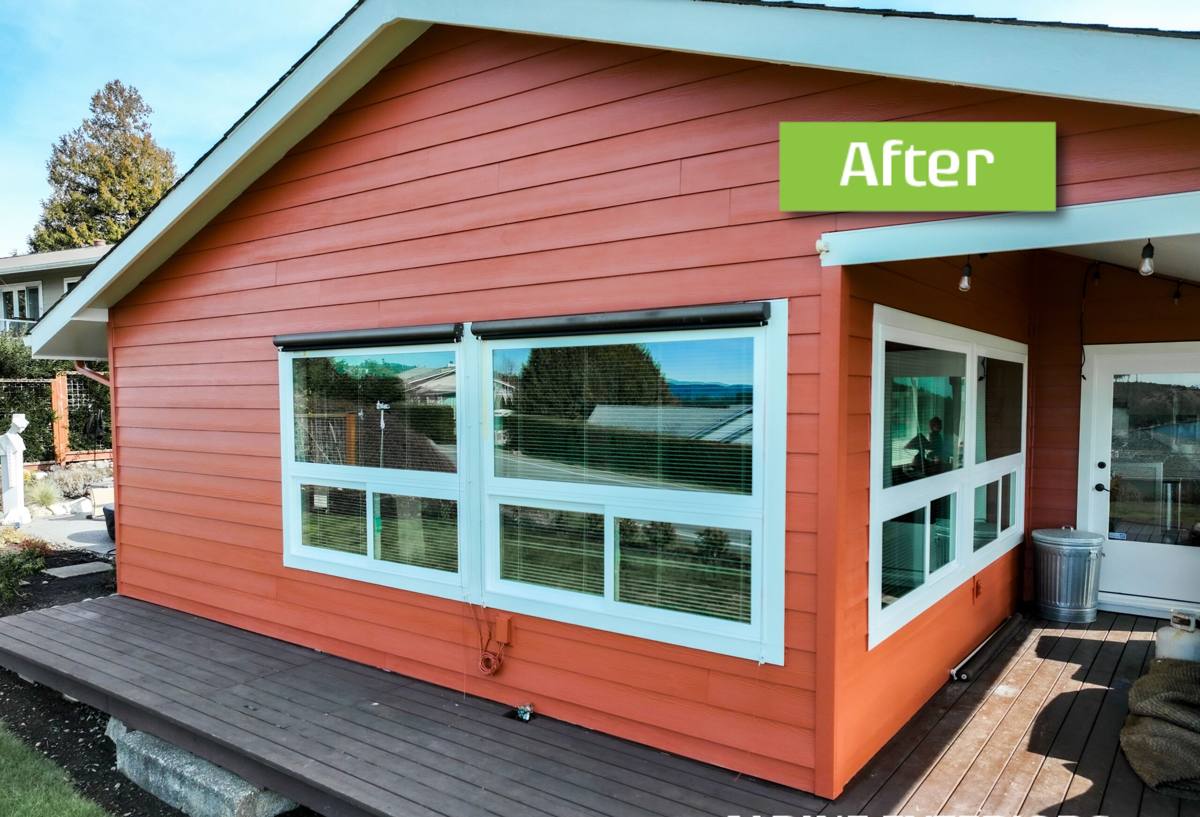
What ColorPlus Technology Actually Is
ColorPlus is James Hardie's factory finishing process. Instead of siding arriving primed and getting painted on-site (or arriving pre-colored the way vinyl does, baked into the plastic itself), Hardie boards go through a multi-coat, oven-cured finishing process at the factory before they ever reach a jobsite. The result is a bonded finish that's more consistent and more resistant to fading, chipping, and moisture intrusion than a typical on-site paint job.
Why factory-applied beats field-painted
Field-painted fiber cement or primed spruce depends heavily on job-site conditions the day it's painted — humidity, temperature, how much time passes between install and finish coat, and the skill of whoever's holding the sprayer. ColorPlus removes most of that variability. The color is baked on before the boards leave the plant, under controlled conditions, every time.
- Consistent color and sheen across every board, not batch-to-batch variation
- Finish is cured and hardened before installation, not exposed to weather while still soft
- Touch-up and caulk products are formulated to match, so trim work doesn't look patched
- Backed by a separate finish warranty on top of the product warranty (more on that below)
The James Hardie Color Palette
Hardie's ColorPlus palette runs from deep, saturated colors like Iron Gray and Deep Ocean to soft neutrals like Arctic White, Timber Bark, and Cobble Stone, plus a range of warm and cool mid-tones. The exact lineup varies slightly by region and product line, and Hardie periodically retires or adds colors, so we always confirm current availability before a project rather than quoting from memory.
Light vs. dark colors in a wet climate
Darker colors show less obvious staining from airborne salt residue and general road grime, but they absorb more heat, which matters less here than it would in a hot, dry climate — Whatcom County's summers are mild. The bigger local factor is moss and mildew: lighter colors tend to show the first faint green or black spotting sooner, simply because there's more contrast. Darker colors can hide early growth longer, which sometimes means it goes unnoticed and unaddressed longer too. Neither is a dealbreaker — it's a maintenance-awareness issue more than a durability one.
Custom and off-palette colors
Hardie boards can also be field-painted in a custom color if a homeowner wants something outside the ColorPlus lineup. That's a legitimate option, but it means giving up the factory finish warranty on the boards you paint, and it puts you back in the position of depending on a quality field paint job to hold up against our rain and salt exposure. We'll do it if that's what a homeowner wants, but we explain that trade-off up front.
Matching Product Line to Color and Exposure
James Hardie's "HZ" (HardieZone) product engineering matters as much as the color itself. Whatcom County sits in a zone where wind-driven rain and moisture cycling are the primary threats, more than extreme heat or freeze-thaw. Hardie's HZ5 formulation, used across the Pacific Northwest, is engineered specifically for wetter climates — different resin and moisture-management properties than the formulation sold in drier regions.
| Product Line | Typical Use | Relevant to Whatcom County |
|---|---|---|
| HardiePlank lap siding | Most common horizontal siding | Available in smooth and cedar-textured finishes; handles driving rain well when flashed correctly |
| HardiePanel vertical siding | Modern vertical look, board-and-batten | Popular on shop buildings and contemporary remodels around Bellingham and Ferndale |
| HardieShingle | Staggered or straight shingle look | Good option for matching older Whatcom County neighborhood character without the upkeep of real cedar shingle |
| HardieTrim | Fascia, corner boards, window trim | Same ColorPlus finish options, keeps trim and field siding color-matched |
Choosing the wrong product line for the exposure — say, a smooth finish in a spot that gets constant wind-driven rain off open water in Blaine or Point Roberts — doesn't ruin the siding, but it can accelerate how soon it needs cleaning or touch-up. Part of a proper Hardie install is thinking through wall-by-wall exposure, not just picking one color and product for the whole house.
Why We Don't Offer Vinyl or LP SmartSide Alongside Hardie
Homeowners sometimes ask why we don't just carry a few product lines and let them choose. The honest answer is that once you've spent years dealing with what our climate does to different siding materials, it's hard to keep recommending products we don't think perform as well here.
Vinyl siding
Vinyl is inexpensive and low-maintenance in the sense that it never needs painting, but its color is baked into the material itself, which means it can fade unevenly over the years, especially on south and west-facing walls. It also expands and contracts significantly with temperature swings, and in a marine climate with constant moisture cycling, seams and J-channels are where water tends to find its way behind the material over time. It's not a bad product everywhere — it's just not what we'd choose to stand behind on a Whatcom County home.
LP SmartSide
LP SmartSide is an engineered wood product, and it's genuinely improved over older wood composite sidings. But it's still wood-based at its core, which means its long-term performance depends heavily on caulking, flashing, and paint maintenance staying ahead of moisture. In a county with our rain totals and moss pressure, wood-based products are the ones most likely to need attention sooner if maintenance slips even one season. Fiber cement doesn't share that vulnerability — it's non-combustible and doesn't absorb and swell the way wood-based sidings can.
None of this means these products are junk. It means that after weighing the trade-offs against our specific climate, we decided we'd rather install one product system well than offer several and let quality be inconsistent.
The Warranty Picture
James Hardie's product warranty and the ColorPlus finish warranty are separate, and it's worth understanding both before you sign a contract with any contractor.
- The fiber cement substrate itself carries a long-term, transferable limited warranty covering the board
- The ColorPlus factory finish carries its own separate finish warranty covering fade and finish integrity
- Field-painting the boards yourself or through a painter (rather than choosing a ColorPlus color) forfeits the factory finish warranty on those boards
- Warranty coverage generally requires installation according to Hardie's published installation instructions — this is why installer experience matters as much as the product choice
We always recommend homeowners read the actual current warranty documents rather than relying on a verbal summary from any contractor, since terms can be updated by the manufacturer.
Practical Color Selection Tips for This Area
A few things we walk homeowners through before finalizing a color:
- Look at samples outdoors, in overcast light — Whatcom County doesn't get the bright, direct sun that makes colors read differently, so indoor lighting or sunny-day photos from elsewhere can be misleading
- Consider how the color will read against typical PNW roof colors (charcoal, weathered wood, driftwood) already common on the house or neighboring homes
- Think about trim contrast — a lot of homes in Bellingham, Ferndale, and Lynden neighborhoods lean toward a darker field color with a lighter, crisp trim color, which also helps corners and window lines read cleanly through gray winter months
- Ask about the maintenance difference between light and dark colors specifically for moss and mildew visibility, discussed above
- Confirm which colors are currently in the ColorPlus lineup for your chosen product line — not every color is offered on every profile
Getting the Installation Right
Color and product selection only matter if the installation is done to spec. Correct flashing, proper gaps at penetrations, ground clearance, and correctly caulked (or intentionally left open, per Hardie's specifications) joints are what keep water from ever reaching the point where color and finish would even be tested. A beautiful color on a poorly flashed wall will still show staining and streaking sooner than a properly installed wall in a plainer color. We install strictly to James Hardie's published specifications, which is also a requirement for the product warranty to remain valid.
If you're weighing colors, product lines, or just trying to figure out what makes sense for your home's exposure to wind, rain, and salt air, we're happy to walk the property with you and put together a free, no-pressure estimate.