 Whatcom County
 Siding in Everson: Built for Whatcom County's Wet Side
Everson sits inland along the Nooksack River in the heart of Whatcom County, surrounded by farmland, timber, and the kind of steady Pacific Northwest weather that doesn't announce itself with hurricanes or hailstorms — it just wears a house down slowly, year after year, until the siding tells the whole story. Long wet winters, humid summers, heavy morning dew off the river bottoms, and shade from mature trees on a lot of Everson properties all add up to one thing: siding here needs to manage moisture and resist organic growth better than siding almost anywhere else in the country. That's the lens we bring to every siding job in Everson, whether it's a full re-side on an older farmhouse or a repair on a newer build out toward the Nooksack.
We install James Hardie fiber cement siding exclusively. That's not a marketing angle — it's a standard we hold because we've seen what works and what doesn't on homes in this exact climate, and we'd rather turn down a job than install something we don't believe will hold up.
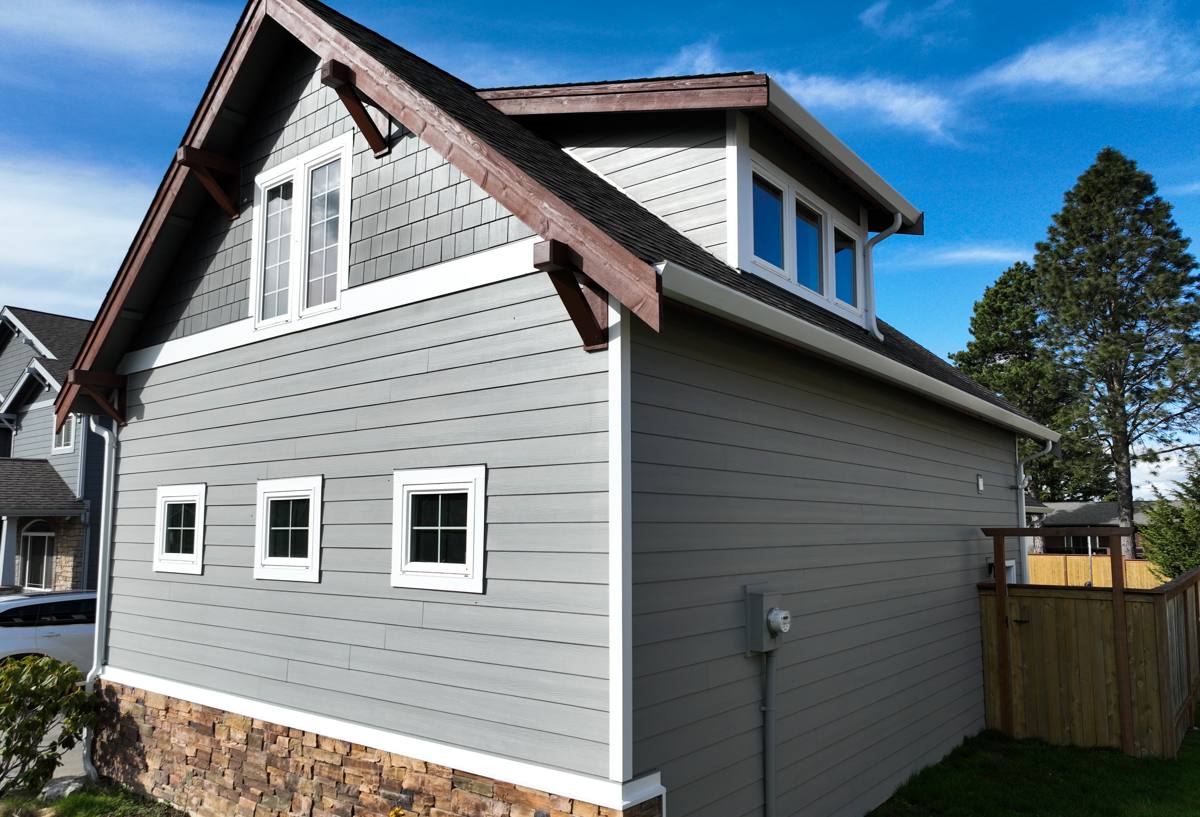
What Everson's Climate Actually Does to Siding
Rain and Humidity, Day After Day
Whatcom County doesn't get the dramatic downpours some regions do — it gets persistent, low-intensity rain across many months of the year, plus the kind of ambient humidity that keeps wood and wood-based products from ever fully drying out. Siding materials that absorb moisture, or that rely on a factory or field coating to keep water out, are working against the clock here. Over years, that moisture cycling — wet, damp, wet again — is what drives swelling, cupping, and eventually rot in vulnerable materials.
Moss, Mildew, and Algae
Everson's mix of tree cover, river-bottom humidity, and long shoulder seasons of mild, damp weather is close to ideal growing conditions for moss and mildew on exterior surfaces. North-facing walls, siding under eaves with limited sun exposure, and anything near mature landscaping are especially prone to green and black staining if the material and finish aren't up to it. This is one of the most common complaints we hear from homeowners moving away from wood-based or lower-grade siding products — not failure, just a constant, losing battle with organic growth.
Temperature Swings and Seasonal Movement
While Whatcom County doesn't see extreme heat, the difference between a cold, damp winter and a warm, dry August is enough to cause real expansion and contraction in siding materials over time. Products that don't handle that movement well develop gaps at seams, cracked caulk lines, and eventually paths for water intrusion behind the siding — which is where the real damage happens, out of sight.
Why We Standardized on James Hardie
James Hardie fiber cement is engineered specifically to handle the conditions we just described. It's a cement-based product, not wood-based, so it doesn't absorb and swell with moisture the way wood, wood composite, or some engineered wood products can. It's also non-combustible, which matters more each year as wildfire smoke and dry-season fire risk become a bigger part of Pacific Northwest summers, even on the wetter west side of the Cascades.
The HZ5 Engineering Advantage
Hardie manufactures regional product lines engineered for specific climate zones, and the Pacific Northwest falls under their HZ5 moisture-focused engineering. That means the product we install in Everson is formulated with this exact climate in mind — not a generic national product, and not something engineered primarily for a drier or hotter region.
ColorPlus Factory Finish
Most of the color failure and touch-up headaches we see on older siding come down to field-applied paint breaking down faster than a factory finish. Hardie's ColorPlus finish is baked on in a controlled factory environment, which gives it better fade resistance and durability than paint applied on-site after installation — and it means fewer repaint cycles over the life of the siding.
A Warranty Backed by the Manufacturer
Hardie backs its siding with a strong, transferable limited warranty. That matters in a farming and family community like Everson, where homes often stay with a family for decades or get sold to the next owner rather than flipped — a transferable warranty protects that value either way.
Why We Don't Install Everything on the Market
We get asked fairly often about vinyl, LP SmartSide, and other fiber cement brands. We're upfront about why we don't install them, because homeowners deserve the real trade-offs, not a sales pitch.
- Vinyl siding is inexpensive and low-maintenance in mild, dry climates, but it can warp or become brittle with the temperature swings and UV exposure Whatcom County sees, and it doesn't offer the fire resistance or the rigid, higher-end appearance that fiber cement does.
- LP SmartSide is a wood-strand product with a resin coating. It performs reasonably well when installation and caulking are executed perfectly and maintained on schedule, but it's a wood-based product at its core, and wood-based products are simply more moisture-sensitive than cement-based ones — a real liability in a climate this wet.
- Other fiber cement brands like Cemplank or Allura are legitimate cement-based competitors, but we've standardized on one manufacturer so our crews install one system, to one spec, with one warranty structure, rather than juggling multiple installation methods and touch-up paint systems across jobs.
- Primed spruce or cedar siding can look beautiful, but real wood requires the most ongoing maintenance of any option — regular refinishing, careful caulking, and vigilant moisture management — and in a moss-and-mildew climate like Everson's, that maintenance burden only grows.
None of these are bad products in every situation. They're just not what we're willing to put our name behind in this specific climate, given what we've seen play out on real homes over time.
How a Siding Project Works, Start to Finish
- Walkthrough and assessment. We look at your current siding, check for hidden moisture damage around windows, doors, and trim, and talk through what you want out of the project.
- Material and color selection. We'll walk you through Hardie's plank, shingle, and panel options along with the ColorPlus palette so the finished look fits the house and the neighborhood.
- Tear-off and prep. Old siding comes off, and we inspect and repair any sheathing or framing issues before anything new goes up — covering damage instead of fixing it just creates problems down the road.
- Weather barrier and flashing. Proper house wrap and flashing details around every window, door, and penetration are what actually keep water out over the long run — the siding itself is the last line of defense, not the first.
- Installation to manufacturer spec. Correct fastening, clearances, and caulking are what make Hardie's warranty valid and what determine how the siding performs for decades, not just for the first few years.
- Final walkthrough. We go over the finished work with you before calling the job done.
Siding Cost Factors in Everson
Every home is different, but these are the main variables that drive cost on a typical Everson siding project:
| Factor | Why It Matters |
|---|---|
| Home size and wall complexity | More square footage, dormers, and cut-outs mean more material and labor time. |
| Current siding condition | Hidden rot or moisture damage behind old siding adds repair scope before new siding can go on. |
| Product selection | Lap plank, shingle-style, and panel siding carry different material and installation costs. |
| Trim and accent details | Additional trim boards, accent colors, or mixed textures add labor and material. |
| Site access | Tree cover, fencing, or tight lot access common on rural Everson properties can affect setup time. |
Siding, Roofing, Windows, and Decks — One Local Crew
Siding rarely fails in isolation. A roof that's shedding water incorrectly, windows with failed flashing, or a deck ledger board holding moisture against the wall can all undermine even a perfect siding installation. Because we handle roofing, windows, and decks alongside siding, we look at the whole exterior envelope on an Everson home rather than treating siding as a standalone product swap. That matters most at the details — where a roofline meets a wall, where a window is flashed into new siding, where a deck attaches to the house — because those transition points are where most real-world water problems start.
Why a Local Crew Matters in Everson
Everson isn't a dense urban market, and that's exactly why local experience counts. A crew that works across Whatcom County regularly knows how river-bottom humidity behaves differently than it does up on higher ground, understands how shaded, tree-lined lots need different moss and drainage considerations than open farmland parcels, and has already seen how different siding products actually perform after five, ten, or twenty years in this specific climate — not just in a manufacturer's marketing material. That local track record is what should give you confidence, more than any national brand name alone.
A Few Things to Check Before You Hire Anyone
- Are they licensed and insured to work in Washington, and can they show proof without hesitation?
- Do they install to the manufacturer's written specifications, or do they cut corners on fastening, flashing, and clearances?
- Will the manufacturer's warranty transfer to a future homeowner if you sell?
- Do they explain trade-offs honestly, or does every product sound like the perfect fit?
- Do they handle the full exterior envelope, or just the one product they're trying to sell you?
If your Everson home's siding is showing moss, gaps, peeling paint, or soft spots — or if you're just planning ahead for a re-side — we're happy to come take a look and give you an honest, no-pressure estimate. There's a form right below this page to get started.