 Whatcom County
 Two Products, One Big Question: What Happens When It Gets Wet?
If you've been shopping for siding in Whatcom County, you've probably run into two very different answers to the same problem: how do you clad a house that sits in one of the wettest corners of the Lower 48 and keep it looking good for decades? Fiber cement and engineered wood siding both claim to have solved it. We install one of them exclusively, and we think homeowners deserve a clear explanation of why, instead of a sales pitch.
Engineered wood siding — often sold under names like LP SmartSide — is a wood-strand product bonded with resins and coated with a protective overlay, then primed or factory-finished. It's lighter than fiber cement, easier to cut, and generally costs less installed. Fiber cement, the category James Hardie built its reputation on, is a mix of cement, sand, and cellulose fibers pressed and cured into planks and panels. It's heavier, denser, and behaves completely differently when it's sitting on a wall in Bellingham, Ferndale, or Lynden through forty inches of annual rainfall.
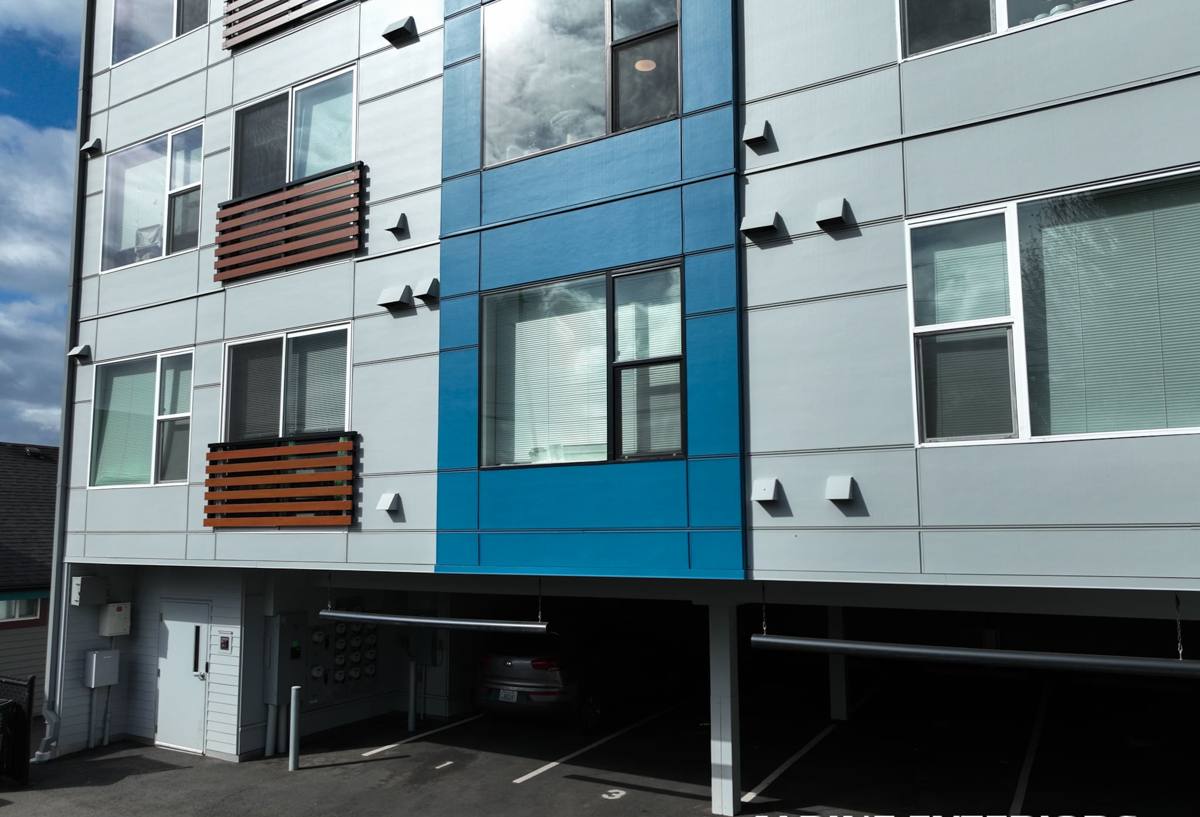
What Engineered Wood Gets Right
We're not going to pretend engineered wood is a bad product — it isn't. It's a legitimate improvement over old-school solid wood and hardboard siding from decades past. A few things it does well:
- Lighter weight makes it faster to handle and install, which can lower labor cost
- It cuts and fastens more like traditional wood, which some crews find faster to work with
- Modern versions use zinc borate treatment to resist fungal decay and insects
- It holds paint well when properly primed and maintained
For a lot of climates, that's a perfectly reasonable siding choice. The trouble is, Whatcom County isn't a lot of climates.
Why Our Local Climate Changes the Math
Whatcom County sits where marine air off the Salish Sea meets the foothills of the Cascades, and that combination produces long stretches of the year where wood-based products simply don't get to dry out. Salt-laden air off Bellingham Bay and the Strait accelerates wear on exposed wood fibers and fasteners. Driving, wind-blown rain — the kind that comes in sideways during a fall or winter system — pushes moisture into seams, laps, and cut edges that face away from the weather. And the moss season here isn't a few weeks; on north-facing walls and shaded elevations, it can run most of the year.
Engineered wood is an organic, wood-fiber product at its core. Its protective coatings and resin treatments are doing real work to keep moisture out, but that's a battle that has to be won every single day, at every cut edge, nail hole, and joint, for the life of the siding. Fiber cement isn't fighting that battle in the same way — it's a cementitious material that doesn't rot, swell, or feed fungal growth, because there's no organic wood fiber for moisture or moss to work on in the first place.
Where Engineered Wood Failures Actually Start
When engineered wood siding has problems, it's rarely because the product itself was defective. It's almost always one of these:
- A cut edge or panel end left unsealed, letting moisture wick into the wood-strand core
- Caulk joints that were skipped, under-filled, or degraded years later without being refreshed
- Siding installed too close to grade, decking, or roofing, holding it in a damp microclimate
- Delayed repainting, letting the factory or field-applied coating break down before it's renewed
Every one of those is a maintenance and installation-discipline issue, not a mystery. But it means the product's long-term performance is only as good as the crew that installed it and the homeowner who keeps up with it afterward — and in a climate that gives you fewer dry days to catch problems early, that margin for error is thinner.
How Fiber Cement Handles the Same Conditions
James Hardie's fiber cement siding is engineered specifically for the failure modes that show up in wet, coastal, and mixed-humidity climates. A few reasons it holds up differently here:
- Non-combustible, non-organic composition — there's no wood fiber for moisture to swell, rot, or feed fungal growth
- ColorPlus Technology — a factory-applied, baked-on finish that's more consistent and more fade- and chip-resistant than field-applied paint, so touch-ups are rare rather than routine
- HZ5 and HZ10 product engineering — Hardie makes versions of its siding formulated for specific climate zones, including the wetter, harsher zones the Pacific Northwest falls into
- Dimensional stability — fiber cement expands and contracts far less with moisture and temperature swings than wood-based products, which means fewer stressed joints and less caulk failure over time
None of that makes fiber cement maintenance-free — it still needs correctly caulked joints, proper flashing, and periodic inspection like any exterior product. But the material itself isn't the weak link the way an organic wood-strand core can be.
Side-by-Side: What Actually Differs
| Factor | Engineered Wood | James Hardie Fiber Cement |
|---|---|---|
| Core material | Wood strand, resin-bonded | Cement, sand, cellulose fiber |
| Moisture behavior | Depends on coating and sealing integrity | Doesn't swell or rot; core is non-organic |
| Fire resistance | Combustible | Non-combustible |
| Finish | Primed or coated at factory; often needs repainting | Factory-baked ColorPlus finish, long repaint intervals |
| Weight/handling | Lighter, easier to cut | Heavier, requires proper tools and technique |
| Warranty structure | Varies by manufacturer, often prorated | Long-term limited warranty, transferable to one subsequent owner |
| Moss/algae resistance on shaded walls | Coating-dependent | Cementitious surface resists organic growth better |
Installation Sensitivity: The Part Nobody Talks About
Both products are installation-sensitive — meaning how they're installed matters as much as what they're made of. But they're sensitive in different ways. Engineered wood is forgiving to cut and handle but unforgiving of skipped sealing steps. Fiber cement is more forgiving of long-term moisture exposure but requires a crew that knows how to handle its weight, use the right blades and fasteners, maintain correct clearances from grade and other surfaces, and follow Hardie's published installation instructions to keep the warranty intact.
This is really the core of why we standardized on one product line: it lets our crews build deep, repeatable expertise in a single system rather than splitting attention across several products with different installation rules, different failure points, and different warranty fine print.
Warranty: Read What You're Actually Getting
Warranty length looks similar on paper across many siding products, but the structure underneath matters more than the number on the brochure. Some engineered wood warranties are prorated after the first several years, meaning the manufacturer's contribution toward a repair shrinks over time. James Hardie's limited warranty on its siding is structured to remain non-prorated for its full term and is transferable to one subsequent homeowner — a meaningful detail if you plan to sell before you plan to reside.
Whichever product a homeowner chooses, we'd encourage actually reading the warranty document rather than the sales sheet. The difference between "covered" and "covered on a declining scale" is significant money down the road.
What We Tell Homeowners Who Ask About Engineered Wood
We don't tell people engineered wood is a scam or that it will fail on their house. Plenty of engineered wood siding performs fine for years, especially on well-protected elevations with disciplined maintenance. What we tell people is this: we've chosen not to install it because we don't want to be in the business of hoping every cut edge gets sealed, every caulk joint gets renewed on schedule, and every homeowner keeps up with repainting for the next 20 years in a climate that doesn't give the product many breaks. We'd rather put a non-combustible, dimensionally stable, factory-finished product on a home and stand behind it with confidence, not caveats.
That's not a knock on every engineered wood installation out there. It's a statement about what we're willing to warranty our own labor against, on homes exposed to Whatcom County's salt air, wind-driven rain, and long moss season.
Questions Worth Asking Before You Decide
- What does the manufacturer's warranty actually cover after year 10, and is it prorated?
- Who is responsible for sealing cut edges and panel joints during installation, and is that documented?
- How often will the finish need to be repainted or recoated, realistically, on a shaded or north-facing wall?
- Does the installing contractor specialize in this specific product, or install several different systems?
- How does the product perform specifically in coastal, high-rainfall climates — not just the manufacturer's general claims?
If you're weighing siding options for a home in Bellingham, Ferndale, Lynden, or anywhere else in Whatcom County, we're happy to walk your property, look at your exposure and elevations, and give you a straight answer about what we'd recommend — with a free, no-pressure estimate and no obligation to book anything on the spot.