 Whatcom County
 Exterior Work in Edgemoor: What the Climate Actually Does to a House
Edgemoor sits close enough to the water that homes here deal with a different exterior environment than houses ten miles inland. Salt-laden air moves off Bellingham Bay, driving rain comes in sideways during winter storms, and the shaded, moisture-heavy microclimate that runs along much of Whatcom County's coastline keeps siding, trim, and roofing damp for long stretches of the year. None of that is dramatic on its own. What it does is compound — a little bit of moisture exposure, day after day, for years, on materials that weren't built to shrug it off.
We've worked on enough homes in this part of the county to know the pattern: siding that looks fine from the street but is soft at the bottom edge, trim that's swelling near roof lines and window returns, and moss creeping across north-facing walls and rooflines that never get a full day of sun. It's not that Edgemoor is unusually harsh. It's that the combination of salt air, rain volume, and shade adds up faster here than in a drier, sunnier neighborhood, and exterior materials that aren't matched to that reality show it early.
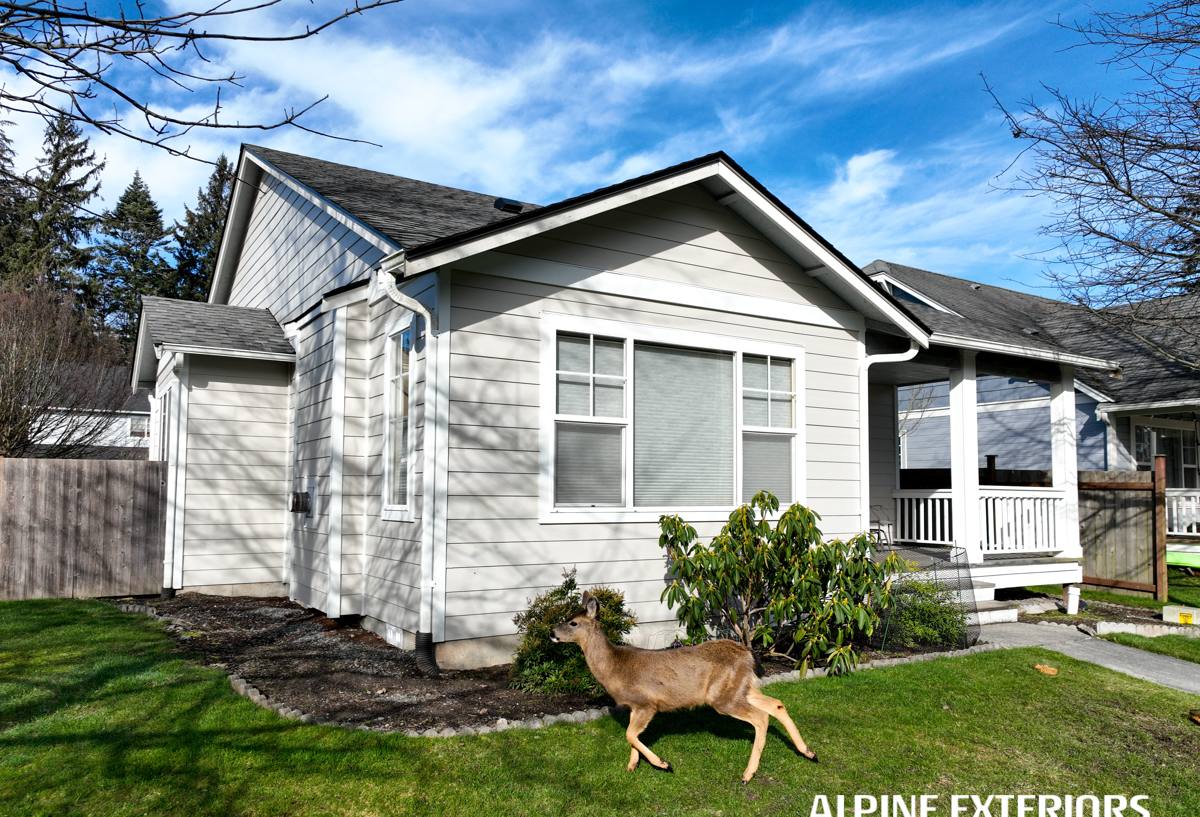
Salt Air: The Slow Corroder
Salt air doesn't just affect metal — though it does accelerate corrosion on fasteners, flashing, and hardware that aren't rated for coastal exposure. It also affects paint film and any wood-based siding product. Salt is hygroscopic, meaning it pulls moisture out of the air and holds it against a surface longer than plain rain would. On painted wood or engineered wood siding, that means the paint film breaks down faster, and once it does, the substrate underneath is exposed to exactly the kind of repeated wetting it can't tolerate long-term.
This is one of the reasons we don't install primed spruce or engineered wood products on homes in this area. Wood-based siding depends entirely on an intact factory or field-applied coating to keep moisture out. In a coastal-influenced neighborhood like Edgemoor, that coating is under more stress than it would be twenty miles inland, and any gap in maintenance — a missed recaulk, a scratch that goes untouched for a season — becomes an entry point faster than it would in a drier climate.
What Salt Exposure Means for Fasteners and Flashing
Beyond the siding face itself, we pay close attention to what's holding it on and what's shedding water around it. Corrosion-resistant fasteners and properly detailed flashing at windows, doors, and roof-to-wall transitions matter more here than they do in a low-exposure inland setting. A siding job that looks right on installation day but uses standard-grade hardware in a salt-air zone is a callback waiting to happen a few years down the road.
Driving Rain and the Moss Season
Whatcom County's wet season is long, and in shaded pockets like parts of Edgemoor, surfaces can stay damp for days after a storm passes. That extended dampness is what feeds moss and algae growth on roofs and on siding, particularly on north- and west-facing walls that get less direct sun. Moss holds moisture against whatever it's growing on. On a roof, that shortens shingle life. On siding, it keeps the surface wet longer than it would be otherwise, which is a problem for any product that isn't dimensionally stable and rot-resistant by nature.
Driving rain adds a second layer to this. Wind-driven storms push water sideways into laps, seams, and butt joints — the places where siding systems are most likely to leak if they weren't installed with the right overlaps, gaps, and flashing details. A siding system's resistance to moisture intrusion is only as good as its installation. That's true of every product, but it matters more in a neighborhood that sees this much wind-driven rain over the course of a winter.
Why We Install Only James Hardie Fiber Cement
We standardized on James Hardie siding for every home we work on, including here in Edgemoor, and it comes down to how the material behaves under exactly the conditions this area produces. Fiber cement is non-combustible, dimensionally stable, and doesn't rot, swell, or delaminate the way wood-based or wood-adjacent products can when they're exposed to repeated wetting. Hardie's ColorPlus finish is baked on at the factory under controlled conditions, which gives it a more consistent, durable bond than field-applied paint — and a coating that holds up is the single biggest factor in how well any siding resists moisture damage over time.
We also use Hardie's climate-engineered HZ product lines, which are formulated differently depending on the region they're built for. That distinction matters in the Pacific Northwest, where the challenge isn't extreme heat or extreme cold — it's sustained moisture. A product engineered with that in mind performs differently than one engineered as a general-purpose solution.
What We Don't Install, and Why
We get asked from time to time why we won't quote vinyl, LP SmartSide, Cemplank, Allura, or cedar. Each of these has legitimate uses and each has real strengths — vinyl is inexpensive and low-maintenance in mild climates, cedar has genuine natural beauty, engineered wood products install quickly. Our concern isn't that these products are defective. It's that, weighed against James Hardie fiber cement for a coastal Whatcom County home, the trade-offs don't hold up as well over a 20-30 year ownership horizon:
- Vinyl siding can warp or become brittle with temperature swings and UV exposure, and it isn't dimensionally rigid the way fiber cement is — a real consideration in wind-driven rain events.
- LP SmartSide and similar engineered wood products rely on an intact factory coating and correct edge-sealing at every cut; any breach lets moisture into the wood substrate, and that's a harder failure mode to catch early than it is with fiber cement.
- Cemplank and Allura are also fiber cement, and structurally comparable in principle — our decision there is about product line consistency, factory finish quality, and warranty support, not a claim that the base material is unsound.
- Primed spruce and cedar are beautiful, traditional choices, but they're the most maintenance-intensive option in a climate that stays wet as long as this one does, and they carry the highest long-term risk of rot if upkeep slips even for a season or two.
We'd rather install one product exceptionally well, understand its behavior in this climate in detail, and stand behind it with a strong transferable warranty than spread our crews thin across five different systems with five different installation quirks.
How a Siding Project Works, Start to Finish
Every Edgemoor project starts with a walk-around of the home, not just a look at the siding surface. We check for soft spots, evaluate existing flashing and trim condition, and look at how water currently moves around the house — where it pools, where gutters overflow, where shade keeps a wall damp longer than the rest of the structure. That assessment shapes the plan more than the siding product choice does.
Typical Project Sequence
- On-site evaluation of existing siding, trim, flashing, and moisture conditions
- Written estimate covering material, labor, disposal of old siding, and any necessary sheathing or trim repair
- Removal of existing siding and inspection of the wall assembly underneath for hidden damage
- Repair of any compromised sheathing before new siding goes on — this step gets skipped by corner-cutting crews and it's where future leaks come from
- Installation of weather-resistant barrier, flashing, and James Hardie siding to manufacturer specification
- Final trim, caulking, and paint touch-up per ColorPlus or field-finish requirements
- Walkthrough and warranty documentation
The step homeowners underestimate is the wall inspection after tear-off. In a moisture-heavy area like this one, it's common to find some degree of sheathing damage behind old siding that was showing no obvious symptoms from the outside. Fixing that properly before the new siding goes up is what determines whether the new install lasts fifteen years or thirty.
Beyond Siding: Roofing, Windows, and Decks
Most of the homes we work on in Edgemoor need more than one thing addressed, and treating the exterior as a connected system rather than separate projects tends to produce better long-term results.
Roofing
A roof that's holding moss or losing granules faster than it should is often shortening the life of the siding below it, because water shedding off a compromised roof edge hits the top courses of siding directly. When we're already on-site for siding work, we'll flag roof condition issues honestly, even if the roof isn't the reason we were called.
Windows
Window flashing is one of the most common failure points we find during siding removal. Old or improperly flashed windows let water track behind the wall assembly in exactly the kind of wind-driven rain events this area gets in winter. Replacing siding without addressing a poorly flashed window just re-wraps the same problem.
Decks
Decks in this climate face their own version of the same moisture challenge — ledger board connections, joist protection, and fastener corrosion resistance all matter more in salt-air, high-rainfall conditions than they do elsewhere. We build and repair decks with the same materials logic we apply to siding: use what's actually engineered for this environment.
Cost Factors Homeowners Should Understand
Every home is different, and we don't quote sight-unseen, but the variables that move a siding estimate up or down are consistent across most Edgemoor projects:
| Factor | Why It Matters |
|---|---|
| Extent of tear-off vs. overlay | Full removal reveals and allows repair of hidden moisture damage; overlay is rarely appropriate on homes with existing water issues |
| Sheathing/framing repair needed | Found only after old siding is removed; the biggest source of cost variance on older homes |
| Home size and wall complexity | More corners, dormers, and trim details mean more labor and material cuts |
| Siding profile and finish selection | Lap width, texture, and factory-finish color options carry different material costs |
| Access and site conditions | Steep lots, limited driveway access, or mature landscaping close to the house add labor time |
| Trim, window, or flashing upgrades bundled in | Addressing these during the siding job is more efficient than a separate future project |
Why a Local Crew Matters Here
A siding crew that mostly works dry, inland, low-exposure jobs doesn't build the same instincts as one that regularly works Whatcom County's coastal neighborhoods. Knowing which walls in Edgemoor are going to hold moss longest, which flashing details actually stand up to a sideways winter storm off the bay, and how salt air changes fastener selection isn't something you get from a manual — it's something you get from doing this work in this specific climate, repeatedly, and paying attention when something doesn't hold up the way it should.
We also stay local for the parts of the job that happen after installation — warranty questions, a caulking touch-up a few years in, a question about moss treatment on a shaded wall. A crew that's still working in the area is a crew that's easy to reach when something comes up.
A Simple Maintenance Checklist for Edgemoor Homes
- Rinse siding and trim of moss and algae buildup at least once a year, more often on shaded, north-facing walls
- Inspect caulking around windows, doors, and trim joints annually and recaulk any cracked or gapped seams
- Keep gutters clear so water isn't overflowing directly onto siding or foundation areas
- Trim back vegetation and tree cover that's keeping specific wall sections shaded and damp longer than the rest of the house
- Walk the exterior after major winter storms and note any soft spots, staining, or new moss growth for early follow-up
If you're weighing a siding, roofing, window, or deck project on an Edgemoor home, we're happy to take a look and give you a straightforward, no-pressure estimate — including an honest read on what's actually going on with your current exterior, not just a sales pitch for new material.