 Whatcom County
 What Whatcom County Weather Actually Does to a House in Cordata
Cordata sits in north Bellingham, close enough to the water and the Fraser Lowland weather patterns that homes here take a specific kind of beating year-round. It's not one dramatic storm that wears out a house — it's the steady accumulation of moisture, salt-tinged air moving in off the Sound, and long stretches of gray, damp weather that never quite dries out between rain events. Add in the region's famously long moss season, and you have an exterior environment that punishes anything with a weak moisture-management plan.
Driving rain is the real culprit for most siding failures we see. It's not rain falling straight down — wind pushes it sideways into seams, laps, and fastener points. Over years, that's where lesser siding products start to fail: swelling at cut edges, soft spots at the bottom courses, paint that can't keep up with the cycle of wet-to-dry. Salt air adds a corrosive element that accelerates fastener and trim degradation if the wrong materials or hardware are used. And moss doesn't just look bad on a roof — moss and algae growth on siding holds moisture against the wall longer than it would otherwise sit, which matters a lot if the underlying material isn't built to tolerate it.
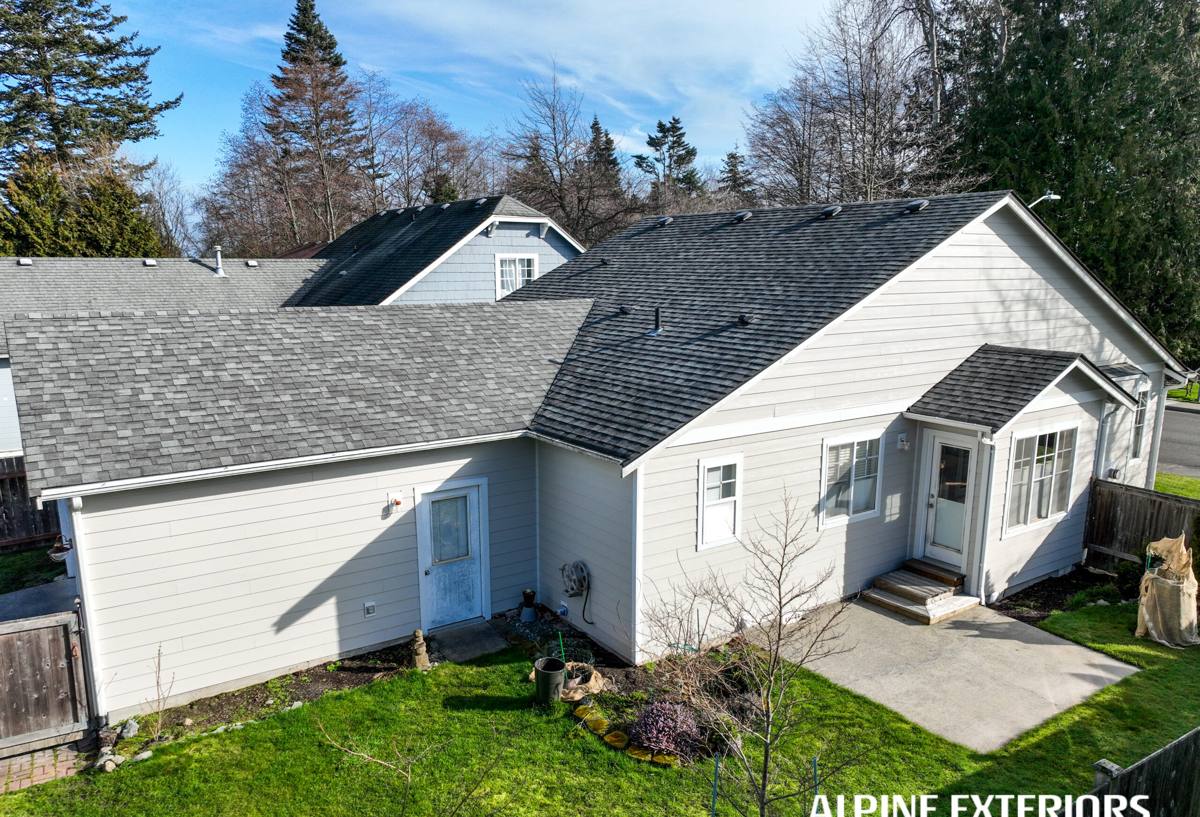
Why We Install Only James Hardie Fiber Cement Siding
We made a deliberate decision as a company to install one siding system: James Hardie fiber cement. We don't offer vinyl, LP SmartSide, Cemplank, Allura, primed spruce, or cedar as options — not because those products have no merit, but because after years of exterior work in this climate, we don't want to stand behind materials that ask homeowners to fight the weather instead of shed it.
What "climate-engineered" means in practice
James Hardie makes region-specific HZ product lines engineered for different climate zones. For the Pacific Northwest, that means a formulation and installation spec built around exactly the conditions Cordata deals with: sustained moisture, temperature swings, and long wet seasons. Fiber cement itself is made from cellulose fiber, sand, and cement — it doesn't absorb water the way wood-based products can, and it isn't vulnerable to the swelling, delamination, or rot that comes with sustained dampness against a wall.
ColorPlus factory finish vs. field-applied paint
Most of what fails first on siding isn't the substrate — it's the paint. James Hardie's ColorPlus finish is baked on in a factory-controlled process, which gives it more consistent coverage and better adhesion than paint applied on site after installation. That matters directly in a climate like this one: a factory finish holds its color and its seal through more wet-dry cycles before it needs attention, and it resists the fading that comes from years of overcast UV exposure and driving rain.
Non-combustible construction
Fiber cement doesn't burn. That's not the primary reason homeowners in Cordata are choosing it — wildfire risk here is lower than it is east of the Cascades — but it's a real, permanent advantage over wood-based siding products, and it factors into insurance conversations for some homeowners.
Why We Don't Install Vinyl, LP SmartSide, or Cedar
We want to be direct about this rather than vague. Each of these products does some things well, and we're not going to pretend otherwise.
- Vinyl siding is inexpensive and low-maintenance in mild climates, but it expands and contracts significantly with temperature swings, can crack in impact, and its seams and J-channels give driving rain more paths to work behind the cladding over time.
- LP SmartSide is an engineered wood product with real strength advantages, but it's still wood-based at its core — meaning cut edges and any breach in the factory coating are vulnerable to moisture intrusion in a climate that rarely lets a wall fully dry out.
- Cedar and primed spruce look excellent when new and can be beautiful, but they demand an ongoing maintenance commitment — re-staining or repainting on a cycle, careful caulking, and vigilance against rot — that most homeowners underestimate until the first signs of trouble show up five or ten years in.
None of that makes these products "bad." It makes them a maintenance and moisture-risk trade-off that we decided we didn't want to install and then have to answer for later, especially in a climate this consistently wet.
A Full Exterior Approach: Siding, Roofing, Windows, and Decks
Siding doesn't work in isolation. On most homes, water problems trace back to how siding, roofing, window flashing, and even deck ledger connections interact — or fail to. We handle all four because they share one job: keeping water out and letting the structure dry when it does get in.
Where these systems overlap
Roof-to-wall flashing details, window head flashing, and deck ledger board attachment are three of the most common places we find hidden moisture damage on older homes in this area. Replacing siding without addressing a bad window flashing detail or a poorly sealed deck ledger just repeats the failure in a few years. Because we work across all four trades, we can flag those issues during a siding estimate rather than after the new siding is already up.
Roofing
A roof in poor condition undermines even the best siding job by dumping water where it shouldn't be. We look at roof condition and flashing details as part of any full exterior assessment.
Windows
Window replacement and re-flashing is often bundled with a siding project, since removing the old cladding exposes the window flanges anyway — it's the efficient time to address both.
Decks
Ledger board attachment points are a common moisture-entry spot behind siding on homes with attached decks, and we address that connection properly whenever we're working on the wall behind it.
What a Hardie Installation Actually Involves
The material is only half the equation — correct installation is what determines whether it performs for decades or fails early. This is where a lot of siding jobs go wrong, regardless of the brand on the box.
Prep and the water-resistive barrier
Before any siding goes up, we address the water-resistive barrier and flashing details at every penetration — windows, doors, vents, and anywhere a fastener or seam could give driving rain an entry point. In this climate, the barrier behind the siding matters as much as the siding itself.
Fastening, clearances, and caulking
James Hardie specifies exact fastener types, spacing, and clearances from grade, roof lines, and other surfaces — these aren't optional details. Proper ground clearance keeps splashback and moss-holding debris away from the bottom courses. Correct fastening prevents the board movement that leads to cracked caulk lines and water intrusion down the road. We follow the manufacturer's installation spec because it's what keeps the warranty valid and, more importantly, what actually keeps water out.
Joint and trim detailing
Butt joints, corner boards, and trim intersections are where a rushed installation shows up first. We detail these to shed water rather than trap it, which matters most exactly where driving rain concentrates — corners, eaves, and lower wall sections.
Cost Factors on a Cordata Siding Project
Every home is different, but the same handful of factors drive most of the cost variation we see on local projects.
| Factor | Why It Matters |
|---|---|
| Home size and wall complexity | More corners, gables, and dormers mean more cutting, trim work, and labor time |
| Existing siding removal | Tear-off of old cladding and disposal adds time compared to a bare-wall installation |
| Underlying damage found | Rot or moisture damage discovered once old siding comes off requires repair before new siding goes on |
| Trim and detail level | Board-and-batten accents, varied reveal widths, and custom trim add labor beyond a standard lap installation |
| Panel vs. lap profile | Different Hardie product lines and profiles carry different material costs |
| Access and site conditions | Multi-story sections, tight lot lines, or difficult staging areas affect labor time |
We don't quote broad ranges without seeing the house — an accurate number comes from an on-site look at wall condition, access, and the scope you want.
Maintenance and Long-Term Performance
Fiber cement isn't zero-maintenance, but it asks a lot less of a homeowner than wood-based alternatives in this climate. A periodic rinse to keep moss and algae from building up, an eye on caulk lines at trim joints over the years, and prompt attention to any impact damage are really the extent of it. Given how much of Whatcom County's siding damage traces back to trapped moisture and moss holding water against a wall, a material that doesn't feed that cycle is a meaningful long-term advantage, not just a sales point.
James Hardie backs its products with a strong transferable warranty on the substrate, plus separate coverage on the ColorPlus finish — worth understanding in detail before you sign anything, since warranty terms vary by product line and installation compliance.
Why a Local Crew Matters in Cordata
Installation quality is what actually determines whether any siding product performs the way it's supposed to. A crew that works in Whatcom County year-round understands how this specific climate behaves — how driving rain moves in off the water, how long moss season really runs, and where local homes typically show wear first. That knowledge shows up in the small decisions on a job site: where extra flashing attention goes, how clearances are set, which corners get the most careful detailing. It's also why we stand behind our own installation rather than subcontracting it out piecemeal.
A Practical Checklist Before You Hire Anyone for Exterior Work
- Ask what siding brand and product line they install, and why they chose it
- Confirm they're licensed and insured in Washington, and ask to see current proof
- Ask how they handle flashing at windows, doors, and roof-to-wall intersections
- Get the manufacturer's installation instructions referenced in your contract, not just "we'll handle it"
- Ask what happens if they find rot or moisture damage once old siding comes off
- Clarify what's covered by material warranty versus workmanship warranty, and for how long
If you're weighing a siding project in Cordata — or want a second opinion on roofing, windows, or a deck while we're looking at the exterior — we're glad to come take a look. There's no pressure and no cost to get an honest assessment and a real number for your home.