 Whatcom County
 Siding in Birchwood: Built for a Tough, Wet Corner of Whatcom County
Birchwood sits close enough to the water and the weather patterns that roll through Whatcom County that its homes take a different kind of beating than houses further inland. Salt-tinged air, near-constant winter drizzle, driving rain events off the Strait, and a moss season that can stretch from October through May all work against a home's exterior. If you've lived here more than a few years, you already know the signs: siding that stays damp longer than it should, paint that chalks and peels faster than the manufacturer's brochure promised, and green-black streaking on north-facing walls that no amount of pressure washing seems to permanently fix.
We're a Whatcom County-based exterior contractor, and Birchwood is part of our regular service area. That matters more than it sounds like it should. A crew that works this specific stretch of coastline week after week learns things a traveling company or a big-box installer never will — which wall orientations take the worst weather, how deep the moisture problem usually runs once you open up an old wall, and which installation shortcuts eventually turn into five-figure repair bills.
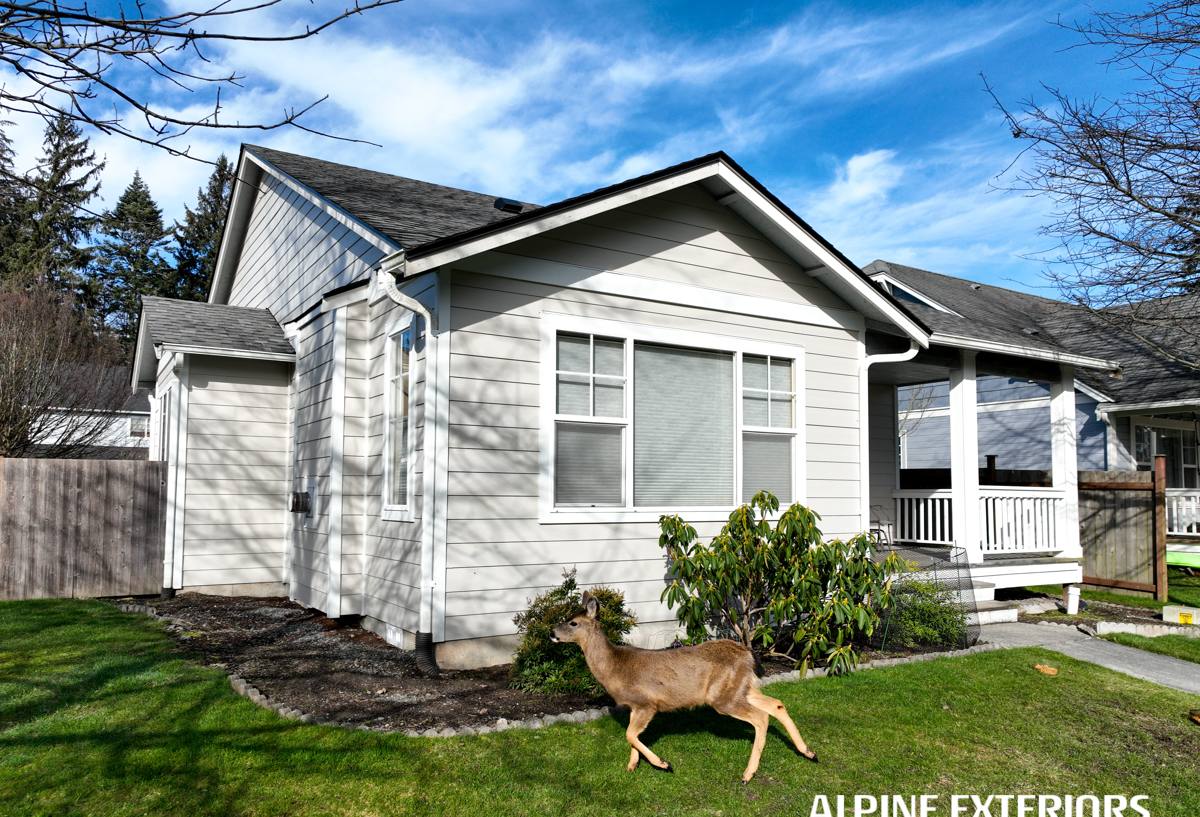
What Whatcom County Weather Actually Does to Siding
It's worth being specific about the mechanisms at work, because "wet climate" undersells what's actually happening to a house over 15 or 20 years.
Moisture Load
Whatcom County gets a lot of low-intensity rain rather than short, heavy storms — the kind of weather that keeps exterior surfaces damp for days at a stretch instead of drenching them once and drying out. Wood-based sidings (cedar, primed spruce, and similar products) absorb that moisture at the surface and, more importantly, at cut edges and fastener penetrations where the protective coating is thinnest. Over time that moisture cycling — wet, dry, wet, dry — is what drives swelling, cupping, and eventually rot.
Salt Air
Homes closer to the water deal with airborne salt that accelerates corrosion on fasteners, flashing, and any exposed metal trim. It also interacts with certain paint and coating chemistries, breaking them down faster than the same product would fail in a dry inland climate.
Moss and Organic Growth
Moss doesn't just look bad — it holds moisture directly against the siding surface, which is worse than open exposure to rain. On shaded, north-facing walls or anywhere tree cover blocks sun and airflow, moss can establish itself on porous or textured siding within a couple of seasons and keep that surface damp nearly year-round.
Wind-Driven Rain
Storms coming off the water don't just fall straight down — they get pushed sideways into wall assemblies, seams, and butt joints. Siding and flashing details that would be fine in a calmer climate get tested here in ways the manufacturer's minimum installation spec may not fully account for.
Why We Install Only James Hardie Fiber Cement
We get asked fairly often why we don't offer vinyl, LP SmartSide, cedar, primed spruce, or other fiber cement brands like Cemplank or Allura. The honest answer is that we've made a professional judgment call, based on years of servicing homes in exactly this climate, that James Hardie is the product we're willing to put our name behind — and the others each carry trade-offs we don't think are worth it for a coastal Whatcom County home.
Wood-Based and Wood-Composite Products
Cedar and primed spruce are genuinely attractive materials, and there's nothing wrong with liking the look. But they're organic materials in a climate that stays damp for long stretches, and that combination means an ongoing maintenance commitment — recoating, caulking, edge-sealing — that most homeowners underestimate when they're comparing sticker prices. LP SmartSide is an engineered wood product with better moisture resistance than raw cedar, but it's still wood-based at its core, and any breach in the factory coating (a nail pop, a scrape, an unsealed cut edge) gives moisture a path in.
Vinyl Siding
Vinyl is inexpensive and low-maintenance in the sense that it doesn't rot, but it has its own weaknesses here: it can warp or distort in temperature swings, it doesn't hold up well to physical impact, and its color is baked through the material rather than factory-finished the way Hardie's ColorPlus system is — which means fading over time is a when, not an if.
Other Fiber Cement Brands
Cemplank and Allura are also fiber cement, and fiber cement as a category is the right material family for this climate — non-combustible, dimensionally stable, and resistant to moisture-driven rot in a way wood products simply aren't. Where we draw the line is the specific product line: we standardized on James Hardie because of its ColorPlus factory-applied finish, its HZ5 product engineering for the Pacific Northwest's moisture and temperature profile, and a transferable warranty structure we can stand behind when we tell a homeowner this siding should outlast a typical ownership period.
How James Hardie Siding Performs in Birchwood's Climate
Fiber cement is cement, sand, and cellulose fibers, engineered and pressed into boards and panels. That composition is what gives it the properties that matter most in a wet, salt-air environment:
- It won't rot, because there's no organic wood fiber for moisture to break down
- It's non-combustible, which matters for both safety and, in many cases, insurance considerations
- It holds paint and factory finish far longer than wood, because the material itself doesn't move with moisture the way wood does
- It resists pest damage — no woodpeckers, no carpenter ants finding a soft entry point
- The HZ5 product line is specifically engineered for regions with the freeze-thaw and moisture cycling common in the Pacific Northwest
The ColorPlus finish is worth calling out specifically for a coastal application. It's baked on in a controlled factory environment rather than field-applied with a brush or sprayer, which gives it more consistent coverage and better long-term adhesion than a site-applied coat — something that matters when salt air is actively working to break coatings down.
What a Full Exterior Approach Looks Like
Siding doesn't fail in isolation. In this climate, roofing, windows, and siding all interact — a roof that's shedding water onto a wall, or a window that isn't flashed correctly, will undermine even the best siding installation. That's why we handle siding, roofing, windows, and decks rather than treating siding as a standalone product sale.
Roofing
Your roof is the first line of defense against the same driving rain and moss growth that affects siding. A roof in poor condition, or with failing flashing at chimneys and valleys, sends water where it shouldn't go — often straight down a wall.
Windows
Window flashing and integration with the siding plane is one of the most common failure points we find when we open up an old wall. Replacing siding without addressing window flashing details is a missed opportunity to fix a problem before it's covered back up.
Decks
Decks take the same moisture and moss exposure as siding, often with less protection, since they're horizontal surfaces that hold standing water longer.
Comparing Siding Options for a Birchwood Home
| Material | Moisture Resistance in This Climate | Maintenance Burden | Typical Lifespan Here |
|---|---|---|---|
| James Hardie Fiber Cement | Strong — engineered for PNW moisture cycling | Low; factory ColorPlus finish, periodic cleaning | 30+ years with proper install |
| Vinyl | Moderate; doesn't rot but can warp | Low, but color fades and isn't repaintable well | 20-30 years, variable |
| Cedar | Weak without diligent upkeep | High; recoating and sealing on a recurring cycle | Highly variable, often 15-25 years |
| Primed Spruce / Engineered Wood | Moderate; coating breach is the main risk | Moderate to high | 20-30 years if coating stays intact |
| Other Fiber Cement Brands | Strong, similar base material properties | Low to moderate, depends on finish system | Comparable to Hardie, product-dependent |
The Installation Detail That Actually Determines Performance
Fiber cement's reputation rests as much on installation quality as it does on the material itself. A poorly installed Hardie job — wrong fastener pattern, missing weep gaps, unsealed cut edges, incorrect flashing at butt joints — can develop moisture problems just as real as a wood siding failure. This is where local experience matters most: we've seen what happens when installation shortcuts meet Whatcom County's rain patterns, and we build our process around avoiding those specific failure points.
What Correct Installation Involves
- Proper clearance between siding and grade, decks, and roof lines to prevent wicking
- Correctly sealed and primed cut edges on every field cut, not just factory edges
- Manufacturer-specified fastener type, spacing, and depth — over-driven nails are a common source of premature failure
- Rain screen or drainage plane detailing appropriate for a high-moisture climate
- Flashing integration at windows, doors, and roof-to-wall transitions
- Correct panel and joint treatment to manage the region's wind-driven rain
Signs a Birchwood Home May Need Siding Attention
Homeowners often wait too long to address siding issues because the early signs look cosmetic rather than structural. Some worth watching for:
- Persistent moss or algae staining that returns quickly after cleaning
- Paint that's peeling, bubbling, or chalking faster than expected
- Soft spots or visible warping, especially near ground level or under downspouts
- Gaps opening up at seams, corners, or trim boards
- Increased drafts or a musty smell near exterior walls, which can indicate moisture intrusion behind the siding
Why a Local Crew Matters More Than It Seems
Anyone can install siding to a manufacturer's minimum spec on paper. What's harder to get from an out-of-area or low-bid contractor is the judgment that comes from servicing this exact microclimate repeatedly — knowing that a north-facing wall under mature trees needs different attention than a south-facing wall in the open, or that a particular flashing detail that works fine in a drier climate isn't sufficient here. Whatcom County's blend of salt air, sustained rain, and moss pressure isn't uniform across the region, and Birchwood's own conditions — proximity to water, tree cover, prevailing wind exposure — shape what a given home actually needs.
If you're in Birchwood and want a straightforward look at what your siding, roof, windows, or deck are dealing with, we're glad to come take a look. There's no pressure and no obligation — just an honest assessment of what your exterior is up against and what it would take to get it right. Fill out the form below to request a free estimate.