 Whatcom County
 Siding Built for Ferndale's Coastal Climate
Ferndale sits close enough to the Salish Sea that salt-laden air is a real factor in how exterior materials age here, not just a talking point. Add in Whatcom County's long stretch of wet months, persistent cloud cover, and the shade from mature evergreens that many Ferndale lots carry, and you have a climate that's tough on siding in three specific ways: moisture intrusion, surface breakdown from salt exposure, and a moss and algae season that can run most of the year on north-facing walls. Any siding product installed in this area has to be evaluated against all three, not just against how it looks on the day it goes up.
We've been doing exterior work throughout Whatcom County long enough to see which products hold their line and color after a decade of this weather and which ones start showing problems in year three or four. That experience is a big part of why we standardized on one siding system rather than offering a menu of options.
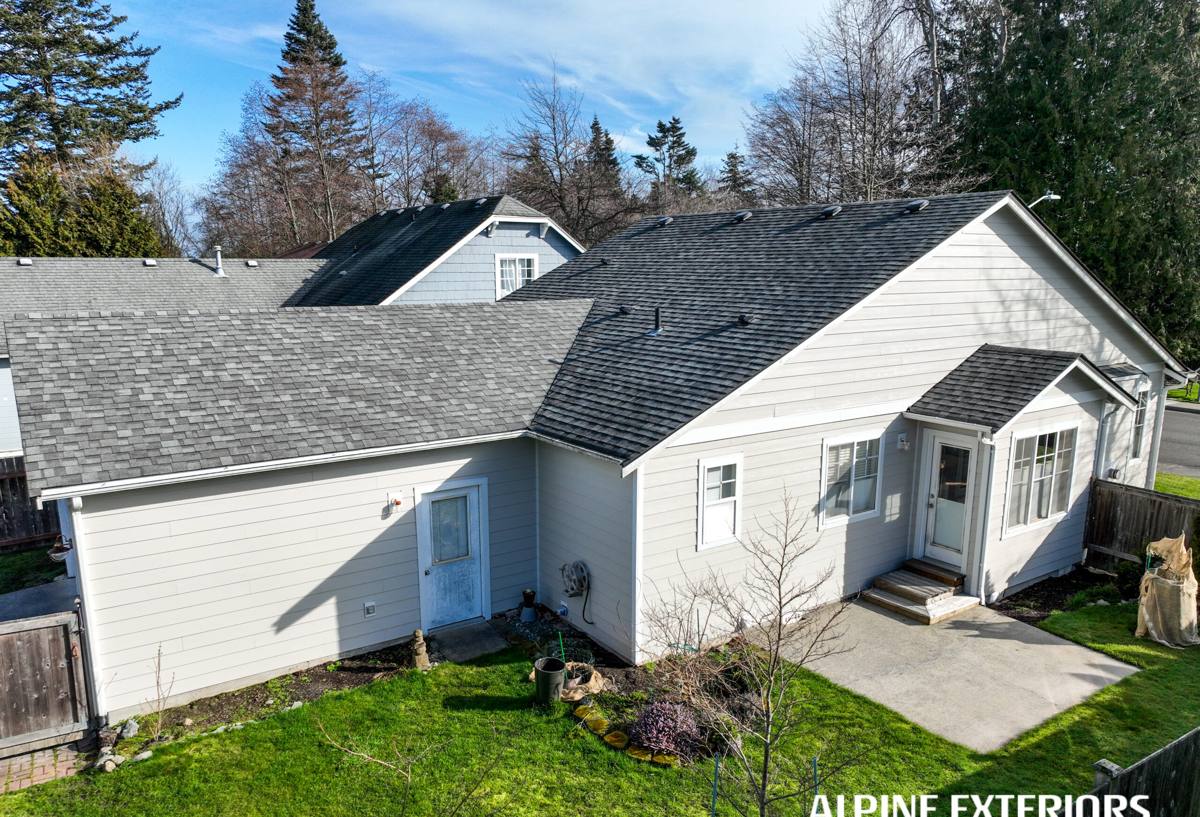
How Whatcom County Weather Wears Down Siding
Driving Rain and Wind-Driven Moisture
Storms coming off the water don't just drop rain straight down — wind pushes it sideways into wall assemblies, especially on west and south-facing elevations. Siding that relies on paint film or a thin factory coating to keep water out is more vulnerable to this kind of exposure than siding engineered as a full moisture-management system, because wind-driven rain finds every seam, nail head, and butt joint.
Salt Air and Surface Degradation
Salt air accelerates the breakdown of many building materials, including paint finishes on wood and composite products. Over years, that means more frequent repainting, more caulking maintenance, and a higher chance of hidden moisture getting behind a compromised surface before anyone notices.
Moss, Algae, and Shade
Whatcom County's tree cover and cloud cover combine to keep siding damp longer than in drier parts of the state. On shaded elevations, moss and algae can establish within a couple of seasons on siding that doesn't handle sustained moisture well. That's not just cosmetic — trapped organic growth holds moisture against the wall and can accelerate rot in the substrate underneath, especially around trim and butt joints.
Why We Install Only James Hardie Fiber Cement
We get asked regularly why we don't offer vinyl, LP SmartSide, or other engineered wood products as options. The honest answer is that after years of exterior work in this exact climate, we don't think those products hold up as well as fiber cement against sustained coastal moisture and moss exposure — not because they're poorly made, but because of how they're built. Vinyl can warp and fade, and its seams rely on lapping rather than a sealed, factory-finished surface. Engineered wood products use wood strand cores that, if the factory coating is ever breached by an installation error or storm damage, are vulnerable to moisture absorption and rot in a way cement-based products simply aren't.
James Hardie fiber cement siding is a mix of cement, sand, and cellulose fiber, which makes it non-combustible and dimensionally stable — it doesn't expand and contract with moisture the way wood-based products do. That stability matters in a climate where the siding is wet more often than it's dry for large parts of the year. We'd rather install one product we trust completely than offer a range of options and let a homeowner unknowingly choose one that's a poor fit for Whatcom County weather.
The James Hardie Product Line for This Climate
James Hardie engineers its siding by climate zone, called HZ10 and HZ5 formulations, matched to the moisture and freeze-thaw conditions of the region where it's installed. Western Washington falls into the wetter HZ5 zone, and Hardie's HZ5 products are formulated for that moisture exposure specifically, rather than a one-size-fits-all mix.
Most of our Ferndale installs use Hardie's lap siding or panel systems finished with ColorPlus Technology — a factory-applied, baked-on finish that's more consistent and more resistant to fading and moisture than field-applied paint. That matters directly for this area's salt air and cloud-cover conditions, since a factory finish holds its color and seal far longer than a coat applied on-site in variable weather. Hardie backs the product with a long transferable limited warranty, which also matters if you ever sell the home.
What Correct Installation Looks Like
Fiber cement siding is only as good as its installation. Hardie is explicit about clearances, fastening patterns, and flashing details, and skipping any of them is how a good product ends up with a bad reputation. A correct install on a Ferndale home typically includes:
- Proper water-resistive barrier and flashing at every window, door, and penetration before siding goes up
- Correct minimum clearance between siding and grade, roof lines, decks, and other hard surfaces
- Manufacturer-specified nailing patterns and fastener types to avoid blow-outs and water entry at fastener heads
- Properly caulked and sealed butt joints, or engineered joint systems that reduce the number of field seams
- Factory-primed or ColorPlus-finished cut edges sealed in the field to prevent raw material from absorbing moisture
Rushed or undertrained crews skip these details because they're not visible once the job is done — until a few winters of driving rain expose them. We train to Hardie's installation specification because that's what keeps the product performing the way it's designed to for the length of the warranty.
Beyond Siding: Roofing, Windows, and Decks Working Together
Siding doesn't work in isolation. On most homes, the roofline, window flashing, and siding all meet at critical junctions, and water problems often show up at those intersections rather than in the middle of a wall. We handle roofing, windows, and decks in addition to siding, which means when we're on a Ferndale project we're looking at how those systems interact rather than just the one scope we were hired for.
A roof with failing flashing at a wall intersection will feed moisture behind even perfectly installed siding. Old windows with degraded seals do the same at every opening. And decks attached to the house create their own set of flashing and clearance requirements where they meet the siding. Addressing siding on a home with an aging roof or original windows without at least evaluating those systems is a common way water problems get missed rather than solved.
What Siding Replacement Costs Depend On
Every home is different, but the major cost drivers for a Hardie siding project in this area tend to be consistent. We give firm, written quotes after an on-site look, but this is generally what moves the number:
| Factor | Why It Matters |
|---|---|
| Home size and wall complexity | More corners, gables, and trim details mean more labor and material cuts |
| Siding profile chosen | Lap, shingle, and panel systems differ in material and installation labor |
| Condition of the substrate | Rot or water damage found once old siding is removed adds repair scope |
| Trim and accessory scope | Fascia, soffit, corner boards, and window trim are often replaced alongside siding |
| Access and site conditions | Steep lots, mature landscaping, or tight setbacks affect staging and labor time |
We don't quote off square footage guesses over the phone. A real number comes from a walk-around that accounts for your home's specific exposure and condition, especially since coastal-facing elevations often need more attention than sheltered ones.
Choosing a Local Ferndale Contractor
Whatcom County has plenty of contractors who'll travel through for a job, but exterior work benefits from a crew that understands the specific weather pattern here — not just "Pacific Northwest rain" in general, but the salt air and moss conditions closer to the water. Before hiring anyone for siding, roofing, window, or deck work, it's worth asking a few direct questions:
- Are they licensed and insured in Washington, and can they provide proof without hesitation?
- Do they install to the manufacturer's written specification, or their own shortcuts?
- Will they put the scope of work, materials, and warranty terms in writing before starting?
- Do they have experience with homes in similar coastal or shaded conditions, not just inland projects?
- Who handles the job day-to-day — a dedicated crew, or rotating subcontractors?
A contractor who's vague on any of these is worth a second look before you sign anything.
Get a Straight Answer for Your Home
If your Ferndale home's siding is showing moss buildup, chalky or fading paint, or soft spots near the base of the walls, it's worth getting a straightforward, no-pressure look before those problems spread to the sheathing underneath. Fill out the form below for a free estimate — we'll walk the exterior, tell you honestly what we see, and explain what a James Hardie installation would look like for your specific home.