 Whatcom County
 Why Sehome Decks Wear Out the Way They Do
Sehome is one of Bellingham's older, established neighborhoods — hillside streets, mature tree canopy, and a housing stock that spans decades of different building practices. Decks built here don't fail because homeowners neglect them. They fail because Whatcom County's climate is genuinely hard on exterior wood and fasteners, and a lot of decks were built to a standard that assumed a drier, milder Pacific Northwest than the one we actually get.
Three things do most of the damage. First, salt-laden air moving in off Bellingham Bay accelerates corrosion in nails, screws, joist hangers, and structural connectors — even ones rated for exterior use start to lose integrity years before the wood around them does. Second, driving rain doesn't just fall straight down here; wind-driven rain gets pushed sideways into ledger boards, stair stringers, and the gaps between deck boards, soaking framing that was never meant to stay wet. Third, the long moss and algae season — often eight months or more of damp, shaded conditions — keeps deck surfaces wet longer after every rain, which is exactly the environment wood rot and slippery surface buildup need to take hold.
None of that means decks in Sehome are doomed. It means a deck built or replaced for this specific climate needs different flashing details, different fastener choices, and different material decisions than a generic deck job.
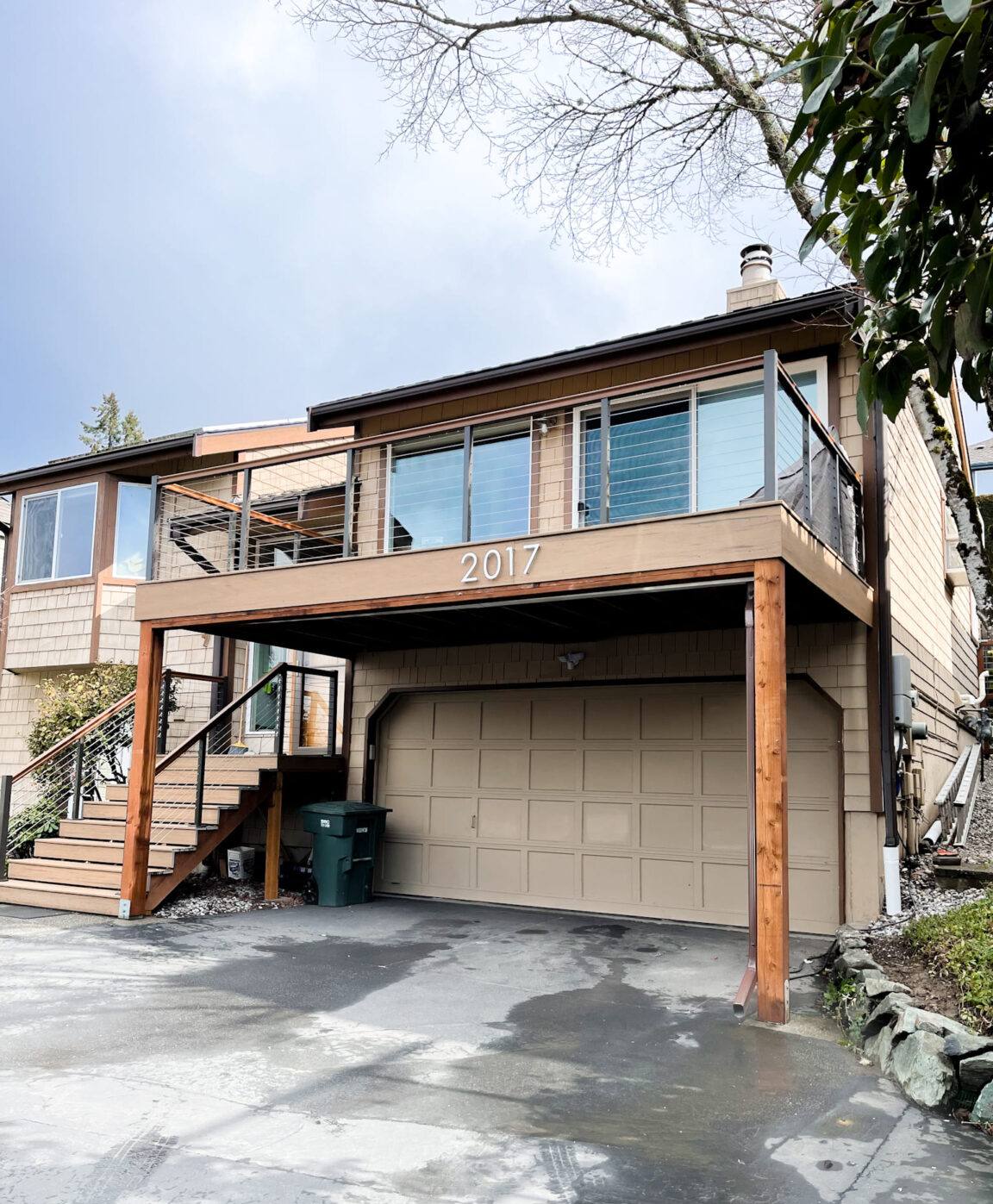
Signs a Deck Needs Replacement, Not Just Repair
Homeowners often call us wanting a few boards swapped out, and sometimes that's genuinely all that's needed. But there's a point where patching a deck costs more over time than replacing it correctly. Here's how we tell the difference on a site visit:
- Soft or spongy decking in multiple areas, not just one isolated board
- Rot or rust at the ledger board connection to the house — this is a structural safety issue, not cosmetic
- Joist hangers or fasteners with visible corrosion, pitting, or rust staining running down the wood
- Persistent moss or algae growth that comes back within weeks of cleaning
- Railings that flex or feel loose when leaned on
- Gaps or cupping in boards that trap standing water instead of shedding it
- A deck more than 20 years old built with original fasteners and no visible flashing at the house connection
If it's one or two of these on a deck that's otherwise sound, repair can make sense. If it's several at once, or the ledger connection is compromised, replacement is the honest recommendation — a deck is only as safe as its weakest structural connection.
What a Correct Deck Replacement Actually Involves
A deck replacement done right is mostly invisible once it's finished — the parts that matter most are underneath the surface. In Whatcom County's climate, we pay particular attention to a handful of details that get skipped on lower-quality jobs:
Ledger Board Flashing
The connection between the deck and the house is the single most common failure point we see, because it's where wind-driven rain gets forced against the building envelope. Correct flashing — installed in the right order relative to the house's water-resistive barrier — keeps water from tracking behind siding and into wall framing. This is not optional in our climate; it's the difference between a deck that lasts and one that causes hidden rot inside the wall.
Structural Fasteners and Hardware
Given the salt air moving through the region, we use fasteners and structural connectors rated for coastal or high-corrosion exposure, not the minimum-grade hardware sold for general use. Mixing incompatible metals (the wrong screw in a hot-dipped galvanized hanger, for example) creates a corrosion reaction that eats hardware from the inside out — something that isn't visible until it fails.
Drainage and Airflow Underneath
A deck that traps moisture underneath stays wet longer after every rain, which feeds rot and moss. Proper joist spacing, gapping between boards, and grading underneath the deck to move water away from the foundation all matter more here than in drier climates.
Stair and Railing Structure
Stairs and railings take more abuse than the deck surface itself — they flex under repeated use and are often the first thing to loosen. We rebuild these to current code requirements, not just to match what was there before, since older decks in this area often predate current railing height and baluster spacing rules.
Choosing Decking Material for This Climate
There's no single "best" decking material — there's a best material for a given budget, maintenance appetite, and how much moss and moisture the site actually deals with. Here's how the common options compare for a Whatcom County deck:
| Material | Moisture & Moss Behavior | Maintenance | Typical Lifespan |
|---|---|---|---|
| Pressure-treated lumber | Absorbs water readily; moss and algae take hold in shaded, damp spots without regular cleaning | Needs cleaning and re-sealing every 1-2 years | 10-15 years with upkeep |
| Cedar | Naturally more rot-resistant than treated pine, but still absorbs moisture and can grey or soften without maintenance | Periodic cleaning and finishing to hold its look and resist moss | 15-20 years with upkeep |
| Composite decking | Doesn't absorb water into the board itself, but surface film and moss can still build up if the deck stays shaded and wet | Occasional washing; no staining or sealing | 25-30 years, backed by manufacturer warranty |
| PVC decking | Fully non-absorbent; best resistance to moisture-driven damage in constantly damp, shaded areas | Lowest maintenance of the group | 30+ years, backed by manufacturer warranty |
For decks in shaded, damp parts of a Sehome lot — under tree cover or on the north side of a house — we're honest with homeowners that composite or PVC decking earns its higher upfront cost back in avoided maintenance and moss battles. For a sunnier, more exposed deck, a well-maintained wood deck can still make sense on budget. We'll walk the site with you and give a straight recommendation rather than pushing whatever has the best margin.
Our Deck Replacement Process
We keep the process straightforward and communicate at each stage, since a deck replacement affects how you use your outdoor space for the duration of the job:
- On-site assessment — we inspect the existing deck, ledger connection, and substructure to confirm replacement is the right call and identify any hidden rot or framing damage
- Written estimate — a clear scope covering demolition, framing, decking material, hardware, and railings, with material options priced separately so you can compare
- Demolition and disposal — full removal of the old deck surface and, where needed, framing and ledger connection
- Structural rebuild — new framing, corrosion-resistant hardware, and correctly sequenced ledger flashing tied into the house's water management
- Decking, stairs, and railings — installed to current code, with attention to drainage and airflow underneath
- Final walkthrough — we go over the finished deck with you, including what maintenance (if any) the material requires going forward
We schedule around Whatcom County's weather patterns rather than fighting them — framing and flashing work in particular needs a reasonable dry window to do correctly.
What Affects the Cost of a Deck Replacement
Every deck is different, so we don't quote sight-unseen prices, but these are the factors that move the number most:
| Cost Factor | Why It Matters |
|---|---|
| Deck size and layout | Square footage and complexity (multiple levels, angles, built-in seating) directly drive material and labor |
| Decking material chosen | Pressure-treated is the lowest upfront cost; composite and PVC cost more but reduce long-term maintenance |
| Substructure condition | If framing or the ledger connection is rotted, that work has to happen before decking goes down — this is common on older decks here |
| Height and stair requirements | Elevated decks and multi-step stairs require more structural work and railing to meet code |
| Site access | Hillside lots and tight side-yard access, common in parts of Sehome, can add time for material handling and disposal |
As a rough range, straightforward pressure-treated replacements tend to start in the lower thousands, while larger composite or PVC decks with elevated framing and railings run considerably higher. We'll give you real numbers once we've seen the site.
Living With Your Deck in a Moss-Prone Climate
Whatever material you choose, a little seasonal attention goes a long way in Whatcom County's damp, moss-friendly climate. A simple maintenance rhythm we recommend to homeowners:
- Sweep debris and fallen leaves off the deck regularly in fall, when they trap moisture against the surface
- Rinse or wash the deck at least once a year to interrupt moss and algae before it establishes
- Check railings and stair connections annually for looseness
- Inspect the ledger board area at the house for staining, gaps, or soft wood
- Trim back overhanging branches that keep sections of the deck shaded and slow to dry
- For wood decks, plan on re-sealing or staining on the schedule the product calls for — skipping a cycle in this climate shows up fast
Why Hire a Crew That Already Works in Sehome
Deck construction detail that works in a dry inland climate doesn't automatically work here. A crew that's replaced decks throughout Whatcom County knows which ledger flashing sequence actually keeps water out of a wall in driving, wind-blown rain, which fastener grades hold up against salt air over the long run, and how much drainage a deck substructure needs to avoid becoming a moss farm within a couple of wet winters. That's knowledge built from doing this work in this specific climate, not from a manual written for somewhere else.
We also know that a deck project affects your daily life — it's tied to your back door, your yard access, and how you use your house. We plan the work to minimize disruption and communicate clearly about timeline, especially around weather windows.
If your Sehome deck is showing its age or you're just not sure whether it needs repair or full replacement, we're happy to take a look and give you a straight answer. Fill out the form below for a free, no-pressure estimate.