 Whatcom County
 Why Edgemoor's Climate Is Hard on Ordinary Siding
Edgemoor sits close enough to the water and under enough tree cover that its homes take a different kind of beating than siding a few miles inland. Salt-laden air off the bay works into seams and fastener heads year-round. Driving rain off winter storms hits walls sideways, not straight down, which means it finds every gap a lesser installation leaves behind. And the long, damp shoulder seasons that define Whatcom County give moss and algae months at a time to get established on north-facing walls and anything shaded by mature trees. None of these three things alone would wreck a wall. Together, over ten or fifteen years, they're what separates a siding job that still looks sharp from one that's chalking, staining, and softening at the bottom courses.
We install James Hardie fiber cement siding exclusively — not vinyl, not LP SmartSide, not cedar, not any of the composite alternatives — because this is the one climate where the differences between products actually show up on the wall, not just on a spec sheet.
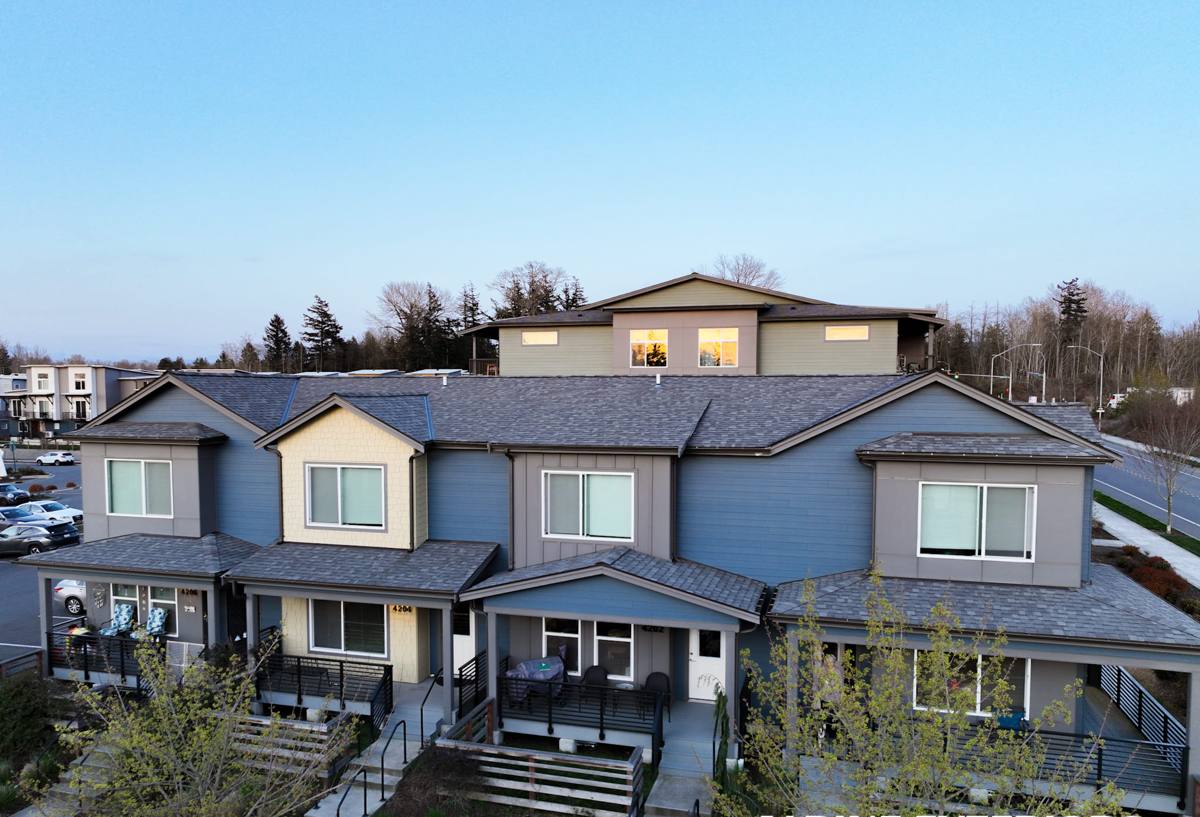
What Fiber Cement Does Differently in a Marine Climate
James Hardie siding is cement, sand, and cellulose fiber pressed and cured into a dense, stable board. That composition matters here for a few specific reasons:
- It doesn't rot. Wood-based siding and trim absorb moisture at cut edges and fastener penetrations; over years in a wet climate, that moisture is what starts decay. Fiber cement has no organic wood fiber for rot to take hold in.
- It holds its shape. Vinyl siding expands and contracts significantly with temperature swings and can warp or bow in direct sun exposure, which opens gaps at laps and trim over time. Hardie's dimensional stability keeps reveals tight and consistent for the life of the product.
- It's non-combustible. Fiber cement carries a Class A fire rating, which matters increasingly for insurance underwriting in Washington regardless of how close a specific property is to wildland fuel.
- The factory finish resists what salt air attacks first. ColorPlus finish is baked on in a controlled factory process, not brushed or sprayed on-site, so it resists the fading and chalking that field-applied paint shows first in coastal exposure.
Choosing the Right Hardie Product Line for This Exposure
Not every Hardie product is engineered the same way, and this is where a lot of installations underperform even when the material itself is right. James Hardie makes climate-specific formulations under its HZ5 (humid, temperate) and HZ10 (harsher, more variable) engineering — the Pacific Northwest falls into the range where HZ5 products are formulated for the moisture cycling and freeze-thaw pattern this region actually sees, rather than a generic national formulation.
Common profiles for this area
- HardiePlank lap siding — the most common choice for full-wall replacement, available in several exposure widths and a smooth or cedar-textured finish.
- HardieShingle — used for gable accents or full shingle-style walls where a homeowner wants a traditional Pacific Northwest look without the maintenance of real cedar shingle.
- HardiePanel — vertical panel siding, often paired with board-and-batten trim for modern or craftsman-style exteriors.
- HardieTrim — matched trim boards that use the same fiber cement composition, so window and corner trim ages at the same rate as the field siding instead of failing first.
Getting the product line right is only step one. The bigger factor in how a Hardie installation performs in a wet, salty climate is how it's installed — and that's where most of the problems we get called out to fix actually originate.
What a Correct Installation Involves
James Hardie publishes detailed installation specifications, and following them is what the transferable warranty is actually contingent on. In a climate like this one, a few details matter more than they would somewhere drier:
Water management behind the siding
Siding is not the primary waterproofing layer on a wall — the weather-resistive barrier and flashing behind it are. A correct install starts with a properly lapped house wrap, correctly flashed windows and doors, and a drainage plane that lets any moisture that does get behind the siding find its way back out instead of sitting against the sheathing. This is invisible once the job is done, which is exactly why it's the step that gets skipped on rushed jobs.
Fastening and gapping
Hardie siding needs to be face-nailed or blind-nailed at the correct spacing with corrosion-resistant fasteners — stainless or hot-dipped galvanized in a marine-influenced area, not standard electro-galvanized, which corrodes faster in salt air and leaves rust streaks bleeding down the face of the board. Boards also need proper gapping at butt joints and around penetrations to allow for the material's minor seasonal movement, sealed with the right sealant rather than caulked tight.
Field-cut edge sealing
Every cut end of a Hardie board exposes raw fiber cement that isn't factory-sealed. Those cut edges have to be sealed with an approved product before installation — miss this on enough boards and you've created dozens of small moisture entry points on a wall that's otherwise doing its job.
Starter strips and clearances
Correct starter-strip installation and ground clearance at the base of the wall keep the bottom course — the part that takes the most splash-back and standing moisture — out of standing water and away from soil contact.
James Hardie vs. Other Siding Options in This Climate
| Factor | James Hardie Fiber Cement | Vinyl | Cedar | LP SmartSide |
|---|---|---|---|---|
| Moisture/rot resistance | No organic material to rot | Won't rot, but seams can trap moisture behind it | Requires ongoing sealing/staining to resist rot | Engineered wood strand core is more moisture-sensitive at cut edges |
| Salt air performance | Factory finish resists chalking and fade | Can become brittle and discolored over time | Weathers unevenly, needs refinishing | Coating can be compromised faster in high-moisture cycling |
| Moss/algae resistance | Dense surface resists growth better than porous wood | Smooth but seams collect debris | Porous surface, prone to moss and algae staining | Moderate; depends on maintenance |
| Fire rating | Class A, non-combustible | Combustible, can melt/deform | Combustible | Combustible |
| Dimensional stability | High — resists warping | Expands/contracts with heat, can bow | Moves with moisture, can cup or split | More stable than solid wood, less than fiber cement |
Every product on that list has legitimate uses somewhere. We simply don't think any of them hold up as well as fiber cement does specifically in the conditions Whatcom County's coastal neighborhoods produce, which is why our crews only carry James Hardie.
Our Process for an Edgemoor Siding Job
- On-site assessment. We walk the exterior, check for existing moisture damage at trim, corners, and penetrations, and look at sun/shade exposure on each elevation since that affects moss risk and product choice.
- Scope and product selection. We recommend a Hardie profile and ColorPlus color based on your home's style, HOA or neighborhood considerations if applicable, and exposure.
- Tear-off and inspection of sheathing. Once old siding is off, we check the sheathing underneath for any hidden rot or moisture damage before anything new goes up — this is often where problems from a prior installation surface.
- House wrap and flashing. Correct lapping and window/door flashing goes in before a single piece of siding is hung.
- Installation to spec. Proper fastener type and spacing, sealed cut edges, correct gapping, and starter strip clearance.
- Trim, caulking, and touch-up. Matched HardieTrim, sealant at penetrations, and factory-matched touch-up paint on any field cuts.
- Final walkthrough. We go over the finished job with you before calling it complete.
What Affects the Cost of a Hardie Siding Job
| Factor | Why it matters |
|---|---|
| Home size and number of stories | More square footage and scaffolding/lift needs for taller walls both add labor |
| Condition of existing sheathing | Hidden rot found during tear-off adds repair scope before new siding goes up |
| Product line and profile | HardiePanel, HardiePlank, and HardieShingle carry different material and labor costs |
| Trim complexity | Homes with more corners, window returns, and architectural detail take more time per square foot |
| Color | Factory ColorPlus finishes and premium colors price differently than standard field-painted options |
| Site access | Tight lots, slopes, and waterfront setbacks common in this area can affect staging and equipment access |
We give a firm, itemized quote after the on-site assessment — not a phone estimate — because these factors vary enough house to house that a generic square-footage number isn't honest.
Signs Your Current Siding Is Losing the Fight
- Green or black staining that returns within weeks of being cleaned, especially on shaded or north-facing walls
- Soft or spongy spots at the bottom courses or around window trim
- Paint that's chalking, peeling, or fading noticeably faster on one elevation than the others
- Visible gaps opening up at butt joints or where trim meets siding
- Rust streaking below fastener heads
- Warping, bowing, or boards that no longer sit flat against the wall
Any one of these on its own might just need attention. Several at once, especially combined with a wall that's original to an older home, usually means the siding system itself — not just the paint — has reached the end of what it can do.
Why Hiring a Crew That Already Works This Area Matters
A siding crew that's done work throughout Whatcom County knows which elevations on a given lot orientation take the worst weather, how much clearance the local moisture cycle actually calls for, and which fastener and sealant choices hold up rather than just meeting minimum code. That's the difference between an installer following a generic national spec sheet and one who's watched how their own work ages five and ten years later in this exact climate. It also means straightforward scheduling and follow-up — someone who's already local, not driving in from out of the area for one job.
If you're weighing a siding replacement or repair in Edgemoor, we're happy to come take a look and walk you through what your home actually needs — no pressure, no obligation. Reach out for a free estimate using the form below.