 Whatcom County
 The Climate Fairhaven Roofs Have to Survive
Fairhaven sits close enough to Bellingham Bay that the air itself becomes part of your roof's maintenance schedule. Salt-laden marine air drifts in off the water and settles on shingles, flashing, and fasteners, speeding up corrosion on any metal component that isn't built for coastal exposure. Add in Whatcom County's long stretch of fall and winter storms — rain that comes in sideways as often as it falls straight down — and you get conditions that find a roof's weak points faster than they'd show up further inland.
Then there's moss. The mix of shade from mature trees, near-constant moisture, and mild temperatures gives moss and algae a growing season that runs most of the year in this part of the Pacific Northwest. On a roof, moss isn't just a cosmetic problem. It holds water against the shingle surface, works its way under tabs as it spreads, and clogs valleys and eaves so water sits instead of draining. None of this is unique to one particular house — it's the baseline every roof in Fairhaven is working against, year in and year out.
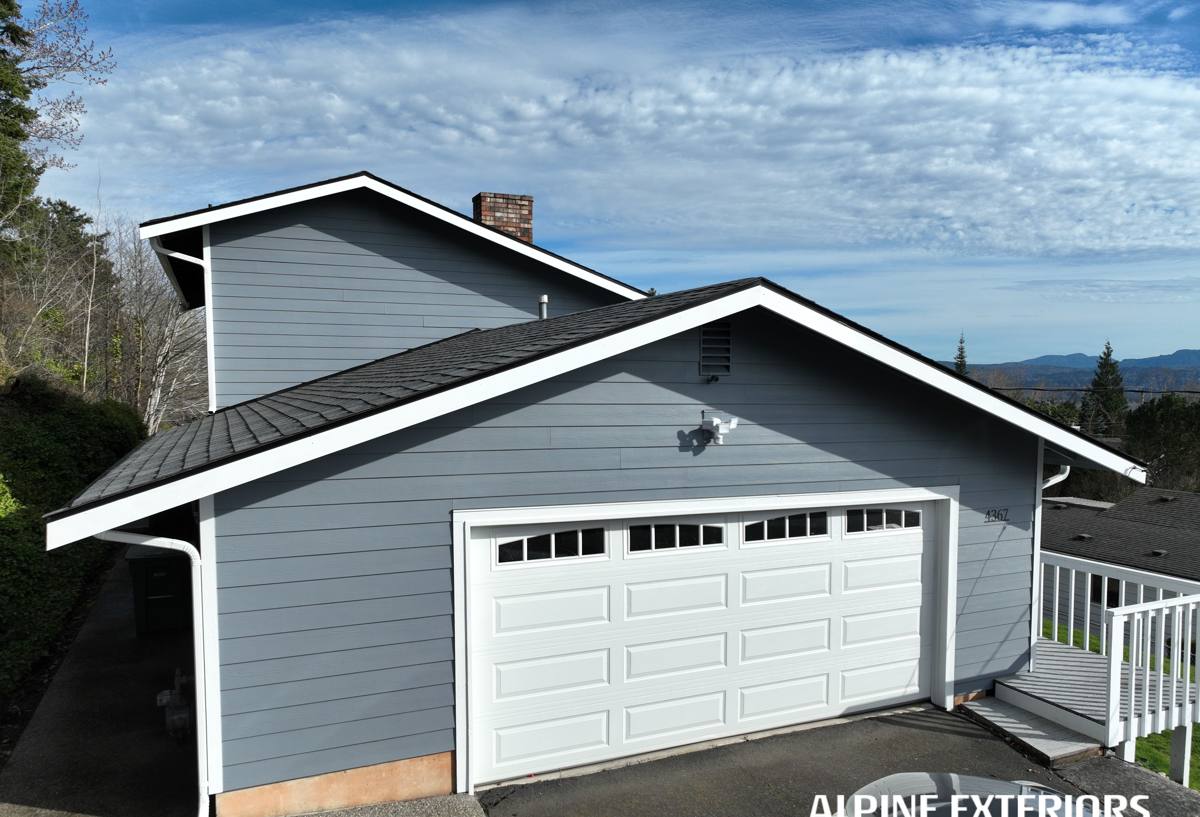
Common Signs Your Fairhaven Roof Needs Repair
Most roof repairs don't start as emergencies. They start as small signals that get ignored because they don't look urgent yet. Worth a look, especially after a windy winter:
- Shingle tabs that are curled, cracked, or missing outright
- Heavy granule buildup collecting in gutters or at downspout outlets
- Thick moss mats, especially on north-facing or shaded slopes
- Dark streaking across the roof field (algae, not just dirt)
- Rusted, lifted, or caulked-over flashing around chimneys, vents, and skylights
- Water stains on ceilings or in the attic after a heavy rain or wind event
- Soft or spongy spots underfoot when walking the roof
- Daylight visible through roof boards from inside the attic
Any one of these on its own might be minor. Two or three together usually mean water has already found a way in, even if there's no visible stain yet.
What's Actually Wearing Out Fairhaven Roofs
Moss and Organic Growth
Moss doesn't just sit on top of a shingle — it roots into the granule surface and lifts the tab edges as it grows, breaking the seal that keeps wind-driven rain out. Once moss has clogged a valley or the space behind a chimney cricket, water backs up under the shingles above it instead of running off. By the time a homeowner notices a stain on the ceiling, the moss has usually been doing damage for a season or more.
Wind-Driven Rain and Flashing Failures
Flashing — the metal at chimneys, sidewalls, valleys, and roof-to-wall transitions — is where most leaks actually originate, not the open field of shingles. Older homes with additions or dormers tend to have more of these transitions, and each one is a spot where a quick caulk-and-hope fix eventually fails as the sealant shrinks and cracks. Wind-driven rain, common off the bay in winter storms, pushes water sideways and upward into gaps that would never leak in a straight-down rain.
Salt Air and Metal Fatigue
Galvanized flashing, exposed fastener heads, and the metal collars on plumbing vent boots all corrode faster in a salt-air environment than the same materials would inland. Rubber pipe boot gaskets also break down faster under the combined stress of UV exposure and salt air, cracking before their expected service life is up. These are small components, but they're responsible for a disproportionate share of the leaks we get called out for.
What a Correct Roof Repair Involves
A repair that actually holds up starts with diagnosis, not patching. Skipping steps here is how a "fixed" leak comes back eighteen months later in a different spot on the ceiling.
- Inspect from both the roof surface and the attic — a stain on the ceiling rarely sits directly under the actual entry point
- Check the decking under the damaged area for soft spots, delamination, or rot before covering anything back up
- Pull back shingles and underlayment beyond the visibly damaged spot to see how far water has actually traveled
- Rebuild flashing details properly rather than sealing over old, failing metal
- Match replacement shingles to the existing roof as closely as color and product availability allow
- Address the underlying cause — moss buildup, a clogged valley, an undersized cricket — not just the symptom
- Confirm the fix from the inside, ideally checking again after the next rain
Repair or Replace: How We Decide
Not every roof problem in Fairhaven calls for a full replacement, and not every leak can be permanently solved with a patch. The honest answer depends on the roof's age, how widespread the damage is, and how many times it's already been repaired.
| Situation | Usually Points To |
|---|---|
| Isolated leak at one flashing detail | Repair |
| Roof is under 10-15 years old with localized damage | Repair |
| Heavy moss with granule loss confined to shaded slopes | Repair, plus moss treatment |
| Granule loss and shingle brittleness across the whole field | Replacement |
| Soft decking limited to one small area | Repair, with decking replaced in that section |
| Soft or rotted decking in multiple areas | Replacement |
| Three or more past repairs in different spots | Replacement |
When a roof is genuinely in the gray zone, we'll say so and lay out both options with our honest read on which one makes more sense given the roof's age and condition — not just the option that's more profitable for us.
Our Roof Repair Process in Fairhaven
We keep the process straightforward because homeowners dealing with an active leak don't need extra complexity added on top of it.
- You reach out with a description of the problem and, if you have them, photos of any staining or visible damage
- We inspect the roof and the attic in person, since the two views together tell the real story
- You get a written estimate that spells out what we found and what we recommend, including whether a repair or replacement makes more sense
- We schedule the work around the weather — opening up a roof section during a stretch of driving rain isn't good for anyone
- On repair day, we protect the landscaping and gutters below, do the work, and clear away debris and old materials
- We walk the finished repair with you and document what was done for your records
What Roof Repair Typically Costs
Costs vary based on what's actually wrong, not just the size of the visible damage. A few factors move the number the most:
| Factor | Why It Matters |
|---|---|
| Roof pitch and access | Steeper or harder-to-access roofs take longer and require more safety setup |
| Number of penetrations involved | Each chimney, vent, or skylight needing new flashing adds labor and material |
| Moss and debris removal | Heavy growth has to be cleared safely before the repair can even start |
| Decking condition | Rotted or soft decking under the shingles adds material and labor to replace |
| Material matching | Older or discontinued shingle lines can be harder to match, sometimes requiring a slightly larger repair area for a clean blend |
As a broad guide, a small, single-location flashing or shingle repair is typically the least expensive fix, while a repair involving several penetrations, moss removal, or a section of decking replacement runs meaningfully higher. Anything approaching the cost of a full re-roof is a sign we should be talking about replacement instead.
Materials and Methods We Rely On
Our approach to repairs is to match what's already on the roof whenever possible, using materials from the same widely available shingle lines — brands like GAF, CertainTeed, and Owens Corning cover most of the roofing installed in this area — so the repaired section blends in rather than standing out as an obvious patch. At flashing details, we use corrosion-resistant metal appropriate for a marine-air environment rather than bare galvanized steel that will show rust within a few seasons here. At eaves and valleys, proper ice-and-water shield membrane goes under the shingles as a second line of defense, since these are the spots where wind-driven rain is most likely to get pushed backward under the shingle edge.
On moss, we treat it as an ongoing maintenance issue rather than something a one-time chemical spray permanently solves. Zinc or copper strips near the ridge can slow regrowth over time, but they're a maintenance aid, not a substitute for physically clearing established moss and making sure valleys and gutters are draining properly. We also don't rely on caulk or roofing cement as a stand-alone fix for a flashing leak — it's a reasonable short-term patch in a pinch, but as a permanent repair it tends to fail again once the sealant shrinks, which just delays the real fix and adds cost down the line.
Why a Crew That Already Works in Fairhaven Matters
A lot of roof repair is judgment calls made on the roof in real time — whether a soft spot is limited to one rafter bay or spreads further, whether a shingle line can be reasonably matched or the repair should be sized differently, whether the weather window is wide enough to safely open up a section. That judgment gets sharper with repetition on the same kind of housing stock and the same climate conditions.
Working regularly in Fairhaven and the rest of Whatcom County also means being familiar with local permitting expectations for larger repair or reroof work, understanding how older homes in this area were typically framed and roofed, and knowing how to sequence work around the region's wet season instead of gambling on a dry stretch that doesn't show up. It also means we've already sourced materials that hold up to salt air and driving rain, rather than defaulting to whatever's standard in a drier inland market.
Get an Honest Look at Your Roof
If you're seeing moss buildup, a stain that showed up after the last windstorm, or flashing that's starting to look rough, it's worth getting a straight answer on whether it's a simple repair or something bigger before it turns into a bigger problem. Reach out for a free, no-pressure estimate — we'll tell you what we actually find, not just what's easiest to sell.