 Whatcom County
 Why Happy Valley's Climate Is Hard on Siding
Homes in the Happy Valley neighborhood deal with a specific combination of weather stress that a lot of siding products simply aren't built for. There's the salt-laden air that drifts in off the water and slowly works on anything with exposed metal fasteners or a weak factory finish. There's the driving, wind-pushed rain that Whatcom County gets for months at a stretch, which doesn't fall straight down so much as get thrown sideways against west- and south-facing walls. And there's the long moss season — the stretch of the year, often six months or more, where shade, moisture, and mild temperatures give algae and moss everything they need to take hold on a roofline, a fence, or a siding panel that never fully dries out.
None of these factors alone is unusual for the Pacific Northwest. Together, on a piece of siding that's marginal to begin with, they compound. A product that would hold up fine in a drier climate can fail here in a fraction of the time — not catastrophically, but through a slow accumulation of paint failure, swelling, soft spots, and green-black staining that never fully washes off. Correct siding installation in this neighborhood isn't about a different look. It's about choosing a material and installation method that account for moisture cycling, salt exposure, and prolonged damp shade before the first panel ever goes up.
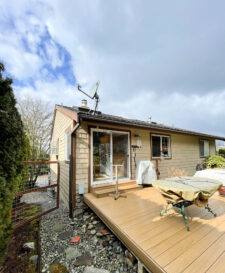
What Happy Valley Homes Actually Need From a Siding Job
Walk a few blocks in this part of Whatcom County and you'll see the tells of a siding system that was never matched to the climate: caulk lines that have separated and let water track behind the panel, corner boards with soft, spongy wood underneath the paint, and north- or shade-facing walls with a persistent green cast no amount of pressure washing seems to fully clear. These aren't cosmetic issues — they're moisture problems working their way outward.
A siding installation built for this environment needs to get four things right:
- Water management behind the cladding. A drainable house wrap and properly lapped flashing at every window, door, and penetration matter more here than in a dry climate, because the assumption has to be that some moisture will get past the outer layer.
- A factory finish that doesn't rely on field-applied paint to do the real work. Job-site painted products are only as good as the prep and the weather on install day — and painting siding in a Whatcom County fall or winter is rarely ideal.
- Material that doesn't swell or wick water. Wood-based and wood-fiber products absorb moisture at cut edges and fastener holes; once that starts, it doesn't reverse.
- Proper clearance and drying capacity. Siding installed tight to grade, decking, or landscaping without a drainage gap holds moisture against the wall and accelerates moss and mildew growth on the lower courses.
Why We Install Only James Hardie Fiber Cement Here
We standardized on James Hardie fiber cement siding for every home we side, and Happy Valley's climate is a clear example of why. Fiber cement is a cement-and-cellulose composite — it doesn't absorb and hold water the way wood-based sidings do, and it isn't a plastic product that can go brittle in freeze-thaw cycling or distort against a hot, dark-colored surface. It's also non-combustible, which matters more every wildfire season across the broader Pacific Northwest, even in a coastal county.
ColorPlus Factory Finish
James Hardie's ColorPlus finish is baked on at the factory under controlled conditions, not brushed or sprayed on-site at the mercy of that day's weather. That finish is engineered to resist fading and hold up to repeated wetting and drying — which is exactly the cycle Happy Valley siding goes through for a good part of the year. It also means touch-up and painting isn't a recurring maintenance line item the way it is with field-finished products.
Climate-Engineered HZ Product Lines
Hardie doesn't make one siding product for the whole country — its HZ5 line is engineered for regions with damp, moderate climates like ours, where the concern is prolonged moisture exposure rather than extreme freeze depth. That's a meaningful distinction: a product engineered for a hot, dry climate isn't necessarily the right formulation for a wall that stays damp under shade for days at a time.
Warranty That Follows the Home
James Hardie backs its siding with a strong, transferable limited warranty on the material, and the ColorPlus finish carries its own separate finish warranty. That matters for resale — a documented, transferable warranty on a correctly installed product is worth something to a future buyer in a way that a patched-together maintenance history isn't.
We don't install vinyl, LP SmartSide, Cemplank, Allura, or unfinished cedar or primed spruce siding, and we're upfront about why. Vinyl can warp and fade with UV and heat cycling and offers little in the way of a rigid, water-resistant wall assembly. Wood-based engineered sidings and raw wood products are more sensitive to moisture intrusion at cut edges and fastener penetrations than fiber cement, and in a climate where wet season runs half the year, that sensitivity shows up sooner rather than later. Alternative fiber cement brands may be reasonable products, but we've chosen to build our installation expertise, warranty backing, and product knowledge around one system rather than juggling several — and Hardie's combination of finish, engineering, and warranty structure is the one we trust to go on a home in this neighborhood.
What a Correct Installation Involves
The siding itself is only part of the job. Most siding failures we get called out to inspect trace back to installation shortcuts, not the material. A correct James Hardie installation includes:
- Tear-off and substrate inspection. Removing old siding and checking the sheathing underneath for rot or water damage before anything new goes on — covering a wet wall with new siding just hides the problem.
- Water-resistive barrier. A properly lapped, drainable house wrap installed shingle-style so water sheds outward instead of behind the wall.
- Flashing at every penetration. Windows, doors, hose bibs, light fixtures, and vents all need integrated flashing, not just a bead of caulk.
- Correct fastening. Hardie specifies fastener type, spacing, and placement by product and exposure; installing to spec is what keeps the manufacturer's warranty valid.
- Proper clearances. Minimum gaps from grade, roofing, decks, and patios so the bottom courses can dry and don't sit in standing water or splash-back.
- Joint and butt seam treatment. Sealed and detailed per manufacturer spec so seams don't become the first place water gets in.
- Trim, caulking, and paint touch-up. Finished with materials compatible with the ColorPlus system so the whole wall performs and looks consistent.
Skipping any one of these steps doesn't usually cause an immediate, visible problem — it shows up two, five, or ten years later as a soft spot, a stain, or a warranty claim that gets denied because the installation didn't meet spec.
Our Process for a Happy Valley Siding Project
We run the same disciplined process on every home, adjusted for what your particular walls, exposures, and existing siding condition need:
- On-site assessment. We look at your current siding, sheathing condition where accessible, trim, and the specific exposures on your home — which walls take the worst weather, where shade and moisture linger longest, and where moss and algae are already established.
- Written estimate and product selection. A clear scope of work, product line, and color selection from Hardie's ColorPlus palette, with pricing that reflects your home's actual size, trim complexity, and prep needs — not a generic per-square-foot guess.
- Prep and tear-off. Removing old material, addressing any rot or damaged sheathing we find, and confirming the wall is dry and sound before anything new is installed.
- House wrap and flashing. Installed and inspected before a single piece of siding goes up — this is the step that determines how the wall performs for the next 30-plus years.
- Siding installation. Installed to James Hardie's fastening and clearance specifications, maintaining warranty compliance throughout.
- Final walkthrough. We go over the finished job with you, check trim and caulking details, and make sure you understand what little maintenance the system does need.
What Affects the Cost of Your Siding Installation
Every home is different, but the same handful of factors drive most of the variation in siding project cost. Here's what typically moves the number, high or low:
| Factor | How It Affects Cost |
|---|---|
| Substrate condition | Rot or water damage found under old siding adds repair scope before new siding can go on |
| Home size and wall complexity | More corners, gables, and dormers mean more cutting, flashing, and labor time |
| Siding profile and product line | Lap siding, shingle-style panels, and board-and-batten looks vary in material and labor cost |
| Trim and accent work | Detailed trim, window surrounds, and accent bands add finish carpentry time |
| Access and site conditions | Tight lots, steep grades, or limited staging area can slow installation |
| Tear-off vs. overlay | Full removal of old siding costs more upfront but avoids hiding existing problems |
Broadly, a full James Hardie siding replacement is a mid-to-upper five-figure investment on most single-family homes, with the final number depending heavily on the factors above. We won't give you a real number until we've actually looked at your walls — anything else is a guess.
Signs Your Current Siding May Already Be Failing
Because moisture damage tends to hide behind the surface, it helps to know what to look for before it becomes structural. Common warning signs on Happy Valley homes include:
- Persistent green or black staining that returns quickly after cleaning, especially on shaded or north-facing walls
- Soft or spongy spots when you press on the siding near the bottom courses or around windows
- Paint that's bubbling, peeling, or chalking heavily, especially on walls that take direct weather
- Visible gaps or separation at seams, corners, and trim joints
- Warping, cupping, or panels that no longer sit flat against the wall
- A musty smell near exterior walls inside the home, which can indicate moisture already inside the wall cavity
Any one of these is worth a professional look before it's addressed with paint or caulk alone — those fixes treat the symptom, not the moisture source underneath.
Why Hiring a Crew That Already Works This Area Matters
Siding installation isn't just about following a manufacturer's manual — it's about applying that manual correctly to the conditions a specific wall actually faces. A crew that regularly works Whatcom County homes already knows which exposures need extra attention to flashing and drainage, how much clearance to leave given how wet the ground stays through winter, and what a home near the water needs differently than one further inland. That local pattern recognition catches problems a first-time or out-of-area crew can miss.
Before hiring anyone for a siding project, it's worth asking a few direct questions:
- Are you a James Hardie installer, and can you explain why you use the specific product line you're recommending for my home?
- Will you inspect the sheathing before installing new siding, and what happens if you find damage?
- What's your plan for flashing around windows, doors, and other penetrations?
- What clearance will you leave at grade, decks, and roof lines?
- Is your installation warranty-compliant with the manufacturer, and what does that warranty actually cover?
- Can I see the written scope of work before I sign anything?
A contractor who answers these clearly and specifically, without vague reassurances, is one worth trusting with your walls.
Get a Straight Answer About Your Home
If your siding is showing its age, or you're planning ahead before a problem gets expensive, we're glad to take a look. We'll give you an honest read on what your home actually needs, walk you through product and cost factors specific to your walls, and put together a written estimate — no pressure, no obligation. Reach out through the form below to get started.