 Whatcom County
 Why Decks Wear Out Faster in Birchwood Than the Warranty Card Suggests
Most decking warranties are written for a dry climate. Birchwood doesn't get one. Between the driving rain off the Sound, the salt-laden air that drifts inland on windy days, and a moss season that can run more than half the year in shaded yards, a deck here takes a beating that a deck in Spokane or Sacramento never sees. That's not a knock on any particular product — it's just the reality of building outdoors in this part of Whatcom County, and it's why a deck that looks fine from the porch can be quietly failing underneath.
Rain That Doesn't Let Up
It's not the volume of rain that does the damage — it's the duration. Long stretches of steady, low-intensity rain give water time to work into every joint, screw hole, and board gap. Ledger connections, stair stringers, and end-grain cuts are the usual entry points. Once moisture gets past the surface and into framing lumber that never fully dries out between storms, rot sets in quietly, often for a year or more before it shows on top.
Salt Air and Metal Fatigue
Homes closer to the water pick up airborne salt that accelerates corrosion on anything metal — fasteners, joist hangers, post bases, and railing hardware. Standard galvanized coatings can wear thin faster in this environment than they would inland. A deck built with the wrong hardware can develop rust streaks and weakened connections well before the decking boards themselves show their age.
A Moss Season That Runs Half the Year
Shaded lots, tree cover, and consistent damp conditions make Birchwood good moss habitat — on roofs, on siding, and on decks. Moss holds moisture against the board surface, feeds mildew growth, and turns a deck slick and slippery in exactly the months you're walking on it in wet shoes. A deck that's designed to shed water and dry out between rains will fight moss naturally; one that traps water won't, no matter how often it gets scrubbed.
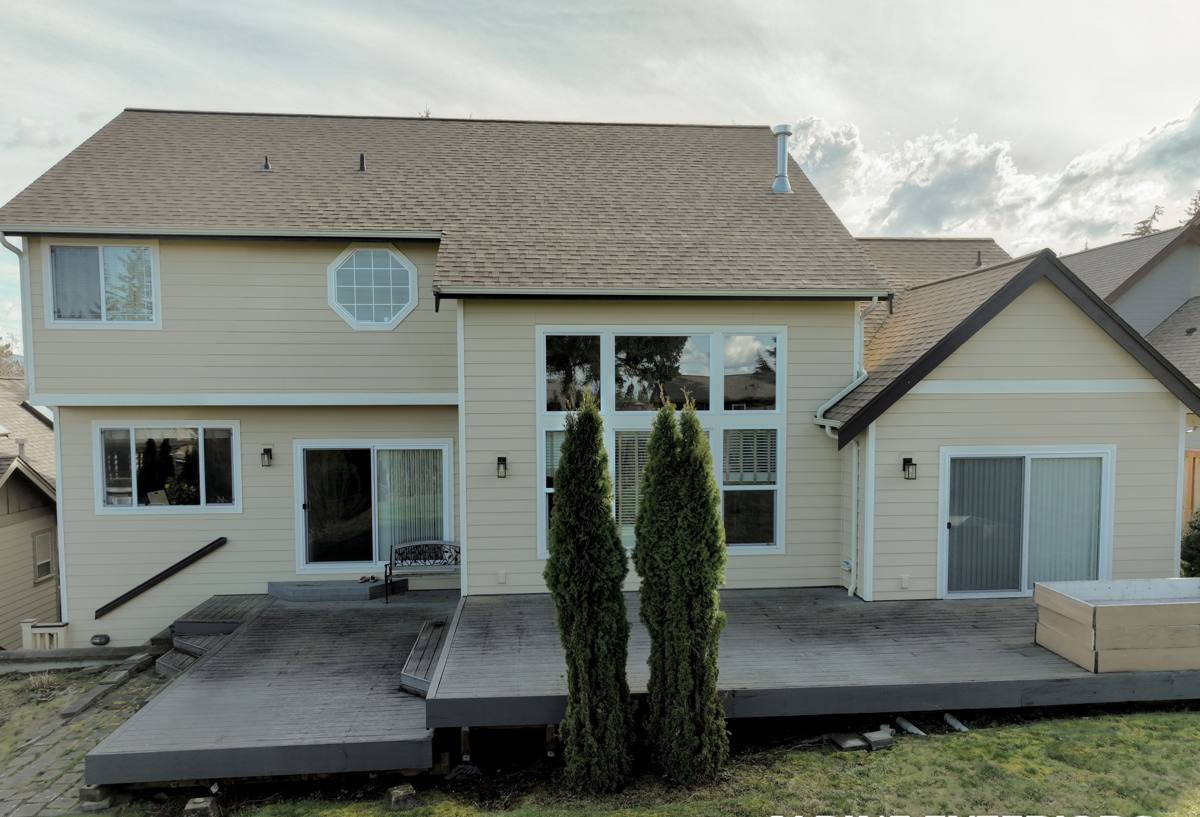
Signs a Birchwood Deck Needs Replacement, Not a Repair
Not every tired deck needs to come out entirely. But there's a point where patching individual boards is just delaying a bigger job — and spending money on a deck whose frame is already compromised. Here's what tells us a full replacement is the honest recommendation:
- Soft, spongy, or bouncy spots in the decking, especially near the house or around posts
- Rust staining bleeding out from screw heads or around metal connectors
- Visible gaps, cracking, or dark staining where the deck meets the ledger board
- Posts that wobble at the base or show soft wood when probed with a screwdriver
- Persistent moss or black mildew that comes back within weeks of cleaning
- Railings that have loosened from their posts, even after re-tightening hardware
- A deck older than 15–20 years that has never had the ledger flashing inspected
The general rule: if the problems are limited to a handful of surface boards and the frame underneath is sound and dry, repair makes sense. If the framing, ledger connection, or footings are compromised, repair is a short-term fix on a structure that's already failing — and in a climate this wet, that failure doesn't slow down.
What a Correct Deck Replacement Actually Involves
A deck replacement is a framing project with decking on top of it, not the other way around. Most of the work that determines how long the deck lasts happens before a single visible board goes down.
Ledger Board and Flashing
The ledger board — where the deck attaches to the house — is the single most common source of long-term failure in this climate. Water that gets behind an improperly flashed ledger doesn't just rot the deck framing; it can work its way into the house's band joist and wall structure. A correct installation uses proper flashing, a water-resistant barrier behind it, and mechanical fasteners rated for the load, sealed to shed water away from the house rather than trapping it against the siding.
Framing, Posts, and Footings
Joists, beams, and posts need to be sized and spaced for the actual load and span, not just "close enough" to what was there before. Footings need to reach the depth and bearing required for the site conditions, and post bases should hold wood posts up off the concrete rather than letting end grain sit in standing water — a detail that matters more here than in drier climates, where a wet footing dries out between rains before it can do damage.
Fasteners and Connectors
Given the salt air exposure common in this area, we spec stainless steel or high-grade coated fasteners and connectors for ledger attachments, joist hangers, and other structural hardware, rather than relying on the minimum-grade galvanized parts sold with standard framing packages. It costs a little more up front. It's a lot cheaper than replacing a deck again in ten years because the hardware corroded before the lumber did.
Choosing Decking Material for This Climate
There's no single "best" decking material — there's a best fit for the site, the budget, and how much upkeep the homeowner actually wants to do. Here's how the common options hold up against Whatcom County's rain and moss:
| Material | Moisture & Moss Behavior | Maintenance | Typical Lifespan Here |
|---|---|---|---|
| Pressure-treated lumber | Resists rot from treatment, but surface holds moisture and grows moss/mildew without regular cleaning and sealing | Annual cleaning; re-sealing every 2–3 years | 15–20 years with upkeep |
| Cedar | Naturally rot-resistant but softer surface; shaded, damp spots still grow moss over time | Regular cleaning and periodic oiling/sealing to hold color and resist moisture | 15–20 years with upkeep |
| Capped composite / PVC | Won't rot or absorb water into the board itself; moss can still grow on the surface film in shaded, damp areas without cleaning | Periodic washing; no sealing or staining required | 25+ years, manufacturer-dependent |
One detail that matters more here than in drier regions: grooved-edge composite boards with hidden fastener systems look clean, but the grooves can hold water and organic debris that feeds moss and mildew if the deck doesn't get enough airflow or sun. On heavily shaded Birchwood lots, we sometimes recommend solid-edge boards or wider board spacing specifically to help the deck dry out between rains rather than chasing the lowest-maintenance marketing claim.
Permits and Code Basics for Deck Replacement
Most deck replacements in Whatcom County require a building permit, particularly when the deck is attached to the house, elevated more than a couple feet, or involves changes to footings, framing, or guardrails. Permitted work means an inspector checks the ledger attachment, footing depth, and structural connections before the decking goes down — which is exactly the part of the job that's invisible once it's finished. Guardrail height, baluster spacing, and stair geometry also follow code minimums meant to keep the deck safe for years of use, not just for the first season. We handle the permit application and inspections as part of the job so homeowners aren't left tracking down paperwork on their own.
Our Deck Replacement Process
- On-site assessment — we inspect the existing deck's framing, ledger connection, posts, and footings to determine what's salvageable and what isn't, and give an honest recommendation.
- Design and material selection — we walk through decking and railing options based on the site's sun/shade exposure, budget, and how much upkeep is realistic for the homeowner.
- Permitting — we prepare and submit the permit application and coordinate required inspections.
- Demolition and disposal — the old deck comes out, including any hidden rot in the framing that wasn't visible from the surface.
- Framing rebuild — ledger flashing, footings, posts, beams, and joists go in to current code and to hold up under sustained wet-season conditions.
- Decking and railing installation — boards, fasteners, and railings go in per manufacturer spec, with attention to spacing and airflow.
- Final walkthrough — we go over the finished deck, maintenance expectations, and answer any questions before calling the job done.
Keeping a New Deck Ahead of the Moss and Moisture
A well-built deck still needs a little seasonal attention in this climate. A few habits make a real difference in how long it stays looking and functioning like new:
- Sweep leaves and organic debris off the deck regularly in fall — trapped wet leaves are moss's favorite starting point
- Rinse or wash the surface a couple times a year, more often in heavily shaded areas
- Trim back overhanging branches or shrubs that keep sections of the deck in constant shade and dampness
- Check the ledger flashing and any visible fasteners once a year for early signs of rust or gapping
- Reapply sealant on wood decking on the manufacturer's recommended schedule, not just when it looks dry
Why a Crew That Already Works in Birchwood Makes a Difference
Deck framing and flashing details that work fine in a dry inland climate aren't automatically the right call on the Whatcom County coast. A crew that already works in Birchwood knows which lots run shadier and wetter, which fastener grade actually holds up against the salt air, and how the local permitting process runs — because they've pulled the permits and passed the inspections before. That local track record shows up in fewer surprises during the job and a deck that's actually built for the weather it has to survive, not a generic spec sheet.
If your deck is showing its age, or you just want an honest opinion on whether it needs repair or full replacement, we're happy to take a look. Fill out the form below for a free, no-pressure estimate.