 Whatcom County
 Siding Repair Built for Columbia's Climate
Homes in the Columbia area sit close enough to the water and the weather patterns that come with it that siding here ages differently than siding forty miles inland. Salt-laden air off the bay, driving rain that comes in sideways during fall and winter storms, and a moss season that can stretch from October through May all put steady pressure on exterior walls. Siding repair in this part of Whatcom County isn't just about patching a crack — it's about understanding why that crack formed in the first place and making sure the repair holds up to the same conditions that caused the damage.
We work on homes throughout Whatcom County, and the repair calls we get from Columbia and the surrounding neighborhoods tend to follow a pattern: moisture intrusion at seams and penetrations, coating failure from salt exposure, and moss or algae holding water against the siding surface long enough to cause rot underneath. None of that is unusual for this part of the state — it's just what happens to a wall that faces the weather here year after year.
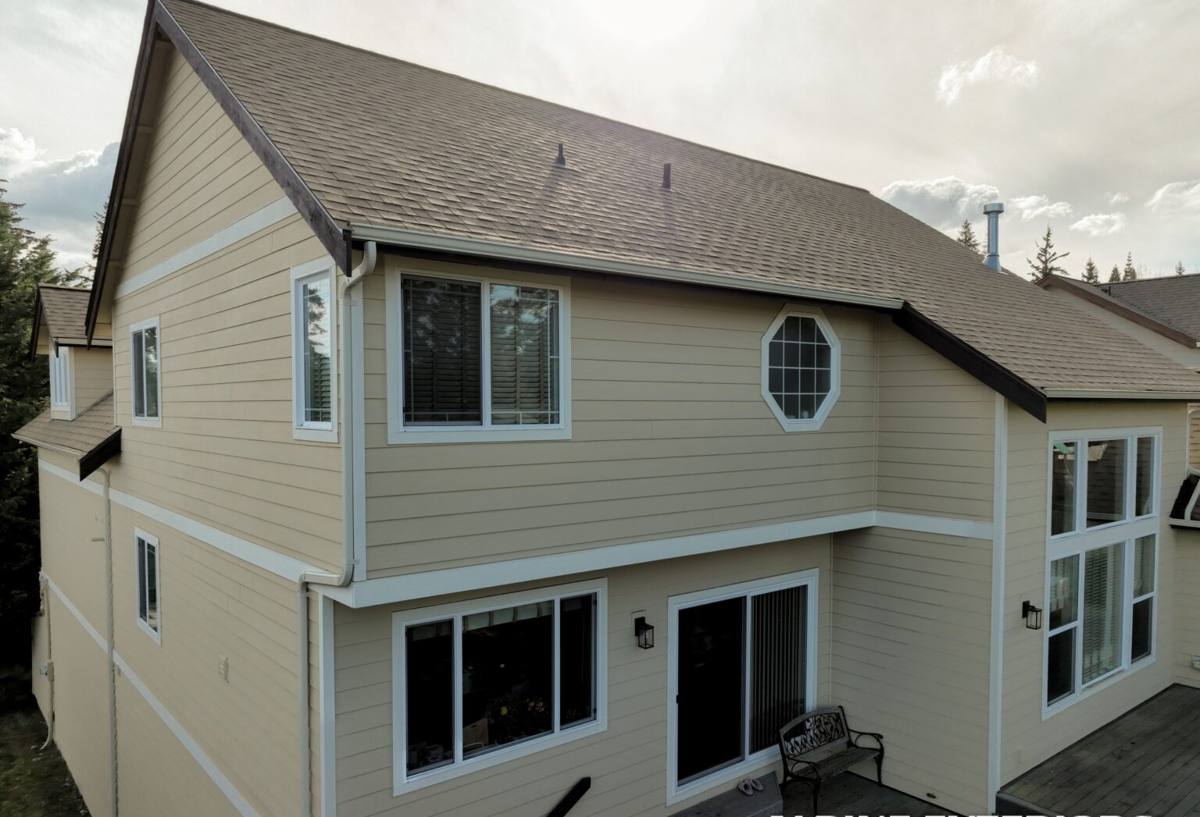
What Salt Air, Rain, and Moss Actually Do to Siding
It helps to understand the mechanics before talking about the fix.
Salt Air
Airborne salt is corrosive and hygroscopic — it pulls moisture out of the air and holds it against whatever surface it lands on. On siding, that means fasteners, trim flashing, and factory finishes take a slow beating. Painted wood and some composite products can chalk, fade, or lose adhesion faster near the water than they would inland. Metal fasteners and flashing that aren't corrosion-resistant can rust and stain the siding around them.
Driving Rain
Whatcom County storms don't always fall straight down. Wind-driven rain gets pushed sideways into laps, joints, corner boards, and anywhere two materials meet — window trim, doors, utility penetrations. If those transitions weren't flashed and sealed correctly during the original install, water finds its way behind the siding instead of running off the face of it. Once water gets behind siding, the sheathing and framing underneath start absorbing it, and that's when small problems become expensive ones.
Moss and Algae
The long damp season here means moss and algae have plenty of time to establish themselves on siding, especially on north-facing walls and areas shaded by trees or roof overhangs. Moss holds moisture against the surface far longer than open air would, and its root structure can work into hairline cracks and seams, widening them over time. Left alone through a few wet seasons, moss-covered siding often has moisture damage underneath that isn't visible until the moss is cleared away.
Signs a Columbia Home Needs Siding Repair
Most siding damage doesn't show up as an emergency — it shows up as small details that get worse if ignored. Worth checking for:
- Soft or spongy spots when you press on the siding, especially near the bottom courses or under windows
- Visible gaps or separation at seams, corners, or trim joints
- Peeling, bubbling, or chalking paint/finish, particularly on walls facing prevailing weather
- Persistent moss or algae growth that keeps coming back after cleaning
- Dark streaking or staining running down from a joint or fastener
- Warping, buckling, or boards that no longer sit flat against the wall
- Rust streaks from fasteners or flashing
- Interior signs — musty smell, peeling paint, or soft drywall on an exterior wall
Any one of these on its own might be minor. Several together, or any sign paired with visible softness, usually means moisture has already gotten past the surface and into the wall assembly.
What a Correct Repair Actually Involves
A lot of siding "repairs" are really just cosmetic patches — caulk over a gap, a fresh coat of paint over chalking, a piece of trim nailed over a soft spot. Those buy time, but they don't address the reason the damage happened. A repair worth paying for should include:
Finding the Actual Water Path
Before anything gets replaced, we trace where water is actually getting in. That often means pulling back siding beyond the visibly damaged area, because water travels downward and sideways behind the wall before it shows up as a stain or soft spot on the surface.
Checking the Sheathing and Framing
If water has been behind the siding for any length of time, the sheathing underneath needs to be inspected. Soft or delaminated sheathing has to be cut out and replaced — patching siding over compromised sheathing just hides the problem for another season.
Correcting Flashing and Water Management
Most recurring siding failures trace back to flashing that was missing, undersized, or installed in the wrong sequence. A proper repair re-flashes the affected area — window and door heads, wall-to-roof transitions, penetrations — so water sheds outward the way it's supposed to, rather than just replacing the visible boards and leaving the same water path in place.
Matching Materials Correctly
Replacement siding needs to match the existing product's dimensions, profile, and fastening pattern, or the finished wall will show it. Where the existing siding is a product we don't install, we're upfront about what a patch can and can't achieve, and we'll walk through whether a full section replacement in James Hardie fiber cement makes more sense than a mismatched patch.
Where James Hardie Fits Into a Repair
We install exclusively James Hardie fiber cement siding — we don't install vinyl, LP SmartSide, Cemplank, Allura, primed spruce, or cedar. That standard applies to repair work too. When a section of siding needs to come off and be replaced, we replace it with Hardie product engineered for this climate, factory-finished with ColorPlus so the color is baked in rather than field-painted.
For homes that already have Hardie siding, repairs are usually straightforward: fiber cement doesn't rot, doesn't attract wood-boring insects, and isn't fazed by salt air or moisture the way some materials are. Most repair calls on Hardie homes trace back to a flashing or installation detail rather than the siding material itself failing.
For homes with a different siding material that's failing, we'll be honest about the situation: a patch might get you a few more years, but if the underlying material has a history of moisture problems in this climate, a full re-side in Hardie is often the more cost-effective decision over a 10-15 year horizon, since it avoids paying for the same repair again in a few years.
Our Repair Process
- Inspection — We look at the visible damage and the areas most likely to be affected but not yet showing signs, including corners, penetrations, and low-sun walls where moss tends to establish.
- Diagnosis — We identify the actual water path and check sheathing condition before quoting anything.
- Scope and estimate — You get a clear breakdown of what needs to be replaced, what can be cleaned and preserved, and why.
- Repair — Damaged siding, sheathing, and flashing are replaced correctly and matched to the surrounding wall as closely as the existing material allows.
- Finish and cleanup — Trim, caulking, and touch-up work are completed so the repair blends in, and the site is cleaned up before we leave.
Repair or Replace? What Actually Drives That Decision
| Factor | Repair Usually Makes Sense | Replacement Usually Makes Sense |
|---|---|---|
| Extent of damage | Isolated to one or two wall sections | Recurring across multiple walls or elevations |
| Sheathing condition | Sound, dry sheathing beneath the damage | Sheathing soft or compromised in several areas |
| Siding age | Under 15-20 years, otherwise in good shape | Original siding is at or past its expected service life |
| Material match | Replacement material available to match existing siding | Discontinued profile/color, or existing material has a track record of failure here |
| Frequency of past repairs | This is the first repair call in years | This is the second or third repair to the same area |
There's no single rule that applies to every house — a home with one damaged section and sound sheathing everywhere else is usually a good repair candidate. A home where we keep finding new soft spots every time we open up a wall is telling you something different.
Why Hiring a Crew That Already Works in Columbia Matters
Siding repair done by someone unfamiliar with Whatcom County's weather pattern can miss the actual cause of failure. A crew used to inland conditions might not think to check for salt-related fastener corrosion or might underestimate how much water a moss-covered wall has absorbed over a wet winter. Working regularly in Columbia and the surrounding Whatcom County communities means we've seen how this specific stretch of coastline behaves — which walls take the worst of the driving rain, which orientations grow moss fastest, and which original installation shortcuts tend to fail first in this climate. That local pattern recognition is what separates a repair that lasts from one that reappears in two years.
Maintaining Siding Between Repairs
A few habits go a long way toward keeping Columbia-area siding in good shape between service calls:
- Rinse siding annually to remove salt residue and organic buildup before it takes hold
- Keep gutters clean so overflow doesn't run down the wall face
- Trim back vegetation and tree limbs that shade siding and keep it damp
- Address moss early with a gentle wash rather than letting it establish for a full season
- Walk the exterior once or twice a year and press-test any area that looks discolored or uneven
None of this replaces a professional inspection when something looks wrong, but it does reduce how often repairs are needed in the first place.
If you're seeing soft spots, gaps, persistent moss, or staining on your Columbia-area home, we're happy to take a look and give you a straightforward assessment — no pressure, no upsell, just an honest read on what's actually going on and what it would take to fix it right. Request a free estimate below and we'll schedule a time to come out.