 Whatcom County
 Why Cordata's Climate Is Hard on Siding
Homes in the Cordata area sit close enough to Bellingham Bay and the Salish Sea that salt-laden air is a fact of life for exterior surfaces, even several miles inland. Layer in Whatcom County's long stretch of driving rain from fall through spring, plus shaded lots and tree cover that keep moisture sitting on walls long after a storm passes, and you've got three separate stresses working on a home's siding at the same time, every year, for the life of the house.
Salt air and coastal exposure
Airborne salt speeds up corrosion on fasteners, flashing, and any exposed metal trim that isn't properly rated for the exposure. It also collects on porous or poorly sealed siding surfaces, where it can hold moisture against the material instead of letting the wall dry between rains.
Wind-driven, sideways rain
Storms coming off the water rarely fall straight down. Wind pushes rain sideways into wall assemblies, testing every seam, corner, and piece of flashing on a house. A siding installation that isn't detailed correctly at those transition points will eventually let water behind the cladding, where it can sit against sheathing and framing for months.
A long moss season
Whatcom County's mild, wet climate keeps moss and algae active for most of the year, especially on north-facing walls, under eaves, and anywhere shade slows drying between storms. Moss and algae hold moisture directly against the siding surface, which is a real problem for materials that swell, rot, or delaminate when they stay damp.
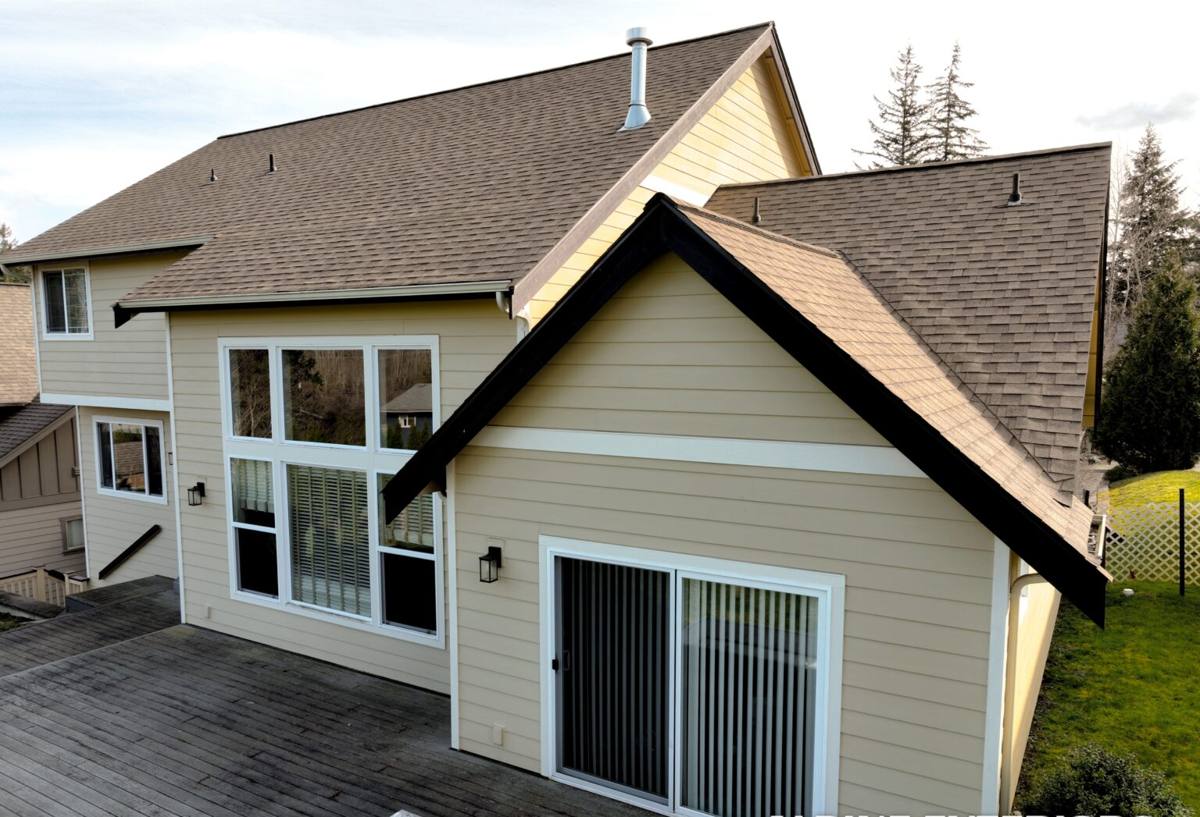
What a Correct Siding Installation Actually Involves
Siding is only as good as what's behind it. A weathertight installation in this climate depends on details that homeowners rarely see once the job is finished, but that determine whether the wall stays dry for twenty years or starts failing in five.
Weather-resistive barrier and flashing
Every wall needs a continuous weather-resistive barrier underneath the siding, with flashing integrated at windows, doors, deck ledgers, and any place two roof or wall planes meet. In a climate with sustained, wind-driven rain, shortcuts here — a missing kick-out flashing, a window without proper head flashing, a barrier that isn't lapped correctly — are exactly where water gets in.
Fastening, clearances, and drainage
Fiber cement siding has to be fastened at the correct spacing and depth, with the right clearance from the roofline, deck surfaces, and grade so water has somewhere to go instead of wicking up into the bottom edge of a board. Rainscreen or drainage-gap installation, where called for, gives the wall assembly a way to dry out between storms rather than trapping moisture against the sheathing — which matters more here than in a drier climate.
Cut edges and factory finish
Any cut edge on fiber cement siding is exposed material that needs to be sealed before installation, not after. Skipping this step is a small labor shortcut that shows up years later as a soft spot or a paint failure right at the cut line — usually at corners and around openings, which is exactly where wind-driven rain hits hardest.
Why We Install Only James Hardie Fiber Cement
We standardized on James Hardie fiber cement siding and don't install vinyl, LP SmartSide, primed spruce, cedar, or other fiber cement brands. That's a deliberate call, not a sales preference. Fiber cement is non-combustible, holds paint and factory finish far longer than wood-based products, and doesn't swell or rot the way engineered wood siding can when it takes on water repeatedly — which is the exact failure mode Cordata's rain and moss cycle sets up. Hardie's ColorPlus factory-applied finish is baked on and warrantied against fading and peeling, so homeowners aren't repainting a wet climate's worth of siding every few years.
James Hardie also engineers specific product formulations for different regional climate zones rather than selling one board for the whole country. In a zone like ours — heavy year-round moisture rather than deep freeze-thaw cycling — that means siding engineered for moisture resistance and dimensional stability under exactly these conditions, backed by a strong transferable warranty when it's installed to the manufacturer's specifications.
How Hardie Compares to Other Siding Options Here
Every siding material has trade-offs. Here's how the options homeowners usually ask about hold up against Whatcom County's salt air, rain, and moss:
| Material | Moisture behavior | Moss/algae resistance | Salt air durability | Finish longevity |
|---|---|---|---|---|
| James Hardie fiber cement | Dimensionally stable when wet; won't swell or rot | Resists staining; cleans up without damaging the material | Non-combustible cement composite, holds up well | Factory ColorPlus finish, warrantied |
| Vinyl | Doesn't absorb water but can warp/buckle with heat and age | Grows moss/algae like any surface; can trap moisture behind panels | Can become brittle over time | Color molded through, but fades and chalks over years |
| LP SmartSide / engineered wood | Wood-based; vulnerable to swelling at cut edges and joints if moisture gets in | Sustained moisture plus moss buildup is a real risk factor | No inherent corrosion issue, but finish stress is higher | Field or factory paint; recoat cycle needed |
| Cedar / primed spruce | Natural wood; absorbs moisture, needs consistent maintenance | Prone to moss, mildew, and rot without regular upkeep | No metal corrosion issue, but the wood itself is exposed | Stain or paint, shortest recoat cycle of the group |
Our Installation Process in Cordata
The process doesn't change site to site, but the details we pay closest attention to are shaped by this area's weather:
- On-site assessment of the existing wall assembly, moisture damage, and any rot found once old siding comes off
- Removal of old siding and inspection/repair of sheathing before anything new goes on
- Installation of a continuous weather-resistive barrier, correctly lapped and sealed
- Flashing at every window, door, deck ledger, and roof-to-wall transition
- Proper fastening pattern and clearances from roofline, deck, and grade
- Sealed cut edges on every piece before it goes up, not after
- Final inspection of caulking, trim, and touch-up paint at any field-cut edges
We walk the finished job with the homeowner before we consider it done, so any questions about maintenance or warranty coverage get answered on site, not after the fact.
Choosing the Right Hardie Product Line and Finish
Hardie's lap siding, panel, and shingle profiles are all available with the ColorPlus factory finish, which matters more here than in drier parts of the country — a factory-cured finish resists the kind of moisture-driven peeling that field-applied paint struggles with over a Whatcom County winter. Darker colors and higher-contrast trim combinations are popular in this area, but the finish system matters more than the shade: a ColorPlus color coated and warrantied at the factory will consistently outlast a field-painted equivalent under sustained damp conditions.
Living With Fiber Cement Through Moss Season
Fiber cement doesn't eliminate moss and algae — nothing that sits outside in Whatcom County year-round will — but it changes what moss growth actually does to your wall. On wood-based siding, trapped moisture under moss can lead to soft spots and rot. On correctly installed Hardie siding, the same growth is a surface condition: it can be washed off with a soft brush and a low-pressure rinse without damaging the substrate underneath. Homeowners should still keep gutters clear, trim back vegetation that shades and dampens walls, and rinse north-facing and shaded elevations once or twice a year — not because the siding is fragile, but because it keeps the finish looking its best.
Why Local Experience in Whatcom County Matters
A siding installation is only as good as the crew's judgment about local conditions — where flashing needs extra attention, which elevations take the worst of the driving rain, and how much clearance a particular lot's drainage actually needs. A crew that already works Cordata and the surrounding Whatcom County communities has seen how these houses age in this specific climate, not a generalized national average. That experience shows up in the small decisions made on site, not just in the brand of siding on the truck.
What Affects the Cost of a Siding Installation
Every home is different, but the same handful of factors drive most of the cost variation we see on Cordata-area projects:
| Factor | Why it matters |
|---|---|
| Condition of existing sheathing | Rot or water damage found after tear-off adds repair work before new siding can go on |
| Home size and wall complexity | More corners, dormers, and roof-to-wall transitions mean more flashing detail and labor time |
| Siding profile and trim package | Lap, panel, and shingle profiles, plus trim width and detail, affect material and labor cost |
| Access and site conditions | Tight lots, slopes, or landscaping close to the house can slow staging and installation |
| Color and finish selection | Factory ColorPlus finishes cost more up front than primed material but remove the need for an early repaint |
We provide a firm, itemized quote after walking the property — we don't work off a generic per-square-foot number, since so much of the real cost depends on what's found once the old siding comes off.
If you're weighing a siding project for a Cordata home, we're happy to take a look and walk you through what we find. The estimate is free, there's no pressure to commit, and you'll get a straight answer about what your walls actually need — just fill out the form below to get started.