 Whatcom County
 Why Cordata's Climate Is Harder on Siding Than It Looks
Cordata sits in north Bellingham, close enough to the water and the Strait of Georgia that salt-laden air is a constant, low-grade factor in how exterior materials age here. Add Whatcom County's long wet season — months of driving rain pushed sideways by wind off the bay — and a moss and algae season that can run from fall through spring on shaded, north-facing walls, and you have a climate that punishes any siding product with weak points in its finish, its fasteners, or its water management details. Homes in this neighborhood aren't dealing with hard freeze-thaw cycles the way inland or mountain towns do. The real enemy here is sustained dampness: siding that stays wet longer than it should, trim that wicks moisture at the end grain, and paint films that chalk and fail years before their warranty says they will.
That's the lens we use on every Cordata estimate. We're not asking "what looks good on day one" — we're asking "what still looks good and still keeps water out in year fifteen, in this specific climate."
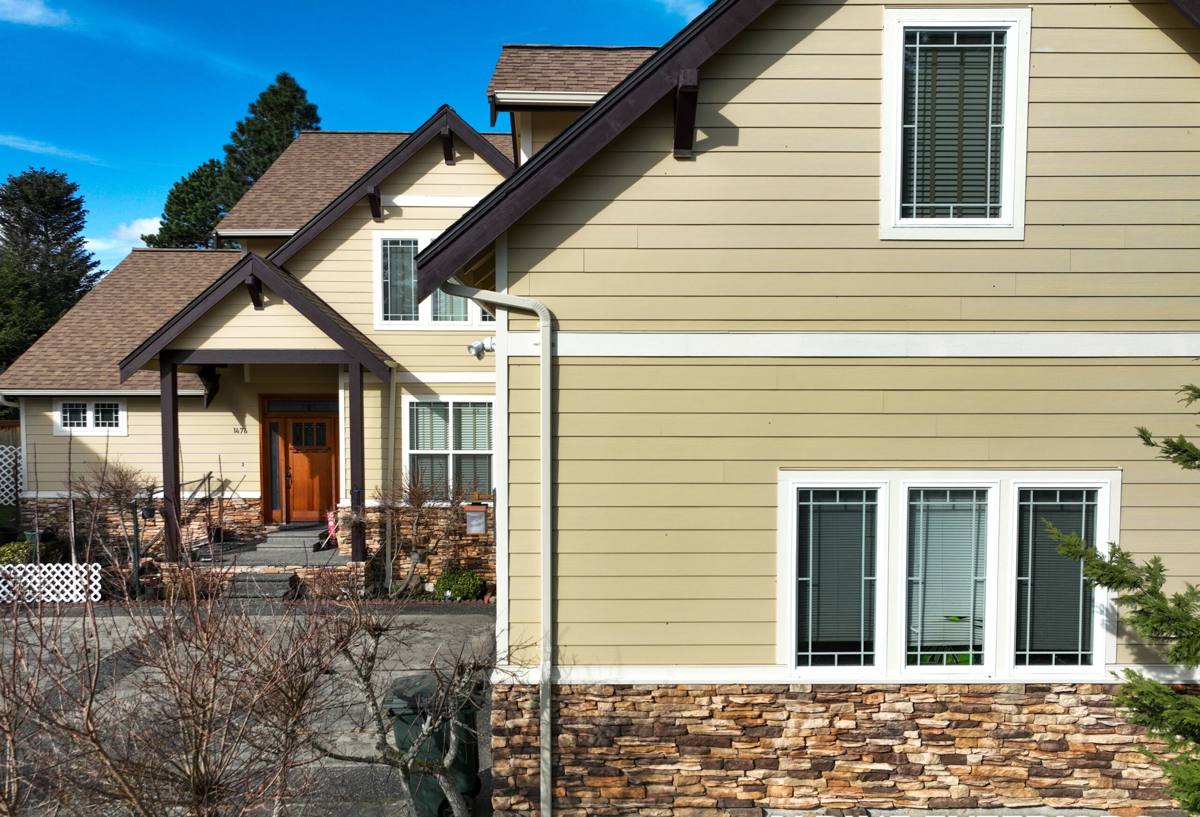
What James Hardie Gets Right for This Environment
James Hardie fiber cement is the only product we install, and in a marine climate like Whatcom County's, the reasons are concrete rather than theoretical:
- Non-combustible core: fiber cement doesn't feed a fire the way wood-based products can, which matters as much for insurance conversations as safety.
- Dimensionally stable in moisture swings: Hardie board doesn't swell and shrink with humidity the way engineered wood siding does, so it holds paint lines and caulk joints longer through a wet Whatcom winter.
- Factory-applied ColorPlus finish: baked on under controlled conditions rather than field-painted, which matters a great deal when your siding spends half the year damp before it ever gets a dry day to cure a field coat.
- HZ5 climate engineering: Hardie's HZ5 product line is formulated for wetter, harsher climate zones, which the Pacific Northwest qualifies as.
- Moss and algae resistance: the factory finish sheds and resists organic growth far better than raw or thinly primed wood substitutes, which matters directly in a neighborhood with real moss season.
None of that means Hardie is maintenance-free. It means the maintenance burden is caulking, gutters, and periodic washing — not re-priming, re-caulking split boards, or replacing rotted corners every few years, which is what we see happen to lesser products in this exact climate.
Why We Don't Install the Alternatives Here
We get asked regularly why we won't quote vinyl, LP SmartSide, or cedar for a Cordata job, and the honest answer is climate-specific, not brand loyalty. Vinyl can warp and gap in sustained wind-driven rain, and its seams are a long-term water path in a place that gets this much rain volume. Engineered wood products depend entirely on an intact factory seal — the moment that seal is compromised at a cut edge or fastener hole, the substrate is exposed to exactly the kind of standing moisture Whatcom winters deliver. Cedar is a beautiful, legitimate material, but it demands a maintenance schedule — regular refinishing, moss treatment, and vigilant caulking — that most homeowners don't actually keep up with once the first two years pass. We'd rather sell one product we can stand behind for twenty years than juggle warranty language across five.
What Correct Installation Actually Involves
Hardie siding fails early almost exclusively because of installation shortcuts, not the material itself. In a climate like this one, the details below aren't optional extras — they're the difference between a 30-year exterior and a callback in year four.
Water Management Comes First
Before a single piece of siding goes up, the wall needs a correctly lapped weather-resistant barrier, proper flashing at every window and door head, and a drainage plane that lets any moisture that gets behind the siding find its way back out. In a house that fields this much wind-driven rain, a rainscreen gap behind the siding is worth the extra step — it lets the wall dry instead of trapping moisture against the back of the board.
Fastening and Clearances
Hardie specifies exact fastener types, spacing, and minimum clearances off grade, decks, and roof lines. Skipping the ground clearance is one of the most common mistakes we correct on re-sides in this area — siding installed too close to grade wicks moisture straight up from wet soil, especially where landscaping beds sit right against the foundation.
Caulking and Sealant Joints
Every butt joint, trim intersection, and penetration needs the right sealant, applied to a clean, dry substrate. In a climate where you might only get a handful of consecutive dry days in a stretch, timing this work around the weather window matters as much as the caulk itself.
Cut Edges Get Sealed
Any field cut exposes raw fiber cement that didn't get the factory finish. Sealing every cut edge with the manufacturer-approved product is a five-minute step per cut that a rushed crew skips — and it's exactly where moisture intrusion starts.
What This Looks Like in Cordata Specifically
Cordata's housing stock is a mix — newer construction from the past couple of decades alongside older homes that have already been through one or two exterior cycles. That mix changes the job in practical ways:
| Home Type | Typical Starting Point | What the Job Involves |
|---|---|---|
| Newer construction (vinyl or engineered wood original siding) | Existing siding often still structurally intact but showing early wear | Full tear-off, inspection and repair of sheathing and barrier, then Hardie install with proper rainscreen detailing |
| Older homes (original wood or early fiber cement) | Weathered trim, possible moisture staining near grade or roof lines | More extensive sheathing repair likely, flashing replaced at all openings, full re-wrap before new siding |
| Homes with heavy shade / north exposure | Visible moss or algae staining on the north or shaded walls | Substrate checked closely for hidden moisture damage before covering it with new material |
Cost Factors on a Cordata James Hardie Project
We don't publish flat per-square-foot numbers because the honest answer always depends on the same handful of variables — but here's what actually moves the price on a job like this:
| Factor | Why It Matters |
|---|---|
| Tear-off vs. new construction | Removing and disposing of existing siding, and repairing whatever it's been hiding, adds labor before the new material ever goes up |
| Substrate condition | Rot or water damage found at tear-off (common near grade or under old flashing) has to be repaired before siding, and it can't always be estimated sight-unseen |
| Siding profile and trim complexity | Lap siding vs. board-and-batten vs. shingle-style panels, plus how much trim and corner detail the home has, changes labor hours significantly |
| Home height and access | Multi-story sections, steep roof pitches, and tight side-yard access all add time and equipment cost |
| ColorPlus vs. field-painted trim | Factory-finished ColorPlus costs more up front but eliminates a repaint cycle |
Our Process, Start to Finish
- On-site walkthrough: we look at the whole exterior — not just the siding, but grade clearance, gutter condition, roof-to-wall transitions, and any moss or staining patterns that hint at a moisture problem.
- Written estimate: a clear scope, product line, color, and price — no vague allowances for "repairs as needed" without an explanation of what that could mean.
- Tear-off and inspection: old siding comes off, sheathing gets inspected, and we show you anything we find before we cover it back up.
- Water-resistive barrier and flashing: replaced or repaired to current standards, with a drainage plane behind the new siding.
- Hardie installation to spec: correct fastening, clearances, cut-edge sealing, and joint caulking, done in weather conditions that let the sealants actually cure properly.
- Final walkthrough: we go around the house with you before calling the job done.
Living With Hardie Siding in a Moss-Prone Climate
Correctly installed Hardie siding is low-maintenance, not zero-maintenance. A short seasonal routine keeps it performing the way it's supposed to for decades:
- Rinse siding gently once or twice a year, especially on shaded or north-facing walls where moss and algae take hold first
- Keep gutters clear so overflow doesn't run down the face of the siding
- Trim back landscaping and tree branches that keep a wall surface damp and shaded
- Inspect caulk joints at trim and penetrations every couple of years and re-caulk any that have cracked or pulled away
- Watch the ground clearance — mulch, soil, or paving that creeps up over time can bring the siding closer to grade than it should be
Why a Crew That Already Works Cordata Matters
Correct installation isn't abstract — it's a set of judgment calls made on-site: how much rainscreen gap this particular wall needs, whether that stained sheathing near the foundation is cosmetic or structural, whether the weather window this week actually allows for proper caulk cure. A crew that has already worked through Cordata's mix of newer and older homes, in this same salt-air, high-rainfall climate, makes those calls from experience rather than guesswork. That's the difference between a siding job that's still tight and dry at year twenty and one that needs attention again in year five.
If you're weighing a re-side in Cordata, we're happy to walk your home with you, take an honest look at what's underneath your current siding, and put together a straightforward estimate — no pressure, no upsell into a product we wouldn't put on our own homes. Use the form below to get started.