 Whatcom County
 Building a Deck That Holds Up in Lynden
A deck in Lynden earns its keep differently than a deck in a dry climate. Whatcom County sits under a long, wet marine-influenced weather pattern for most of the year, and Lynden's location in the Nooksack River valley adds its own wrinkle: cooler overnight temperatures, heavier dew, and a longer stretch of shaded, damp ground around outbuildings, fence lines, and under-deck areas than homeowners moving here from drier states expect. None of that means you can't have a great deck. It means the deck has to be built with that reality in mind from the footings up, not treated as an afterthought once the framing is in.
We build and replace custom decks for homeowners throughout Whatcom County, and the decks that last aren't the ones with the fanciest railing — they're the ones where the person building them understood how water, moss, and freeze-thaw cycles actually behave in this valley over a ten- or twenty-year span.
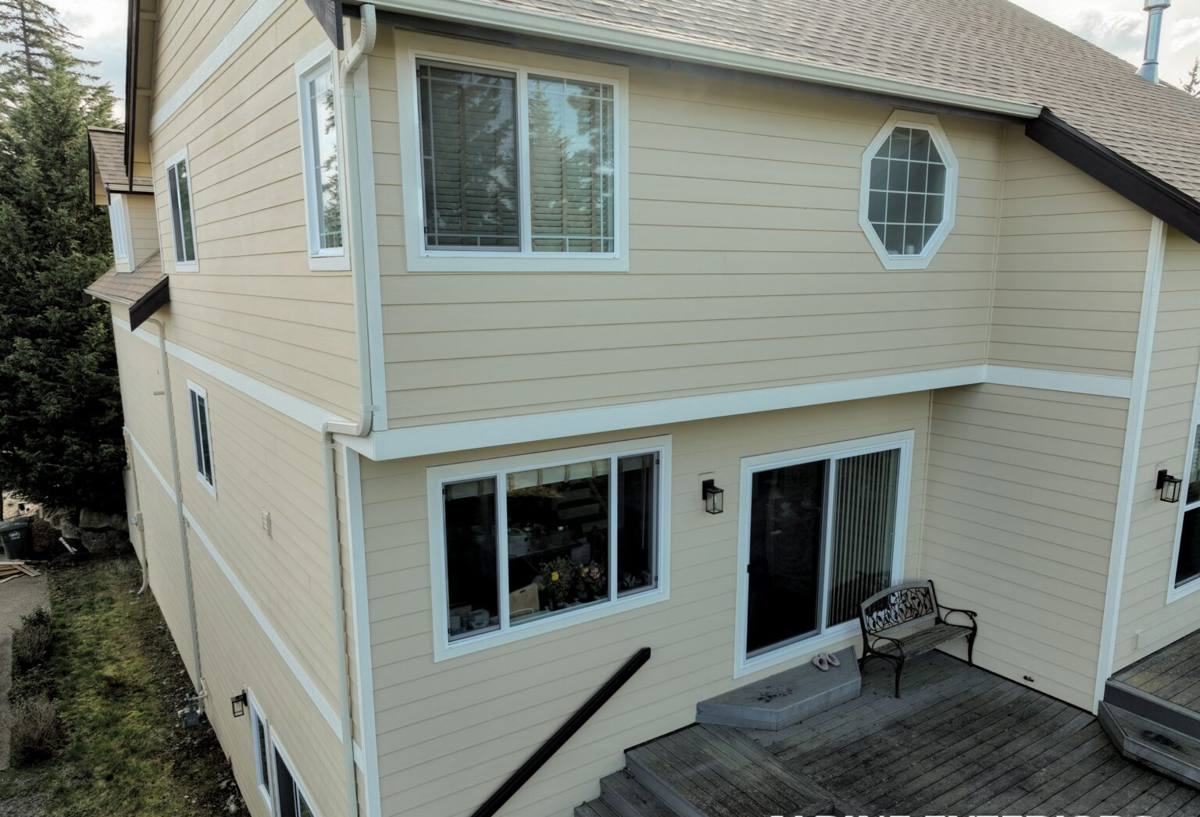
What Lynden's Weather Actually Does to a Deck
It helps to be specific about the failure modes we see, because they shape almost every material and construction decision on the job.
Driving rain and standing moisture
Wind-driven rain off the valley doesn't just fall on a deck — it gets pushed sideways into railing joints, under loose boards, and into any end grain that isn't sealed or protected. Combined with our long wet season, that means wood surfaces spend a lot of the year damp, which is exactly the condition that accelerates rot, fastener corrosion, and finish failure.
A long moss season
Shaded decks, north-facing decks, and decks near mature trees or fence lines grow moss and algae for a good chunk of the year here, not just a few weeks. Moss holds moisture against the wood surface, which speeds up graying, splintering, and rot in softer woods, and it makes boards slick and genuinely dangerous underfoot if it's not managed.
Freeze-thaw cycling
Whatcom County doesn't get deep, prolonged freezes most winters, but we do get repeated freeze-thaw swings — cold snaps followed by rain and thaw. That cycling is hard on footings that weren't poured below frost depth, on fasteners that were never rated for exterior use, and on any decking material with a tendency to trap water and crack when it refreezes.
Marine-influenced air
Even set back from the coast, Whatcom County sits under persistent marine humidity for much of the year. That moist air keeps everything — wood, metal hardware, concrete — slower to dry out between rain events than homeowners moving from a continental climate usually anticipate, which is part of why hardware selection matters as much as it does here.
Choosing the Right Decking Material for Lynden
There's no single "best" decking material — there's a best material for your budget, your maintenance appetite, and how shaded or exposed your particular yard is. Here's how the common options actually perform under Whatcom County conditions:
| Material | Moisture Behavior | Maintenance | Realistic Lifespan Here |
|---|---|---|---|
| Pressure-treated fir/hem-fir | Absorbs and releases moisture readily; prone to checking and cupping if not sealed | Annual cleaning, re-sealing every 1-2 years | 10-15 years with upkeep |
| Cedar | Naturally rot-resistant, but still needs sealing against our wet season | Cleaning plus sealant every 1-2 years to hold color and resist moss | 15-20 years with upkeep |
| Capped composite | Doesn't absorb water or support rot; can still stay damp on the surface and grow moss/algae without airflow | Occasional cleaning; no sealing or staining | 25+ years, manufacturer-backed |
| PVC decking | Fully moisture-resistant, most consistent performance in constant damp shade | Occasional cleaning | 25+ years, manufacturer-backed |
For decks that sit in full sun most of the day, a well-maintained wood deck can still be the right call, especially if the look and feel of real wood matters to you and you're comfortable with a maintenance routine. For shaded, north-facing, or tree-covered lots — which describes a fair number of Lynden properties — composite or PVC decking earns its higher upfront cost back in avoided moss battles and rot repair. We'll walk your specific lot and give you an honest read on which category fits before you commit to a material.
Structural Basics That Matter More Here Than Elsewhere
Footings below frost depth
Every footing we pour goes below the local frost depth and bears on solid, undisturbed soil — not on fill or topsoil. Skipping this is invisible for the first year or two and shows up later as a deck that shifts, racks, or develops gaps as the ground heaves through freeze-thaw cycles.
Ledger attachment and flashing
Where a deck ties into the house, the ledger board is one of the most common failure points we see on older decks — water gets behind it and rots the house's rim joist from the outside in, often long before anyone notices. We flash every ledger connection properly and use structural fasteners rated for that connection, not general-purpose deck screws.
Joist protection
Joist tops take standing water off the decking above them for years on end. We use joist tape or an equivalent flashing on top of every joist so the cut ends and fastener holes aren't sitting in constant moisture — a small step that meaningfully extends the framing's life in our climate.
Airflow underneath
A deck built low to the ground with poor airflow underneath stays damp longer after every rain, which speeds up rot in the framing and encourages moss on the underside of boards. Where grading and height allow, we build in enough clearance for air to move.
Railings, Fasteners, and Hardware
Hardware is where a lot of decks quietly fail years before the decking itself gives out. In a climate with this much sustained moisture, mixing metals or using interior-grade fasteners is a guaranteed problem — you get galvanic corrosion, streaking, and eventually failed connections at exactly the points holding the structure together.
- Structural connectors and fasteners rated for exterior/ground-contact use, matched to the decking and framing material (especially important with treated lumber, which is corrosive to the wrong metals)
- Stainless or coated hardware at any point exposed to standing water or direct weather
- Railing posts through-bolted to framing, not just toe-screwed — this is a safety issue as much as a longevity one
- Hidden fastener systems on composite and PVC decking installed per manufacturer spacing, which matters for both appearance and warranty coverage
Permits and Code in Whatcom County
Most raised decks require a permit, and the requirements depend on your jurisdiction — unincorporated Whatcom County and the City of Lynden each have their own permitting process and inspection sequence. Permits typically cover footing depth and spacing, ledger attachment, guardrail height and baluster spacing, and stair geometry. We handle the permit application and coordinate inspections as part of the job, so you're not the one tracking down requirements or scheduling inspectors around your own schedule.
How Our Custom Deck Process Works
- On-site assessment — we look at sun exposure, drainage, existing structure (for replacements), and how the space will actually be used before recommending anything.
- Material and design walkthrough — an honest comparison of your material options for your specific lot, with real cost and maintenance trade-offs, not a sales pitch toward the highest-margin product.
- Permit and engineering — we pull permits and handle any required engineering for larger or elevated structures.
- Site prep and footings — footings poured below frost depth on solid bearing soil.
- Framing with moisture protection built in — ledger flashing, joist protection, and corrosion-appropriate hardware throughout.
- Decking, railing, and finish work — installed to manufacturer spec where composite or PVC is used, or properly sealed where wood is used.
- Final inspection and walkthrough — we don't consider the job done until it's passed inspection and you've walked it with us.
Maintaining a Deck Through Whatcom County's Seasons
Even a well-built deck needs some seasonal attention here, and what it needs depends on the material:
- Late summer: clean debris from between boards and off ledger flashing before the wet season starts
- Fall: clear leaves and organic debris regularly — trapped leaves are one of the fastest ways to start a moss patch or a rot spot
- Wood decks: re-seal on the schedule your specific product calls for, generally every 1-2 years, and treat moss promptly rather than letting it establish
- Composite/PVC decks: periodic washing to keep pollen, algae film, and organic buildup from making the surface slick
- Year-round: keep gutters and downspouts near the deck clear so runoff isn't dumping extra water onto or under the structure
- Annually: check railing connections and stair stringers for movement, especially after a hard freeze-thaw stretch
Why Hire a Crew That Already Works in Lynden
A deck built to a generic national spec will often pass inspection and look fine on day one. The difference shows up in year five and year ten, in the details a crew only gets right consistently once they've seen what actually fails in this specific climate — which ledger connections rot first, which lots hold moss longest, which fastener combinations corrode here. We work throughout Whatcom County and bring that local pattern recognition to every custom deck we build, rather than treating Lynden the same as a dry-climate build somewhere else.
If you're planning a new custom deck or replacing one that's showing its age, we're happy to come take a look and give you a straightforward, no-pressure estimate — just fill out the form below.