 Whatcom County
 Why Fairhaven's Climate Is Harder on Siding Than Most of Whatcom County
Fairhaven sits close to the water on Bellingham Bay, and that location changes what siding has to survive. Homes a few miles inland deal mostly with rain and cool, damp winters. Homes near the bay deal with all of that plus a steady dose of salt-laden air moving off the water. Salt air speeds up corrosion on anything metal — fasteners, flashing, hose bibs, light fixtures — and it can accelerate the breakdown of paint films on wood and engineered wood siding that weren't built to shed moisture aggressively.
Add in wind-driven rain. When a storm comes off the water, rain doesn't just fall straight down — it gets pushed sideways into walls, especially on west- and southwest-facing elevations. Siding that relies on a tight caulk joint or a thin coating to keep water out will eventually let moisture past the surface. And because much of Whatcom County stays cool and overcast for long stretches of the year, whatever moisture gets behind or trapped against siding doesn't dry out quickly. That's what drives the long moss and algae season here — shaded walls, north sides of homes, and anything under tree cover can stay damp for weeks, which is exactly the environment moss, algae, and mildew need to take hold.
None of this means Fairhaven is a bad place to own a home with wood-look siding — it just means the siding, the installation details, and the material itself all need to be matched to a marine, high-moisture climate rather than a generic one.
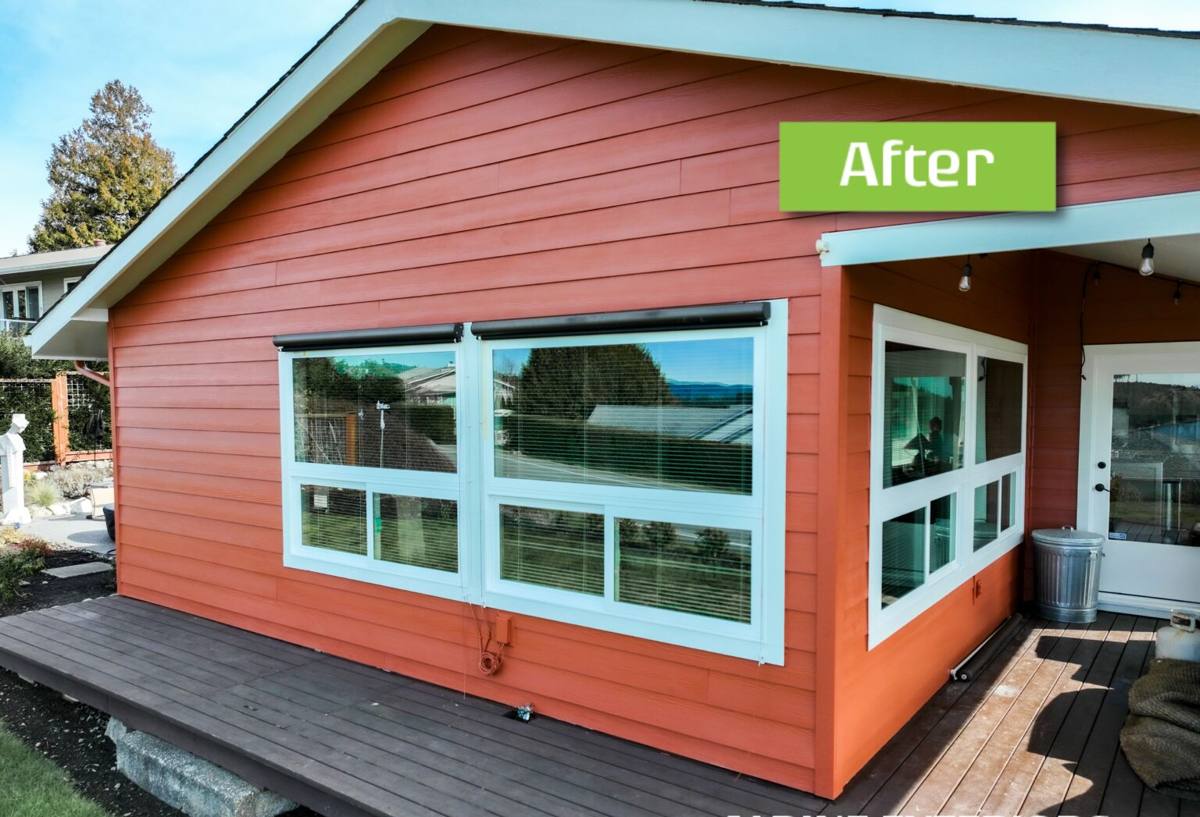
What a Correct Fiber Cement Job Requires Near the Bay
Moisture Management Behind the Siding
Fiber cement is dimensionally stable and doesn't rot, but the wall assembly behind it still needs a real drainage plane. That means a properly lapped weather-resistive barrier, correctly flashed windows and doors, and a way for any incidental moisture that does get behind the cladding to drain and dry out rather than sit against the sheathing. This matters more in Fairhaven than in a drier climate, because any mistake here has more moisture and more time to find it.
Fasteners and Flashing That Can Handle Salt Air
Standard fasteners can start showing corrosion faster in a marine environment than they would a few miles inland. Correct installation near the bay means using fasteners and flashing rated for the exposure — stainless steel or hot-dip galvanized where the manufacturer calls for it — instead of whatever is fastest or cheapest to run. The same goes for any exposed metal trim or flashing details around windows, roof-to-wall transitions, and deck ledgers.
Clearances and Gaps for Wind-Driven Rain
Manufacturer specifications for fiber cement include minimum clearances from grade, roofing, decks, and other siding, plus specific gaps at butt joints and trim. These aren't arbitrary — they're what keeps wind-driven rain from wicking into the ends of boards or pooling where two surfaces meet. Skipping or shrinking these clearances to make a job look tighter is one of the most common ways an otherwise good product fails early in a wet, windy climate.
The James Hardie System We Install
We install James Hardie fiber cement exclusively — not LP SmartSide, not vinyl, not unbranded fiber cement, not primed wood. Hardie is non-combustible, holds paint and factory finish far longer than wood-based sidings, and offers formulations engineered specifically for different climate exposures.
| Feature | What It Means for a Fairhaven Home |
|---|---|
| HZ5 climate formulation | Engineered for regions with both freeze-thaw cycles and sustained damp weather — a closer match to Whatcom County's winters than a formulation built for hot, humid climates |
| ColorPlus factory finish | Baked-on finish that resists fading and holds up better against salt air and UV than field-applied paint, reducing repaint cycles |
| Non-combustible core | Doesn't feed a fire the way wood or wood-composite siding can |
| Transferable warranty | Coverage that can pass to the next owner, which matters for resale in a desirable neighborhood like Fairhaven |
Hardie's lap and panel products give us the flexibility to match the look of the traditional lap and shingle-style siding common on older homes in this area, without the maintenance burden that comes with the real wood versions of those looks.
Signs Your Current Siding Is Already Losing the Fight
Because of the salt air and the long damp season, siding problems here often show up earlier than homeowners expect. Before they turn into sheathing or framing damage, most failures give warning signs:
- Dark green or black staining that returns within weeks of being cleaned, especially on shaded or north-facing walls
- Paint that's peeling, bubbling, or chalking heavily rather than just fading evenly
- Soft or spongy spots when you press on the siding near the bottom courses or around windows
- Visible corrosion streaks below nail heads or metal trim
- Gaps opening up at butt joints or corners where caulking has failed
- A musty smell near exterior walls inside the home, which can point to trapped moisture
Any one of these on its own isn't necessarily an emergency, but in this climate they tend to get worse faster than they would inland, so it's worth having them looked at rather than waiting.
What Drives the Cost of a Fairhaven Siding Project
Every home is different, but the same handful of factors move the price on most fiber cement jobs near the bay:
| Factor | Why It Matters |
|---|---|
| Condition of existing sheathing | Homes with hidden moisture damage need repair or replacement before new siding goes on — this is more common on homes with a history of failed caulk joints or poor flashing |
| Home size and wall complexity | More corners, dormers, and trim details mean more cutting, flashing, and labor time |
| Siding profile chosen | Lap siding, shingle-style panels, and board-and-batten each have different material and labor costs |
| Access and site conditions | Tight lots, mature landscaping, and proximity to the bay's setback and shoreline rules can affect staging and permitting |
| Trim and accessory work | Fascia, soffit, and trim replacement done at the same time as siding avoids paying for a second mobilization later |
We give a written, itemized estimate before any work starts, so you know exactly what's driving the number rather than a single lump sum.
Our Process, Step by Step
Inspection and Scope
We start by walking the exterior, checking siding condition, flashing, and any soft spots, and pulling test sections where we suspect hidden moisture damage. This tells us the real scope before we quote it.
Prep and Repair
Any damaged sheathing or framing gets replaced before new siding goes up. We install or correct the weather-resistive barrier and flashing details at every window, door, and penetration — this is the step that determines how the wall performs for the next several decades, not just how it looks on install day.
Installation to Manufacturer Spec
Hardie panels and planks go up following James Hardie's fastening schedule, clearances, and joint treatment for our climate zone, with corrosion-resistant fasteners throughout. We don't shortcut clearances to make a job look tighter, because that's exactly what causes early failures in a wet, salt-exposed environment.
Finish and Walkthrough
Trim, caulking where specified, and touch-up painting on cut edges finish the job. We walk the exterior with you before we call it done, and we stand behind the installation, separate from the manufacturer's product warranty.
Why Local Experience in Fairhaven Actually Matters
A lot of siding contractors can install fiber cement somewhere dry and inland without much drama. Fairhaven is less forgiving. A crew that regularly works this close to Bellingham Bay knows which elevations take the worst wind-driven rain, which lots stay shaded and damp long enough to grow moss even after a cleaning, and which older homes in the area are more likely to have hidden moisture issues behind the original siding. That experience shows up in fewer callbacks, not in a sales pitch — it shows up in flashing details done right the first time and fastener choices that don't need to be explained twice.
It also matters for warranty follow-through. If a question comes up two or five years after installation, a local crew that's still working in Whatcom County is easy to reach and has a record of exactly what went into your walls.
Maintenance in a Marine, Moss-Prone Climate
Correctly installed Hardie siding is low-maintenance, not zero-maintenance. In a climate like this, a simple annual routine keeps it performing the way it's designed to:
- Rinse siding gently once a year, focusing on shaded and north-facing walls where moss and algae take hold first
- Keep gutters clear so overflow doesn't run down the face of the siding
- Trim back landscaping and tree limbs that keep walls shaded and damp longer than they need to be
- Check caulking at trim and penetrations every couple of years and have any cracked sections redone
- Have a professional look at any staining or soft spots early rather than waiting for a full inspection cycle
None of this is heavy work, but skipping it in a climate this damp lets small issues turn into bigger ones faster than it would somewhere drier.
If you're seeing early wear on your current siding, or you're planning ahead for a home near the water in Fairhaven, we're happy to take a look and walk you through what we'd recommend — no pressure, no obligation. Use the form below to request a free estimate.