 Whatcom County
 Whatcom County's Climate Doesn't Go Easy on Decks
Happy Valley sits close enough to Bellingham Bay and the Salish Sea that salt-laden air is a constant, low-grade factor in how fast a deck ages. Add in the long stretch of driving rain that runs from fall through spring, plus the shaded, moisture-holding conditions that grow moss on almost any horizontal wood surface in this part of Whatcom County, and you have a climate that's genuinely tougher on decks than most homeowners realize until they're standing on one that's starting to give.
None of this means decks can't last here. It means they have to be built and replaced with those three factors in mind from the start — not with a generic approach borrowed from a drier climate.
The Ledger Board: Where Most Deck Failures Actually Start
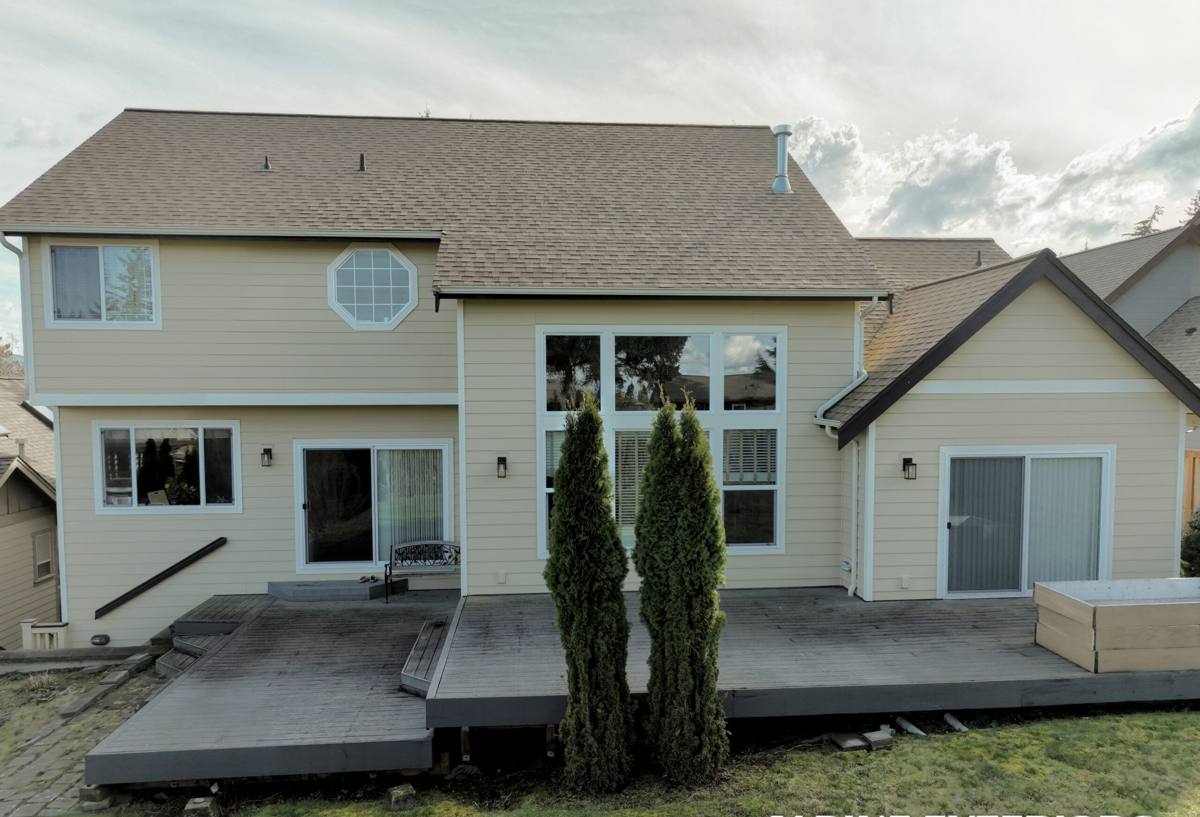
If you take one thing away from this page, make it this: the single most common reason a deck fails structurally isn't the decking boards people see — it's the ledger board, the framing member that bolts the deck to the house, and the flashing around it. When that flashing is missing, undersized, or improperly lapped with the house's water-resistive barrier, rain gets behind it and into the rim joist and framing below. In a climate with as much sustained rain as Whatcom County gets, that leak doesn't dry out between storms. It just keeps feeding rot.
A deck can look fine from the yard — solid railing, decent boards — and still be failing where it attaches to the house. That's one of the main reasons "just replace the boards" repairs don't hold up here long-term, and why a proper replacement always starts by opening up the ledger connection, not just resurfacing over it.
Fasteners and Hardware Matter More Near the Water
Standard fasteners corrode faster in salt-air environments, and once a joist hanger or ledger bolt starts rusting, it loses holding strength quietly — you won't see it until the deck moves. For Happy Valley homes, we treat hot-dip galvanized or stainless hardware as the baseline, not an upgrade, especially anywhere it will stay damp: ledger bolts, joist hangers, and post bases.
Signs a Deck Needs Replacement, Not Another Repair
Repair makes sense when the problem is isolated. Replacement is the honest answer when the framing, ledger connection, or footings are compromised, because no amount of new decking fixes what's underneath. Signs it's time to stop patching:
- Soft, spongy, or springy spots when you walk across the deck, especially near the house
- Visible gaps, staining, or dark streaking where the deck meets the siding — a sign water has been getting behind the ledger
- Wobble or movement in the railing posts when pushed by hand
- Persistent moss or algae that comes back within weeks of cleaning, especially on shaded sections
- Fasteners that are rusted, backing out, or leaving reddish-brown stains on the wood
- Posts or footings that have shifted, settled, or sit in standing water after rain
- A deck older than 15-20 years that was never rebuilt to current code, particularly around guardrails and stair stringers
If you're only seeing one or two of these and the framing underneath is solid, targeted repair may still be reasonable. Once the ledger, joists, or footings are involved, replacement is almost always the more honest recommendation — and usually the cheaper path over the next decade, since repeated repairs on failing framing add up.
What a Correct Deck Replacement Involves
Framing and Structure
Every replacement starts below the surface: sizing joists correctly for the actual span and load, spacing them to match the decking material chosen (composite typically wants tighter joist spacing than wood), and rebuilding the ledger connection with proper flashing that laps correctly with the house's siding or house wrap so water sheds outward, not inward.
Footings and Drainage
Footings need to sit below frost depth and bear on undisturbed soil, not fill. In the wetter, low-lying sections of Whatcom County, we also pay attention to where water actually goes once it leaves the deck — grading and drainage around posts and footings matters more here than in drier climates, since standing water around a post base is a slow but steady path to rot and movement.
Guardrails, Stairs, and Code
Guardrail height, baluster spacing, and stair stringer sizing are code items, not style choices, and older decks in this area were often built before current guardrail requirements existed. A full replacement is the natural point to bring all of that up to current code rather than carrying an old liability forward.
Choosing a Decking Material for This Climate
There's no universally "right" decking material — the right call depends on how much maintenance you want to do, your budget, and how much shade and moss exposure the deck's location actually gets.
| Material | Upfront Cost | Maintenance | How It Handles Moss & Damp Shade |
|---|---|---|---|
| Pressure-treated wood | Lowest | Needs cleaning and re-sealing every 1-2 years | Moss grows readily if not cleaned; sealing helps but doesn't stop it |
| Cedar | Moderate | Regular cleaning, periodic oil/sealant | Naturally more rot-resistant, but still hosts moss in shaded spots without upkeep |
| Composite | Higher | Low — occasional washing | Won't rot, but can still grow surface moss/algae in deep shade; cleans off easily |
| PVC decking | Highest | Lowest — washing only | Best moisture and moss resistance of the group; doesn't absorb water at all |
Our honest take: for a Happy Valley deck that sits under trees or on the shadier side of the house, the maintenance gap between wood and composite/PVC becomes a real quality-of-life issue within a few years — wood in constant shade needs more frequent attention than most homeowners actually keep up with. For decks in more open, sunny yards, well-maintained cedar still holds up fine and costs less up front. We'll walk your specific site with you before recommending one over the other.
Permits and Code in Whatcom County
Most attached deck replacements in Whatcom County and the City of Bellingham require a building permit, particularly when the deck is being rebuilt from the framing up rather than having boards swapped on an otherwise untouched structure. Permit requirements typically hinge on deck height above grade, whether it's attached to the house, and guardrail/stair scope. We handle the permit process as part of the job rather than leaving it to the homeowner, because an unpermitted deck rebuild can complicate a home sale or insurance claim later — a detail worth getting right the first time.
Our Deck Replacement Process
- On-site assessment — we inspect the existing structure, including the ledger connection and any framing we can access, to confirm replacement is the right call before quoting it
- Written scope and material selection — a clear plan covering framing, hardware, decking material, and railing, with pricing tied to what's actually being done
- Permit filing — submitted before demolition begins, so there's no gap where work stalls waiting on paperwork
- Tear-out — full removal of the old deck surface and any compromised framing, with the ledger and rim joist inspected once exposed
- Rebuild — new footings as needed, framing, ledger flashing, decking, and code-compliant railings and stairs
- Final walkthrough — we go over the finished deck with you, including basic care guidance for whatever material was installed
Why a Crew That Already Works Happy Valley Matters Here
Deck problems in this part of Whatcom County follow patterns — which lots hold water longer after a storm, which yards stay shaded enough to grow moss year-round, which ledger connections tend to have been flashed poorly in older construction. A crew that's already worked houses in and around Happy Valley has seen those patterns repeatedly and knows what to check for before a single board comes off. That's not a marketing point — it's the difference between a replacement that anticipates this climate and one that has to be revisited in a few years because a drainage or flashing detail was missed.
It also matters for something as simple as scheduling around this region's weather. Deck framing and flashing work needs a reasonable dry window to do correctly, and a local crew has a realistic sense of when that window actually holds here versus a forecast that looks fine on paper.
Keeping a New Deck Ahead of the Rain and Moss
A correctly built deck still benefits from basic upkeep in this climate:
- Sweep debris out of board gaps regularly — trapped leaves and needles hold moisture against the surface
- Rinse off moss and algae as soon as it appears rather than letting it establish, especially in shaded corners
- Check that gaps between boards stay clear so water can drain through rather than pooling
- Re-seal wood decking on the schedule the material calls for — don't stretch it because it "still looks fine"
- Have the ledger flashing and under-deck area glanced at every few years, since that's the spot most likely to develop a hidden problem
If your deck in Happy Valley is showing soft spots, rust stains, persistent moss, or you're just not sure whether it needs a repair or a full replacement, we're happy to take a look and give you a straight answer. Reach out for a free, no-pressure estimate using the form below.