 Whatcom County
 Why Sehome's Climate Is Hard on Decks
Sehome sits close enough to Bellingham Bay and the broader Puget Sound air mass that salt-laden moisture is a constant, even on days when it isn't raining. Add in Whatcom County's long stretch of driving rain from fall through spring, plus tree cover that keeps many lots shaded and damp well into what should be drying season, and you get a recipe that's hard on any outdoor structure. Decks take the brunt of it because they're horizontal — every surface is designed to shed water, but gravity and wind-driven rain still find ways to push moisture into seams, fastener holes, and the gap between boards and framing.
The result, on decks that weren't built or maintained with this climate in mind, is predictable: green-black moss and algae films on the walking surface, corroded fasteners, soft or rotted joists hidden under boards that still look fine from above, and mildew staining that keeps coming back no matter how many times it's pressure washed off. None of that is a flaw in composite decking itself — it's what happens when a deck built for a drier climate, or built without attention to drainage and airflow, meets a Pacific Northwest winter.
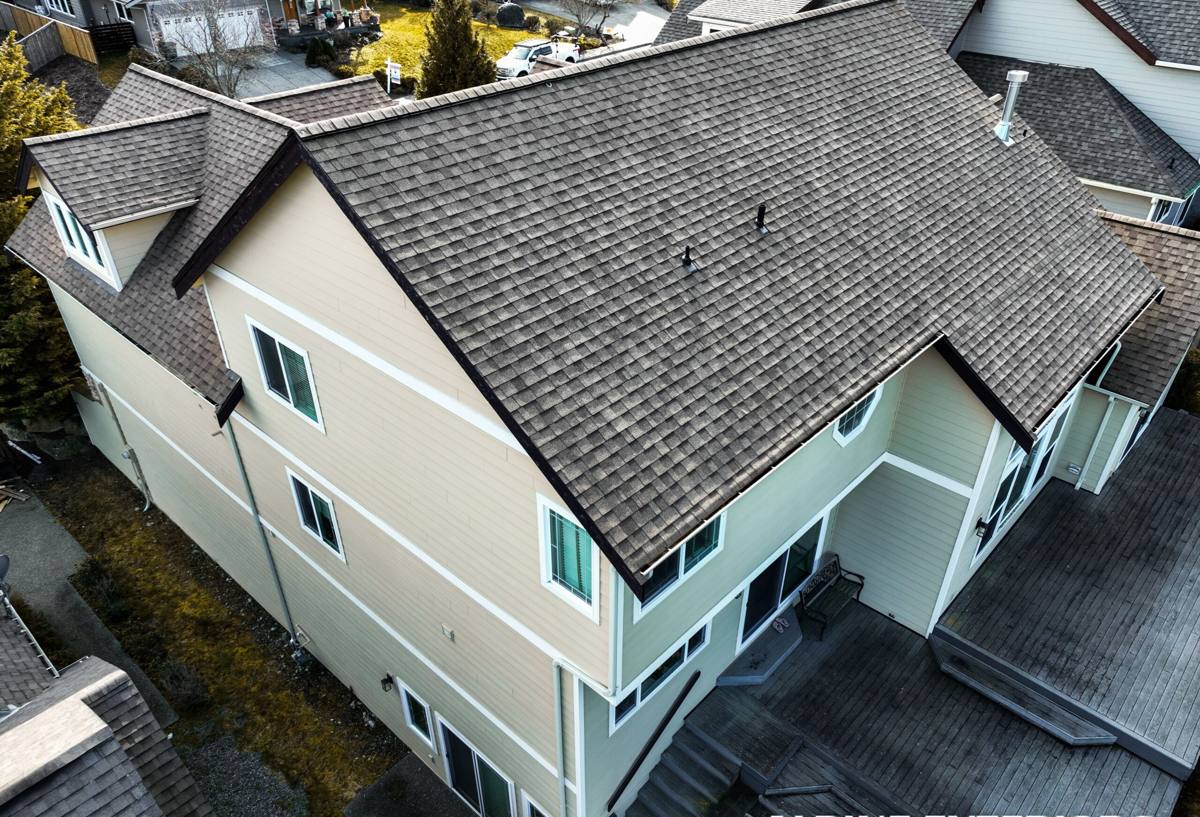
What a Correct Composite Deck Build Actually Involves
Composite decking is a good material choice for this area precisely because the boards themselves don't rot, splinter, or need annual staining. But the board is only part of the system. Most of the problems we get called out to fix on existing decks aren't board failures — they're substructure, drainage, or fastening mistakes that would cause trouble under any decking material.
Ledger Board and Structural Attachment
Where a deck attaches to the house, the ledger board and its flashing are the single most common source of hidden water damage. A ledger that's face-nailed without proper flashing, or flashed but not sealed correctly at the top, lets water track behind the siding and into the rim joist. In a climate with as much sustained rain as Whatcom County sees, that's not a slow problem — it's a matter of a few wet seasons before framing is compromised. We flash every ledger connection so water sheds outward and down, never behind the house wrap or siding.
Joist Spacing and Substructure Material
Composite boards have manufacturer-specified joist spacing requirements, and they're usually tighter than what's traditional for wood decking — often 16 inches on center, sometimes less for angled or picture-frame layouts. Building to wood-deck spacing habits under composite boards leads to bounce and, over years, visible sagging between joists. We also treat all framing lumber as a long-term moisture-exposure item, using pressure-treated or naturally resistant lumber and metal joist hangers rated for exterior use, not just whatever was left over from an interior framing job.
Drainage and Ventilation Beneath the Deck
This is the piece that gets skipped most often, and it's the one that matters most in a moss-prone climate. A deck built low to the ground, over soil that doesn't drain, with no airflow underneath, will stay damp for weeks after every rain event. That damp air condenses on the underside of the boards and the tops of the joists, feeding mold and speeding up hardware corrosion even when the decking above never shows a drop of standing water. Correct grading beneath the deck, a gap for airflow, and in some cases a sub-deck drainage system for spaces used as dry storage or a lower patio, all matter more here than they would in a drier region.
Fastening System
Face-screwing composite boards is faster, but it leaves screw heads exposed to standing water and eventually leads to the fastener corroding or the hole enlarging as the board expands and contracts with temperature. Hidden fastener clip systems, matched to the specific board profile, keep the walking surface free of exposed metal and reduce the number of points where water can sit against a screw head.
Composite, Wood, and PVC: How They Actually Compare Here
Homeowners in Sehome usually aren't choosing decking in the abstract — they're choosing it for a specific lot, often shaded, often within reach of salt-influenced air. Here's how the three common options actually hold up under those conditions:
| Material | Moisture & Salt-Air Behavior | Maintenance Needed | Typical Lifespan | Upfront Cost |
|---|---|---|---|---|
| Pressure-treated wood | Absorbs moisture, prone to cupping, splitting, and mildew staining in shaded, damp spots | Annual cleaning, periodic re-staining or sealing | 10-15 years before major boards need replacing | Lowest |
| Capped composite | Cap layer resists moisture absorption and staining; core doesn't rot, but surface can still grow surface mildew/algae film if never cleaned | Occasional wash to remove moss/algae film; no staining or sealing | 25-30+ years, backed by manufacturer warranty | Mid-to-upper |
| Solid PVC | Fully non-porous; best resistance to moisture and salt air; no wood fiber to feed mold | Lowest maintenance; occasional wash | 25-30+ years | Highest |
We don't push one product line over another — the right call depends on budget, how shaded the site is, and how the deck will be used. What we won't do is install decking over a substructure that skips the drainage and flashing work described above, regardless of which board goes on top, because that undermines the warranty and the performance of even the best board.
Our Process, From Estimate to Finished Deck
The steps are the same for every composite deck we build in Sehome, whether it's a full rebuild or new construction:
- Site walk and structural assessment — we look at grade, drainage, existing framing (if any), shade exposure, and how the deck ties into the house.
- Material selection — we walk through composite vs. PVC options and board profiles based on your budget and the site conditions, not a one-size answer.
- Permit and code check — we confirm what Whatcom County or City of Bellingham permitting requires for the height, size, and attachment method before work starts.
- Demo and framing — removal of any failing structure, then framing built to the spacing and hardware standards the new decking requires.
- Flashing and drainage — ledger flashing, grading, and airflow gaps built in before a single board goes down.
- Installation — hidden-fastener boards installed to manufacturer spec, including expansion gaps sized for our temperature swings.
- Final walkthrough — we go over care instructions specific to the board you chose and point out anything worth watching over the first year.
Living With Composite Decking in a Moss-and-Salt-Air Climate
Composite decking doesn't need staining or sealing, but "low maintenance" isn't "no maintenance" here. In Sehome's shaded, damp winters, a film of algae or moss can build up on any decking surface, composite included, especially in spots that don't get direct sun. The fix is simple and infrequent: a routine wash with a deck-safe cleaner and a soft-bristle brush, done once or twice a year, keeps the surface from staining and keeps it from getting slick. Pressure washing works but should be done at a wide fan setting and moderate pressure — too tight a nozzle can etch the cap layer on some composite boards over time.
It's also worth checking, once a year, that leaves and debris haven't built up in the gaps between boards or along the edge where the deck meets the house. That debris holds moisture against the board edges and can clog the drainage gap underneath, which defeats the ventilation work done at installation.
Signs an Existing Deck in Sehome Needs Attention
- Boards that feel spongy or flex noticeably underfoot, especially near the house
- Persistent green or black staining that comes back within weeks of cleaning
- Rust streaks around fasteners or visible corrosion on hardware
- Gaps or separation where the deck meets the ledger board at the house
- Standing water or slow drainage underneath the deck after rain
- Musty smell coming from the crawlspace or storage area below the deck
- Railings or stair stringers that feel loose or move under normal weight
Any one of these is worth a look before it turns into a full rebuild. Several of them together usually mean the substructure, not just the surface boards, needs work.
What Affects the Cost of a Composite Deck Project
| Cost Factor | Why It Matters |
|---|---|
| Board tier (capped composite vs. solid PVC) | Material cost per square foot varies significantly between product lines |
| Substructure condition | Reusing sound existing framing costs far less than a full tear-out and rebuild |
| Height and access | Elevated decks need stairs, railings, and often engineered footings, adding labor and material |
| Drainage work | Grading, sub-deck drainage systems, or dry-space ceilings underneath add cost but prevent moisture problems specific to this climate |
| Layout complexity | Picture-framing, angled boards, and built-in features increase both material waste and labor time |
| Railing and fastener system | Hidden fasteners and composite or metal railings cost more upfront than basic wood alternatives |
We give a written estimate that breaks these out so you can see where the money goes, rather than a single lump-sum number.
Permits and Local Considerations
Most raised decks in Whatcom County, and within Bellingham's city limits where Sehome sits, require a building permit once they pass a certain size or height off grade — the exact thresholds and setback requirements depend on the jurisdiction and the specific lot. Footings generally need to reach below the local frost depth, and attachment to an existing house structure is inspected as part of the permit process. We handle the permit application and inspection scheduling as part of the job so you're not navigating that separately, and we won't start ledger or footing work on an assumption about what's allowed — we confirm it first.
Why Hiring a Crew That Already Works in Sehome Matters
A lot of what separates a deck that holds up in this climate from one that doesn't comes down to details that aren't obvious until they fail — flashing details, drainage slope, fastener choice, joist spacing for a specific board profile. A crew that regularly works Sehome and the surrounding Whatcom County area has already seen how these decks age here, not in a showroom or a drier region's install guide. That means fewer surprises: we know which shaded lots need extra attention to drainage, which board profiles hold up best against the salt-influenced air near the bay, and what a permit review actually asks for locally. It also means faster, more accurate estimates, because we're not guessing at conditions from a photo — we know what this ground, this rainfall pattern, and this moss season do to a deck over time.
If you're planning a new composite deck or replacing one that's showing its age, we're happy to take a look and put together a straightforward, no-pressure estimate — just fill out the form below.