 Whatcom County
 What South Hill's Climate Actually Does to Siding
South Hill sits inside a stretch of Whatcom County where three weather patterns overlap year-round: salt-laden air moving in off the water, long stretches of driving, wind-pushed rain, and a moss season that can run from fall through spring. None of these are dramatic on their own. Together, over ten or fifteen years, they're what separates siding that still looks tight and clean from siding that's cupping, staining, and rotting at the bottom courses.
Salt air is corrosive to exposed metal fasteners and trim, and it accelerates the breakdown of coatings that aren't formulated to handle it. Driving rain doesn't just wet the surface of a wall — wind pressure pushes water sideways and upward, which is exactly the kind of exposure that finds every weak seam, gap, and undersized flashing detail. And moss doesn't just grow on roofs; on north-facing and shaded wall sections it takes hold on siding too, holding moisture against the surface for months at a time. A siding product and installation method that isn't built for all three at once is going to show it early.
Why This Matters More on Some Walls Than Others
Not every side of a house takes the same beating. North- and west-facing walls in this part of the county typically see the most sustained moisture and the least direct sun to dry things out between storms. Those are the elevations where a mediocre installation shows problems first — softening trim, dark streaking, and paint or coating failure years ahead of the rest of the house.
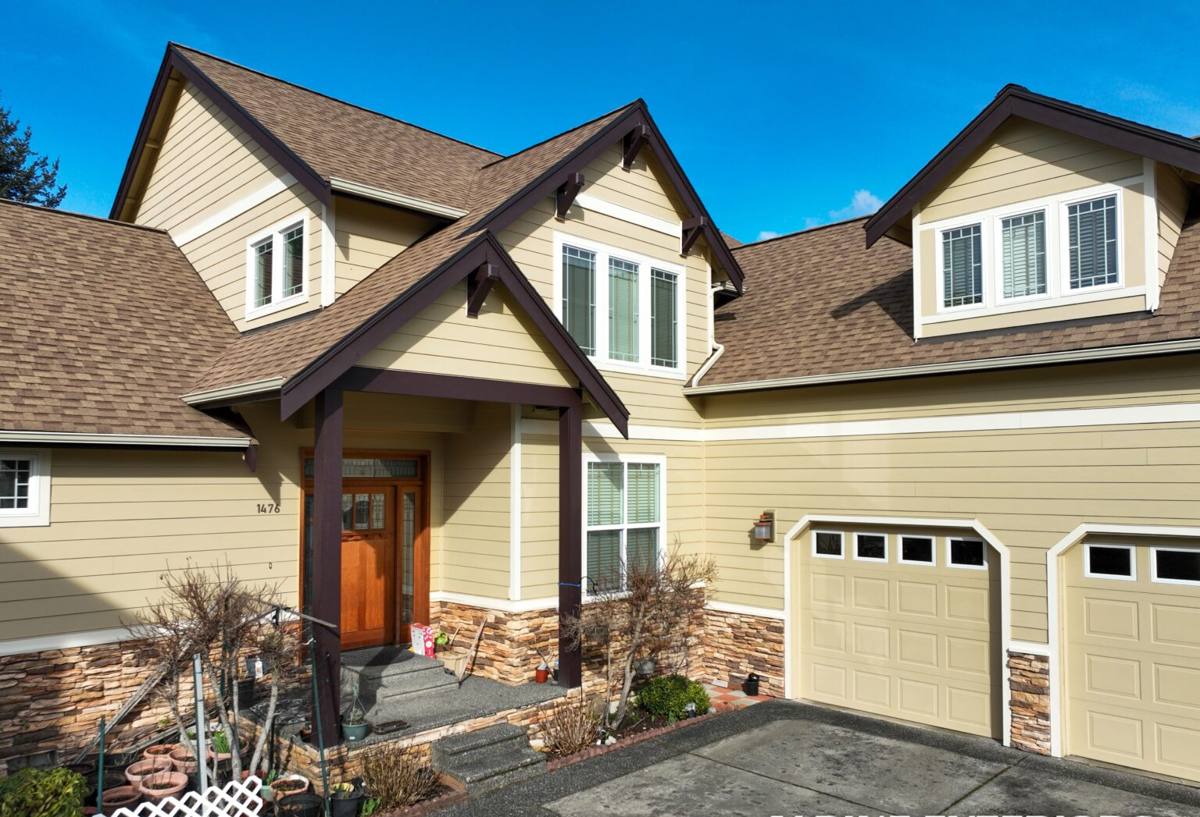
Why We Install Only James Hardie in This Area
We standardized on James Hardie fiber cement for every job we do, including here in South Hill, and we don't install vinyl, LP SmartSide, Cemplank, Allura, or unprimed wood siding. That's not a marketing position — it's a decision built around what actually holds up in this climate without turning into an ongoing maintenance project for the homeowner.
Fiber cement is non-combustible, dimensionally stable when it gets wet and dries out repeatedly, and it doesn't feed moss and mildew the way wood-based products can. James Hardie's HZ5 product line is specifically engineered for the Pacific Northwest's moisture and temperature cycling, which is the exact stress pattern South Hill homes deal with for most of the year.
ColorPlus Finish vs. Field-Applied Paint
Most of the color problems we see on older siding — fading, chalking, peeling at the laps — trace back to field-applied paint that was never going to hold up to years of driving rain and UV exposure. James Hardie's ColorPlus finish is baked on at the factory in a controlled process, which gives it better adhesion and UV resistance than a coat of paint applied on-site, and it comes backed by its own finish warranty separate from the substrate warranty. That's a meaningfully different proposition than "siding you'll need to repaint in eight to ten years."
What a Correct James Hardie Installation Actually Involves
The siding material is only part of the equation. Most of the failures we get called out to inspect on other companies' work aren't Hardie's fault — they're installation shortcuts that let water get behind the material or trap it there. In a climate like this one, those shortcuts fail faster than they would somewhere drier.
Water Management Behind the Cladding
- A drainage plane (weather-resistive barrier) installed correctly, with proper laps, so water that gets past the siding has somewhere to go besides your sheathing
- Flashing at every window, door, and horizontal trim transition — not caulk used as a substitute for flashing
- Kick-out flashing at roof-to-wall intersections, which is one of the most commonly missed details and one of the most damaging when it's skipped
- Proper clearance between the bottom of the siding and roof lines, decks, and grade, per James Hardie's published minimums
- Rain screen or furring strategy where wall assembly and exposure call for it, to let the wall breathe and dry
Fastening and Fit
James Hardie publishes specific fastener types, spacing, and placement requirements, and they vary by product line and exposure. Blind-nailing where it's called for, correct fastener penetration into framing, and proper joint treatment at butt seams all affect how the siding performs over time — not just how it looks on installation day. Panels cut and fit tight with the manufacturer's expansion gaps, not jammed corner to corner, hold their caulk lines and paint lines far longer.
| Detail | Why It Matters Here |
|---|---|
| Weather-resistive barrier laps | Wind-driven rain finds gaps; correct shingle-lap sequencing keeps water moving down and out |
| Kick-out flashing | Prevents concentrated runoff from soaking wall cavities at roof intersections — a common rot starting point |
| Bottom clearance from grade/decks | Keeps siding out of standing moisture and splash-back, especially during long wet stretches |
| Fastener spec and placement | Under-driven or over-driven nails and wrong spacing lead to cracking and loosening under wind load |
| Caulking at trim, not at flashing gaps | Caulk is maintenance-dependent; it's a finish detail, not a substitute for proper flashing |
Our Process for South Hill Homes
- Walkthrough and assessment — we look at your current siding, trim, and any problem areas (staining, soft spots, moss buildup), and check what's happening behind the surface where we can access it.
- Scope and product selection — HardiePlank lap siding, HardiePanel, or HardieShingle depending on your home's style, plus trim and accessory matching.
- Written estimate — a clear breakdown of materials, labor, and any additional work the assessment turned up (rot repair, flashing corrections, etc.), no surprise add-ons mid-job.
- Prep and removal — old siding removed, sheathing inspected and repaired where needed before anything new goes on.
- Weather barrier and flashing install — the part of the job that determines how the wall performs for the next 30-plus years, done to manufacturer and code spec.
- Hardie installation — panels, fastening, and trim installed to James Hardie's published specifications for this climate zone.
- Final walkthrough — we go over the finished work with you before calling the job done.
Cost Factors for a South Hill Siding Project
Every home is different, and we don't quote a price without seeing the house, but these are the factors that actually move the number:
| Factor | How It Affects Cost |
|---|---|
| Current siding removal | Multiple layers or damaged sheathing underneath add labor and repair time |
| Home size and wall complexity | More corners, dormers, and trim details mean more cutting and detail work |
| Product line chosen | HardiePlank, HardiePanel, and HardieShingle have different material and labor costs |
| Underlying repairs | Rotted sheathing or framing found during removal needs to be fixed before new siding goes on |
| Trim and accessory scope | Full trim replacement to match new siding versus reusing sound existing trim |
| Access and site conditions | Steep lots, tight setbacks, or limited staging area affect labor time |
Signs Your Siding Is Losing the Fight with the Climate
Homeowners often wait too long because the damage isn't obvious from the street. Here's what to check, especially on north- and west-facing walls:
- Soft or spongy spots when you press on the siding, particularly near the bottom courses
- Dark streaking or persistent moss/algae growth that pressure washing only removes temporarily
- Visible cupping, warping, or gaps opening up at seams and corners
- Paint that's chalking, peeling, or has needed repainting more than once in the last decade
- Staining or bubbling on interior walls near exterior corners, which can point to moisture getting in behind the siding
- Fastener heads showing rust streaks or backing out of the surface
Why a Crew That Already Works This Area Matters
Installation details that are optional in a dry inland climate aren't optional here. A crew that's worked houses throughout Whatcom County already knows which wall orientations need extra attention, how much clearance to leave given the rain patterns, and where moss tends to establish itself on local homes. That's the difference between a generic install that meets code on paper and one that's actually set up to handle what this specific area throws at it year after year.
It also matters for warranty support. James Hardie's warranty coverage depends on the product being installed to their specifications — a crew unfamiliar with those specs, or unfamiliar with how to adapt them to marine exposure, is more likely to create the kind of installation gaps that void coverage or cause early failures that aren't covered at all.
Caring for James Hardie Siding After Installation
One advantage of switching to fiber cement is how little ongoing maintenance it asks for compared to wood or vinyl. That said, "low-maintenance" isn't "no-maintenance":
- Rinse the siding once or twice a year to clear pollen, salt residue, and early moss growth before it takes hold
- Keep gutters clear and downspouts directed away from the wall to reduce splash-back and sustained wetting
- Trim back vegetation and shrubs that hold moisture against the siding or block airflow
- Re-caulk trim joints as needed over the years — caulk is a maintenance item even on a well-installed system
- Have any impact damage or corner separation repaired promptly rather than left to let moisture in
If your siding is showing its age, or you're planning ahead for a project, we're happy to take a look and walk you through what your home actually needs — no pressure, no upsell. Reach out for a free estimate using the form below.