 Whatcom County
 Why Blaine's Location Is Hard on Siding
Blaine sits right against the water at the northern edge of Whatcom County, and that location comes with a particular kind of weather stress most inland siding never has to deal with. Salt-laden air blowing off the water works its way into fastener heads, seams, and any spot where a coating has thinned or worn through, accelerating corrosion and finish breakdown in ways that don't show up on a home twenty miles inland. Add in driving rain that comes in sideways during winter storms, and water gets pushed into laps, joints, and trim intersections that were never designed to handle wind-driven moisture.
Then there's moss. Whatcom County's long wet season means north-facing walls, areas under eaves that don't get sun, and anything shaded by trees or fences stay damp for months at a time. Moss doesn't just look bad — it holds moisture against the siding surface far longer than open air would, and that constant dampness is exactly what breaks down caulking, primer, and the wood or fiber substrate underneath if the siding isn't sealed and installed correctly in the first place.
None of this means siding in Blaine is doomed to fail. It means repairs here have to account for salt exposure, wind-driven rain, and moss retention specifically — not just patch the visible damage and hope it holds.
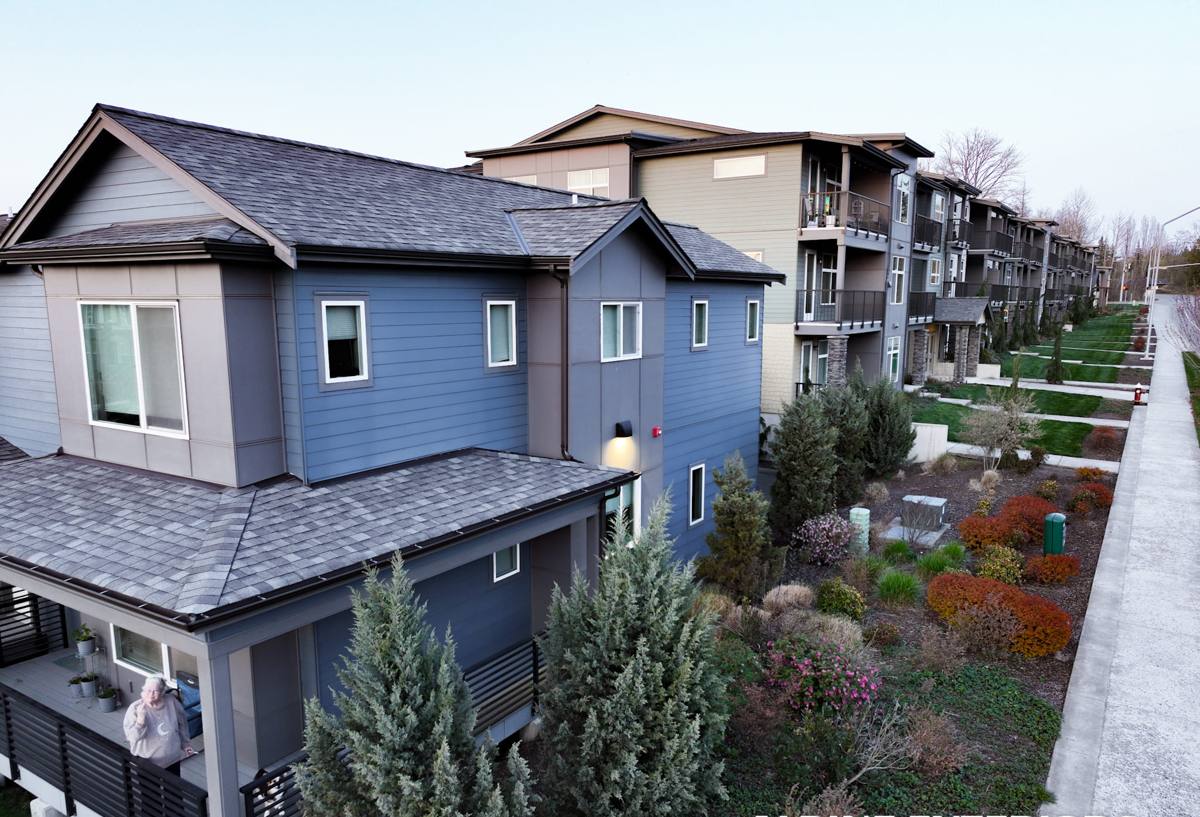
Signs Your Siding Actually Needs Repair
Most homeowners call about a repair after they've noticed something visually obvious, but by the time siding damage is easy to see, moisture has often been getting behind it for a while. Here's what we look for, and what you can check yourself before calling anyone:
- Soft or spongy spots when you press on the siding, especially near the bottom courses, around window and door trim, and at any point where two materials meet
- Visible cracking or splitting, particularly after a hard freeze or a stretch of driving rain
- Paint or finish that's bubbling, peeling, or chalking in patches rather than evenly across the wall — uneven wear usually means moisture is trapped in that specific area
- Persistent moss or dark staining that comes back within weeks of being cleaned off
- Gaps opening up at seams, corners, or trim joints where caulking has shrunk, cracked, or pulled away
- Rust streaking from fastener heads, which is common near the water and usually means the fasteners weren't corrosion-rated for a coastal environment
- Warping or buckling boards, which often points to moisture trapped behind the siding rather than a surface problem
If you're only seeing one or two of these on a small section, it's very likely a legitimate repair rather than a full re-side. If you're seeing several of these spread across multiple walls, that's usually a sign of a systemic moisture or installation issue that a spot repair won't actually fix.
What a Correct Repair Actually Involves
A repair that's done right is not just "cut out the bad board and nail in a new one." That approach might make the wall look fine for a season, but if the underlying cause isn't addressed, the same spot fails again — often worse, because the surrounding material has now had extra time to absorb moisture too. A repair worth paying for includes:
Finding the actual cause
Before anything gets replaced, we look at why that section failed. Was water getting behind the siding through a bad seal at a window or door? Is a downspout dumping water directly onto that wall? Is there no gap for drainage behind the siding, so moisture just sits there? Replacing the board without answering that question means the repair is temporary.
Checking what's behind the siding
Once boards are pulled, we check the house wrap or weather-resistive barrier, the flashing at any penetrations, and the sheathing underneath for rot or soft spots. In a climate with Blaine's rain exposure, it's common to find that the visible siding damage is smaller than the moisture damage hiding behind it.
Matching material and finish, not just color
A patch that's close in color but a different material, thickness, or finish stands out immediately and often behaves differently in weather — expanding, contracting, or absorbing moisture at a different rate than the original siding. Matching properly matters more with fiber cement than with most materials, because factory-applied finishes have a specific texture and sheen that field-applied paint doesn't fully replicate.
Sealing and flashing details, not just the board itself
Most siding failures we see near the water trace back to a flashing or sealant detail, not the siding material itself. A correct repair re-does those details — proper flashing laps, correctly oriented drip edges, sealant only where it belongs — rather than just caulking over the gap and calling it finished.
Repair or Replace? How We Make That Call
Not every damaged section needs a full re-side, and we're not going to tell you it does. But there are situations where a repair is genuinely the wrong call — it costs money now and again in a year or two when the underlying problem resurfaces. Here's how we think about it:
| Situation | Usually a Repair | Usually Points to Replacement |
|---|---|---|
| Damage location | Isolated to one or two sections | Spread across multiple walls or elevations |
| Cause of damage | A single identifiable source (a bad seal, one damaged board) | A systemic issue — no drainage gap, widespread failed fasteners, original install defects |
| Age and material of existing siding | Newer siding, same material still available and in good condition elsewhere | Older siding nearing the end of its service life, or a material we'd advise against reinstalling |
| Moisture behind the siding | Localized, sheathing largely sound | Rot or moisture damage found in multiple areas once boards are opened up |
| What's currently installed | James Hardie fiber cement in otherwise good shape | Vinyl, LP SmartSide, cedar, or primed spruce that's failing due to inherent maintenance or moisture issues, not just one bad spot |
That last row matters. We only install James Hardie fiber cement siding, so if what's on your home now is a different material and it's failing broadly rather than in one isolated spot, we'll tell you honestly that a repair is a short-term fix, and walk you through what full replacement with Hardie would look like and why — not because the other material is worthless, but because we've seen how those materials perform over time in exactly this climate, and we don't want to sell you a patch job we don't believe will hold.
Our Siding Repair Process in Blaine
- On-site inspection. We look at the damaged area and the surrounding wall, check for moisture with a meter where it matters, and identify what's actually causing the problem — not just what's visible.
- Honest diagnosis. We tell you what we found, including if it's more extensive than what prompted the call, and what a proper fix requires. If it's a small job, we say so.
- A clear plan and price. You get a written scope before any work starts — what's being removed, what's being replaced, what flashing or sealant work is included, and what it costs.
- Careful removal. Damaged material comes off without unnecessarily disturbing sound siding around it, and we check the house wrap and sheathing underneath as we go.
- Correcting the cause, not just the symptom. Flashing, drainage gaps, and sealant details get fixed as part of the repair, not skipped to save time.
- Matched materials and finish. Replacement boards are matched for profile, exposure, and finish so the repair blends in rather than standing out as an obvious patch.
- Cleanup and a final walk-through. We clear debris and walk the repair with you before we consider the job done.
What Repairs Typically Cost — and What Drives the Price
We're not going to quote a number that doesn't mean anything without seeing the house, but here's what actually moves the price on a siding repair, so you know what you're paying for when you get a quote:
| Cost Factor | Why It Matters |
|---|---|
| Extent of hidden damage | If the sheathing or house wrap needs repair once boards are opened up, that adds material and labor beyond the visible siding |
| Height and access | A second-story repair near a roofline or over a deck takes more time and equipment than a ground-level wall |
| Matching existing material | Sourcing the correct fiber cement profile, exposure width, and color match takes more effort than a generic patch |
| Flashing and trim work involved | Repairs that require redoing flashing at a window, door, or roofline take longer than a straight board swap |
| Number and location of damaged sections | Several small repairs scattered across a house often cost more in total labor than one larger contiguous section |
As a general rule, an isolated board repair with no hidden moisture damage is a modest, half-day-or-less job. Repairs that turn up rotted sheathing, failed flashing, or damage behind multiple courses take longer and cost more — which is exactly why we open things up and look before quoting a firm price rather than guessing from the driveway.
Why It Matters That We Already Work in Blaine
A repair crew that only occasionally works this far north treats every job as a one-off. A crew that regularly works Blaine and the surrounding Whatcom County coastline already knows which wall orientations take the worst wind-driven rain, where moss builds up fastest given the tree cover and shade patterns common here, and which flashing and fastener choices actually hold up against salt exposure over years, not just at installation. That's not a marketing point — it changes what gets checked during an inspection and what gets specified in the repair.
It also means we're not guessing at what's "normal" for a house on this stretch of coastline versus what's an actual defect. Some wear is expected here; some is a sign the original installation missed something. Knowing the difference is what keeps you from either overpaying for unnecessary work or underpaying for a fix that won't last through next winter.
Keeping Moss and Moisture From Coming Back After a Repair
A correct repair should hold, but a few habits make a real difference in a climate like this one:
- Keep gutters clear so water isn't overflowing directly onto siding below
- Trim back vegetation and tree limbs that keep a wall shaded and damp longer than it needs to be
- Rinse moss and organic buildup off siding before it has a chance to establish, rather than after it's already staining the surface
- Check caulking at trim and penetrations once a year — it's a five-minute look that catches small gaps before they become water intrusion
- Watch downspout discharge points to make sure water is being carried away from the foundation and lower siding courses, not dumped against them
What We Use for Repairs, and Why
We only install and repair with James Hardie fiber cement siding. It's non-combustible, holds its factory-applied ColorPlus finish far longer than field-applied paint, and the HZ5 product line is engineered specifically for the freeze-thaw and moisture conditions common in the Pacific Northwest. When we're matching into existing Hardie siding, that consistency in material and finish is straightforward. When a repair involves a different material — vinyl, LP SmartSide, cedar, or primed spruce — we'll still do honest work, but we'll also tell you plainly if what's failing is a limitation of that material in this climate rather than something a patch will permanently solve, and what replacing that section or the whole wall with Hardie would involve. We'd rather give you that information upfront than have you pay twice.
If you're dealing with damaged, cracking, or moss-stained siding on a Blaine home, we're happy to take a look and give you a straight answer about what it needs — whether that's a targeted repair or something more. The estimate is free, there's no pressure attached to it, and you'll walk away knowing exactly what's going on with your siding either way.