 Whatcom County
 Why Decks Wear Out Faster in South Hill
South Hill sits close enough to Bellingham Bay that salt-laden air is a real factor in how fast exterior materials break down, and it gets the same long, wet stretch of fall-through-spring weather as the rest of Whatcom County. That combination is hard on decks in ways that don't show up right away. A deck that looks fine from a distance can have soft framing, corroding hardware, or trapped moisture underneath the boards long before the surface tells you something is wrong.
We've replaced enough decks in this area to know the failure pattern is rarely one big thing. It's usually a slow accumulation: standard fasteners corroding faster than they should near the water, moss and algae holding moisture against wood that never fully dries between rains, and ledger connections that were never properly flashed to begin with. By the time boards are visibly cupping or the structure feels spongy underfoot, the damage has usually been building for a few seasons.
Salt Air and Hardware
Homes on South Hill get more airborne salt exposure than inland Whatcom County properties. Standard electro-galvanized screws and bolts corrode noticeably faster in that environment, which weakens connections at the exact points — ledger boards, joist hangers, post bases — where deck failures actually start.
Moss, Algae, and Trapped Moisture
Whatcom County's long moss season isn't just a cosmetic problem. Moss and algae hold water against decking and framing well after a storm has passed, which keeps wood wet for extended stretches and accelerates rot, especially in shaded areas or spots with poor airflow underneath.
Driving Rain and Water Intrusion
Wind-driven rain off the bay pushes water sideways into gaps, seams, and ledger connections that a straight-down rain would never reach. Over time this finds any weakness in flashing or board spacing and drives moisture into places it shouldn't be.
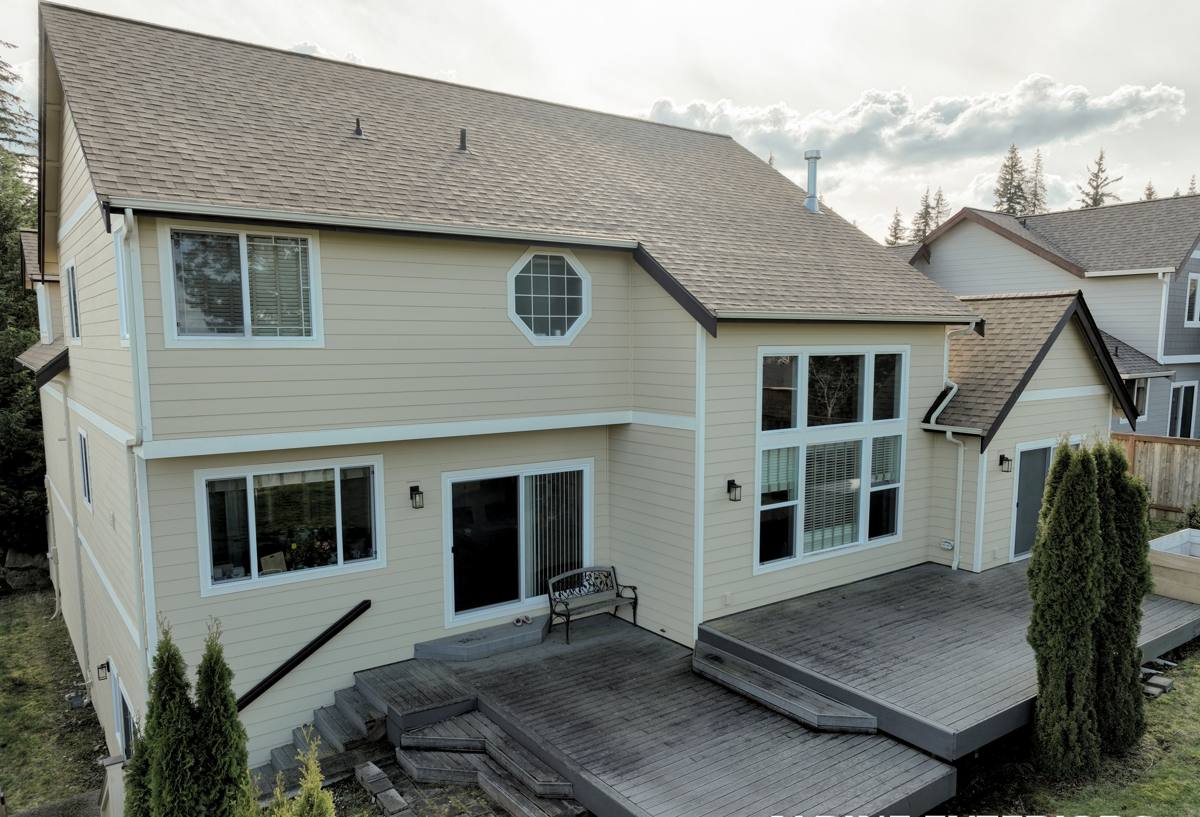
Signs a Deck Needs Replacement, Not Just Repair
Not every tired-looking deck needs a full teardown. But there's a point where patching individual boards is just delaying a bigger, more expensive problem — and sometimes creating a safety issue in the meantime. Here's what tells us a deck has crossed that line:
- Soft, spongy, or bouncy spots in the decking or framing underfoot
- Visible rot or discoloration at the ledger board where the deck meets the house
- Rusted, loosened, or missing structural fasteners and joist hangers
- Posts that wobble or show rot at the base where they meet concrete footings
- Persistent moss or algae growth that returns within weeks of cleaning
- Gaps opening up between boards or boards that have cupped or split
- A railing that flexes more than it should when leaned on
- A deck older than 15-20 years that has never had major structural work
If you're seeing two or more of these, it's worth having someone look at the framing underneath, not just the surface boards.
What a Correct Deck Replacement Actually Involves
A deck replacement done right isn't just swapping old boards for new ones. The parts nobody sees — the framing, the flashing, the connections — are what determine whether the new deck lasts 10 years or 25 in this climate.
Framing and Structural Connections
We start below the surface: ledger board attachment and flashing, joist spacing and condition, post and footing integrity, and hardware. In a climate with this much rain and salt exposure, corrosion-resistant structural screws and hangers rated for treated lumber and coastal exposure aren't an upgrade — they're the baseline we build to.
Ledger Flashing
The ledger board connection where the deck attaches to the house is the single most common source of hidden rot we find on older decks in this area. Proper flashing here — installed so water sheds away from the house rather than behind the ledger — is one of the details that separates a deck that lasts decades from one that rots from the inside out within a few years.
Decking Material and Fastening
Board spacing, fastener choice, and ventilation underneath all affect how well a deck sheds the kind of driving rain and standing moisture common here. We also account for drainage and airflow under the deck itself, since trapped moisture underneath is what feeds moss and rot even when the top surface looks dry.
Choosing the Right Decking Material for This Climate
There's no single "best" decking material — each comes with real trade-offs in maintenance, upfront cost, and how it behaves in a wet, salty, moss-prone environment. We'll walk through the honest pros and cons for your project rather than push whatever has the best margin.
| Material | Upfront Cost | Maintenance | Moisture/Moss Behavior |
|---|---|---|---|
| Pressure-treated wood | Lowest | Annual cleaning and periodic sealing/staining | Prone to moss growth and rot if maintenance lapses |
| Cedar | Moderate | Regular sealing to maintain color and water resistance | Naturally rot-resistant but still needs upkeep in constant damp |
| Capped composite | Higher | Occasional washing, no staining or sealing | Resists moisture absorption well; still needs airflow underneath to discourage moss |
| PVC decking | Highest | Lowest — periodic washing only | Doesn't absorb water, most resistant to rot and moss staining |
Composite and PVC products cost more upfront but shift the ongoing burden away from annual maintenance, which matters in a climate where a skipped sealing season can undo a lot of progress. Wood costs less to install but only holds up here if someone stays on top of cleaning and sealing every year. We'll be straight with you about which trade-off fits your budget and how much upkeep you actually want to do.
Our Deck Replacement Process
- On-site assessment. We inspect the existing deck's framing, ledger connection, footings, and hardware condition before quoting anything, since the framing condition drives most of the cost.
- Honest scope and estimate. You get a clear breakdown of what needs replacing structurally versus cosmetically, with material options and their real trade-offs explained.
- Permitting. We handle the paperwork for any work that requires local permitting, so you're not left figuring out jurisdiction requirements on your own.
- Demolition and disposal. Full removal of the old structure down to sound framing or footings, with debris hauled off site.
- Framing and structural work. Ledger flashing, joist and post work, and hardware upgraded to corrosion-resistant fasteners suited to this climate.
- Decking installation. Boards, railing, and fasteners installed to your chosen material's spec, with attention to spacing and drainage.
- Final walkthrough. We go over the finished deck with you, including care and maintenance guidance specific to the material you chose.
Permits and Code Considerations
Deck replacement work in Whatcom County can require a permit depending on the deck's height, size, and whether structural elements like footings or ledger attachment are being changed — rules that vary by whether a property falls under county or a local municipality's jurisdiction. Guardrail height, baluster spacing, and footing depth for our frost conditions are the kinds of details that get checked. We pull and manage the permit as part of the job so you don't have to interpret code language yourself, and so the finished deck passes inspection the first time.
What Drives the Cost of a Deck Replacement
Deck replacement costs vary widely based on size, material, and how much structural work is needed — a straightforward wood-to-wood swap on sound framing costs meaningfully less than a full teardown with rotted framing and an upgrade to composite. Rather than quote a number that doesn't apply to your situation, here's what actually moves the price:
| Factor | Why It Matters |
|---|---|
| Deck size and layout | Square footage and complexity (multiple levels, stairs, angles) directly drive material and labor |
| Framing condition | Rotted joists, posts, or footings add cost beyond the visible decking |
| Material choice | Wood, composite, and PVC span a wide cost range per square foot |
| Railing style | Cable, glass, or custom railing costs more than standard baluster railing |
| Height and access | Elevated decks or difficult site access add labor time |
| Permit requirements | Structural changes may require engineering or additional inspections |
We give a firm, itemized estimate after seeing the actual site and framing condition — not a rough number pulled from a phone call.
Why Hire a Crew That Already Works South Hill
Building or replacing a deck in South Hill isn't the same job as doing it twenty miles inland. A crew that already works this part of Whatcom County knows to spec corrosion-resistant hardware without being asked, knows how much airflow a deck needs underneath to fight off the local moss cycle, and has already dealt with the specific permitting process for this area. That familiarity shows up in fewer surprises during the job and a deck that's actually built for the conditions it'll sit in, not a generic spec sheet.
Maintaining Your New Deck in This Climate
Whatever material you choose, a few habits go a long way toward getting the full lifespan out of a South Hill deck:
- Sweep debris and standing leaves off the deck regularly, especially in fall
- Keep gutters and downspouts near the deck clear so runoff doesn't pool against it
- Wash off moss and algae as soon as it appears rather than letting it establish
- Reseal wood decking on the schedule your material calls for — don't stretch it another season
- Check railing and stair connections annually for looseness
- Make sure vegetation isn't blocking airflow underneath or against the deck
If you're weighing whether your current deck needs repair or full replacement, or you're ready to plan a new one built for South Hill's weather, we're happy to take a look and give you a straightforward, no-pressure estimate — just fill out the form below.