 Whatcom County
 Building a Deck That Can Handle Edgemoor's Weather
Edgemoor sits close to the water, under a heavy canopy of mature trees, and squarely inside Whatcom County's wet, marine climate. That combination is tough on outdoor living spaces. Salt-laden air off Bellingham Bay accelerates corrosion on hardware and fasteners. Driving rain finds its way into every gap, seam, and end-cut that isn't properly sealed. And the shade from all those trees means a long moss season — decks here stay damp longer than decks in more open, sunnier parts of the county, giving algae and moss more time to take hold before summer dries things out.
None of that is a reason to avoid building a deck in Edgemoor. It's a reason to build it correctly, with materials and details chosen for this specific microclimate rather than a one-size-fits-all approach pulled from a warmer, drier region. That's the difference between a composite deck that still looks good in fifteen years and one that develops black streaking, soft spots, or fastener staining within the first few winters.
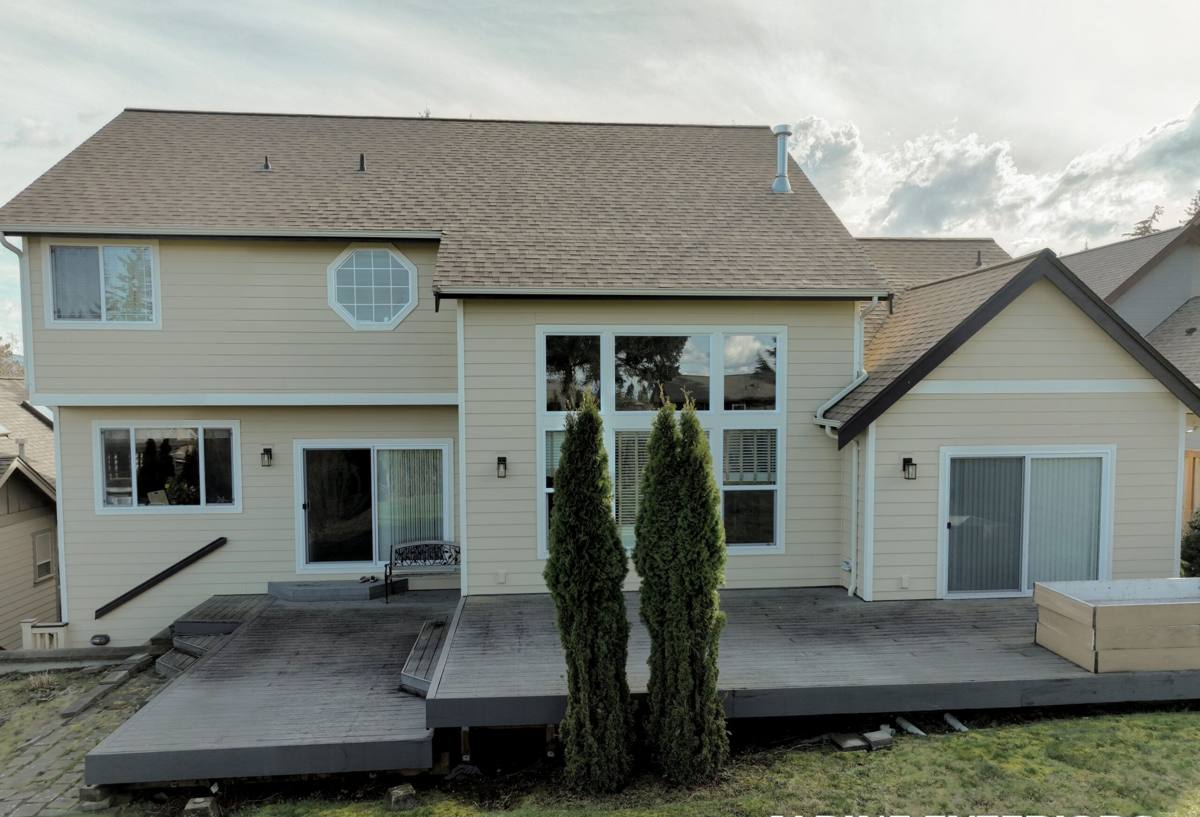
Why Composite Decking Is a Strong Fit for This Neighborhood
Waterfront and near-waterfront exposure
Homes close to Bellingham Bay deal with salt air, wind-driven rain, and constant humidity swings that natural wood struggles to handle without frequent refinishing. Composite decking doesn't absorb moisture into its fibers the way wood does, so it isn't prone to the cupping, splintering, and grey weathering that salt air speeds up in cedar or fir decking.
Shade, tree cover, and moss pressure
A lot of Edgemoor's character comes from mature trees — and those same trees drop needles, leaves, and pollen onto deck surfaces while blocking the sun that would otherwise dry things out. Capped composite boards resist moisture absorption into the board itself, which limits — though doesn't eliminate — the surface conditions that let moss and algae get a foothold. Wood decking in the same spot typically needs yearly cleaning, brightening, and re-sealing just to keep organic growth in check.
Composite isn't maintenance-free — nothing outdoors in Whatcom County is — but it removes the wood-specific failure points, like rot, splintering, and warping, that shade and salt air make worse.
What a Correct Composite Deck Installation Actually Involves
Composite boards are only as good as what's underneath them. Most of the deck problems we get called out to inspect in this area trace back to substructure and detailing mistakes, not the decking material itself.
- Ledger flashing: Where the deck attaches to the house, proper flashing keeps rain from tracking behind the siding and into the wall assembly — a real risk given how much wind-driven rain the area sees off the bay.
- Joist tape: Pressure-treated joists still absorb water at fastener penetrations. Taping the tops of joists before decking goes down keeps moisture out of the wood and extends the life of the frame underneath your composite boards.
- Board spacing and airflow: Composite boards need consistent gapping for drainage and expansion. Too tight, and water pools on the surface and boards can buckle with temperature swings. Too loose, and debris and moisture collect between boards, feeding moss growth.
- Fastener choice: Salt air corrodes standard steel fasteners over a few seasons. We use hardware rated for coastal exposure so you don't end up with rust streaking through light-colored composite boards.
- Ventilation underneath: Composite doesn't rot, but the framing underneath it can if airflow is blocked. Skirting and low-clearance decks need vents or gaps designed in from the start.
Composite Board Types We Install
Not all composite decking is built the same way, and the right choice depends on your budget, how much sun or shade the deck gets, and how close you are to the water.
| Board Type | Moisture & Moss Resistance | Typical Lifespan | Best Fit |
|---|---|---|---|
| Uncapped composite | Fair — surface can absorb some moisture over time | 15-20 years | Budget-conscious, sunnier or drier lots |
| Capped composite | Strong — polymer shell resists staining and moisture | 20-30 years | Most Edgemoor homes, especially shaded or waterfront lots |
| PVC / cellular composite | Excellent — no wood fiber content to absorb moisture | 25-30+ years | Heavy shade, dock-adjacent, or high-moss conditions |
We don't push one brand or tier on every job. What we push is matching the board to the site conditions — a sun-exposed deck on a more open lot can often perform fine with a mid-tier capped composite, while a shaded, tree-heavy lot close to the water usually justifies stepping up to a fully capped or PVC product to keep moss and staining under control long-term. We'll walk you through the actual product lines available at the time of your estimate rather than quote you a brand off a brochure.
Moss, Algae, and Salt: What Edgemoor Decks Are Up Against Long-Term
Even the best composite board will develop some surface film in a shaded, damp spot — that's biology, not a product defect. What matters is how easy that film is to remove and how well the deck was built to shed water in the first place.
A few things we see cause avoidable moss and algae buildup on decks in this area:
- North-facing or heavily shaded decks that rarely get direct sun
- Boards installed tight against siding or landscaping with no airflow gap
- Debris such as needles, leaves, and seed pods left to accumulate in board grooves
- Low-clearance decks with no ventilation underneath
Salt air adds a second layer to this: it doesn't feed moss, but it does corrode unprotected metal — railings, fasteners, post bases — faster than in inland parts of the county. We spec hardware and railing systems rated for coastal exposure on Edgemoor jobs by default, not as an upsell.
Our Process, Start to Finish
- Site walk and measure: We look at sun exposure, tree cover, drainage slope, and how close the deck sits to grade or water, then measure for an accurate quote.
- Substructure check: On replacement projects, we inspect existing framing for rot or damage before deciding what can be reused and what needs to be rebuilt.
- Flashing and joist protection: Ledger flashing and joist tape go in before a single composite board is laid.
- Decking installation: Boards go down with proper gapping, hidden or face fasteners depending on the product, and attention to picture-framing and stair details.
- Railings and finish details: Coastal-rated hardware, fascia, post caps, and any stair or skirting work.
- Final walkthrough: We check every board, fastener, and edge with you before calling the job done.
Repairs We Commonly Handle on Existing Composite Decks Nearby
We also get called to fix composite decks that were installed without these details. Common issues include boards fastened too tightly that have started to buckle, joists underneath the composite that are soft or rotting because no joist tape or ventilation was used, railing posts loosening because standard hardware corroded in the salt air, and persistent staining in shaded sections where debris was never cleared from board grooves. Most of these are fixable without a full tear-off, but a few — especially rotted framing — mean pulling boards to get at the structure underneath. If your deck is a few years old and something feels off, like soft spots, movement in the railing, or standing water that won't drain, it's worth having it looked at before winter rain makes the problem worse.
Cost Factors for a Composite Deck in Edgemoor
Every deck is different, but the same handful of factors drive most of the cost variation we see on local jobs:
| Factor | Why It Matters |
|---|---|
| Board tier | Entry-level composite vs. fully capped or PVC changes material cost significantly |
| Substructure condition | Rebuilding rotted framing adds labor and material before decking even starts |
| Deck height and access | Elevated or hard-to-access lots, common near the water, take more labor |
| Railing system | Coastal-rated hardware and cable or glass railings cost more than basic composite balusters |
| Size and layout | Picture-framed borders, angles, and multiple levels add cutting and fitting time |
As a very rough starting point, installed composite decking in this region generally runs somewhere in the mid-to-upper double digits per square foot, with the final number depending heavily on the factors above. We'll give you an exact figure for your project, not a generic average, once we've seen the site.
Why Hiring a Crew That Already Works in Edgemoor Matters
A lot of composite decking problems in this area aren't material failures — they're the result of a crew applying general best practices without accounting for Whatcom County's specific conditions. A contractor who mostly works drier, sunnier regions may not default to coastal-rated fasteners, may not think to spec extra ventilation under a shaded deck, or may not flag a waterfront setback issue before it becomes a permitting headache.
We work throughout Whatcom County, including waterfront and near-waterfront neighborhoods like Edgemoor, and we build every composite deck assuming salt air, shade, and heavy rain rather than treating them as exceptions. That means the right fasteners, the right ventilation, and the right board tier from the start, not upsells added after something goes wrong.
Questions Worth Asking Before You Hire
- Do you use joist tape and proper ledger flashing on every composite deck, or only on request?
- What fastener and hardware grade do you use, given the salt air near the water?
- How do you handle ventilation on low-clearance or shaded decks?
- Can you show the difference between the composite board tiers you install, not just quote one?
- What's the manufacturer's warranty structure, and does your installation meet its requirements?
A contractor who can answer these clearly, without hesitation, is one who's actually built decks in conditions like Edgemoor's, not just decks in general.
If you're planning a new composite deck or replacing an aging wood deck in Edgemoor, we're happy to walk the site, talk through board options for your specific sun and shade conditions, and give you a clear, no-pressure estimate. Use the form below to get started.