 Whatcom County
 Fiber Cement Siding Built for Lynden's Weather
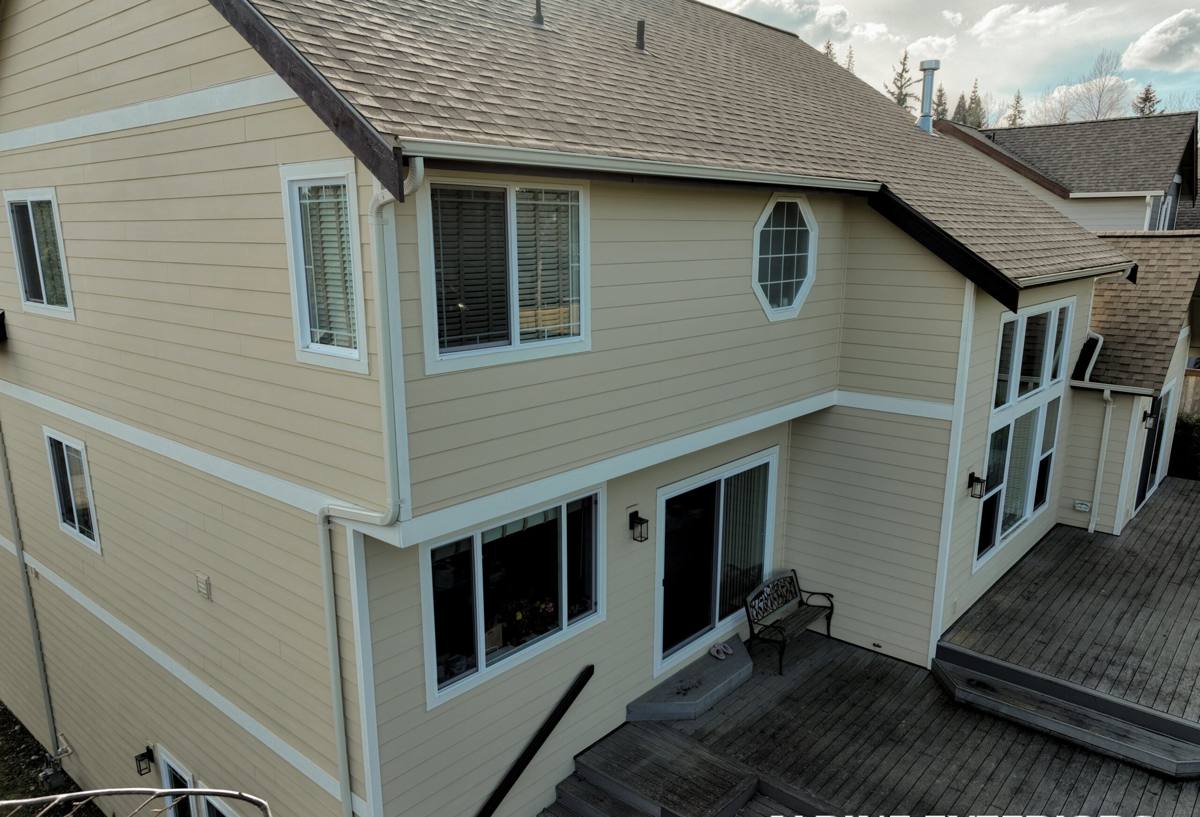
Lynden sits in a stretch of Whatcom County where the weather asks more of a house than most siding products are built to handle. Homes here take on driving rain off the Nooksack lowlands, damp marine air carrying salt from the Sound, and a moss season that can run seven or eight months out of the year on north- and west-facing walls. Siding that looks fine in a showroom in Phoenix often struggles here within a decade. Fiber cement, installed correctly, is one of the few claddings that holds up to this combination year after year without constant babying.
This page covers what fiber cement siding installation looks like specifically for Lynden homes: what the climate actually does to a wall assembly, what a correct install requires, and how our process is built around the realities of this county rather than a generic national spec sheet.
What Whatcom County's Climate Does to Siding
Driving Rain and Wind-Driven Moisture
Lynden doesn't get the heaviest rainfall totals in the county, but storms here frequently come with enough wind to push water sideways into wall assemblies rather than letting it run straight down. That matters more than total rainfall. Siding with weak seams, poor flashing details, or a manufacturer that doesn't engineer for wind-driven rain will let moisture behind the cladding long before it looks damaged from the street.
Moss, Mildew, and Prolonged Dampness
Whatcom County's moss season is long, and it's not just a roof problem. Shaded siding, especially on the north and west elevations of homes near tree lines or close-set lots, stays damp for extended stretches. Organic growth on siding isn't cosmetic — it holds moisture against the surface and, on products that aren't dimensionally stable, accelerates warping, swelling, and paint failure.
Salt Air and Coastal Influence
Lynden is inland enough that salt exposure is lighter than on the immediate coast, but Whatcom County as a whole sits close enough to the Sound that airborne salt still reaches inland properties, especially with prevailing westerly winds. Salt-laden moisture accelerates corrosion on fasteners and metal flashing and speeds up the breakdown of finishes that aren't formulated for it.
Temperature Swings and Freeze-Thaw
Whatcom County winters bring repeated freeze-thaw cycles rather than one long deep freeze. Any siding product that absorbs water expands when it freezes, and repeated cycles of that expansion are what crack caulk joints, split boards, and pop fasteners over a handful of winters.
Why Fiber Cement Specifically — and Why It Has to Be Hardie
We install James Hardie fiber cement exclusively, and we don't install LP SmartSide, vinyl, Cemplank, Allura, or raw wood siding. That's not a marketing position — it's a standard we set after weighing how each product actually performs in exactly the conditions Lynden sees.
- Non-combustible: fiber cement doesn't feed a fire the way wood-based composite products can, which matters for insurance considerations as much as safety.
- Dimensionally stable in wet climates: Hardie's fiber cement doesn't swell, cup, or delaminate the way engineered wood siding can when it stays damp for months at a time.
- Factory-baked ColorPlus finish: the finish is cured onto the board at the factory under controlled conditions, which holds color and resists fading and moss adhesion far better than field-applied paint.
- Climate-engineered HZ product line: Hardie's HZ10 formulation is specifically engineered for cold, wet, freeze-thaw climates like the Pacific Northwest — it's not a one-size-fits-all national product.
- Warranty structure: a real, transferable manufacturer warranty backs the material when it's installed to Hardie's published specifications, which protects the value of the investment if the home sells.
Vinyl is cheap and low-maintenance but it's a petroleum product that becomes brittle in cold snaps and can warp under direct afternoon sun exposure on south and west walls. LP SmartSide and other engineered-wood products perform reasonably in dry climates but are more sensitive to sustained moisture exposure than fiber cement — and sustained moisture is exactly what a Lynden winter delivers. Cemplank and Allura are also fiber cement, but we've standardized on Hardie for its finish system, engineering documentation, and consistency of supply and support in this region. Primed spruce and cedar look great on day one but require an ongoing maintenance commitment — re-staining, re-caulking, and moss treatment — that most homeowners underestimate until year three or four.
What a Correct Fiber Cement Installation Involves
Fiber cement is only as good as the installation behind it. A huge share of the siding failures we get called out to inspect in Whatcom County aren't material failures — they're installation shortcuts that let water get where it shouldn't.
Water Management Comes First
Before a single piece of Hardie board goes up, the wall needs a correctly lapped weather-resistive barrier, properly integrated window and door flashing, and a rainscreen or drainage plane appropriate to the wall assembly. On a home with the rain exposure Lynden gets, skipping or shortcutting this step is the single most common cause of hidden rot behind siding that looks perfect from the curb.
Fastening and Clearances
Hardie specifies fastener type, spacing, and placement, and those specs exist for a reason — under-driven or over-driven nails, wrong fastener material, or missing the stud will show up as cracking or streaking within a few years. Ground clearance and roof-to-wall clearances also have to meet Hardie's minimums, which matters on Lynden lots where landscaping, decks, or grade changes can crowd the bottom edge of the siding.
Joints, Caulking, and Trim
Every butt joint, corner, and trim intersection is a place water can get in if it's not detailed correctly. We follow Hardie's published joint treatment and caulking guidance rather than field-improvising, because this is exactly where DIY and low-bid installs tend to cut corners.
Painting and Touch-Up
ColorPlus finished boards come factory-cured, but field-cut edges need to be sealed with the matching touch-up product, and any site-painted trim needs a coating system rated for this climate. Skipping edge sealant is a common shortcut that leads to moisture wicking into cut ends.
Installation Quality Checklist
- Weather-resistive barrier lapped correctly, shingle-style, with no reverse laps
- Window and door flashing integrated with the barrier, not just caulked over it
- Rainscreen or drainage gap appropriate for the wall assembly
- Correct fastener type, length, and spacing per Hardie's installation instructions
- Minimum clearance maintained from grade, decks, roofing, and other hard surfaces
- All field-cut edges sealed with Hardie touch-up product
- Joints and corners detailed per manufacturer spec, not generic caulk-and-cover
- Site-applied trim and touch-up paint rated for Pacific Northwest exposure
Our Process for a Lynden Fiber Cement Project
1. On-Site Assessment
We walk the home and look at what's actually happening on each elevation — where moss and mildew are collecting, where past caulk or paint has failed, and where water may already be getting behind the existing siding. North and west walls near mature trees or tight side yards usually tell the real story.
2. Wall Assembly Review
Once existing siding is off, we inspect sheathing and framing for hidden moisture damage before anything new goes up. This is where problems from a previous installation — missing flashing, saturated sheathing — get caught and corrected rather than covered over.
3. Correct Installation to Spec
Barrier, flashing, fastening, clearances, and joint treatment are all done to Hardie's published specifications for our climate zone, not shortcuts to save a day of labor.
4. Final Walkthrough
We go over the finished work with the homeowner, including what routine maintenance (if any) is expected and how the warranty coverage works going forward.
Comparing Siding Options for a Lynden Home
| Factor | James Hardie Fiber Cement | Vinyl | Engineered Wood (LP SmartSide) | Cedar / Primed Spruce |
|---|---|---|---|---|
| Moisture tolerance in PNW winters | High — dimensionally stable | Moderate — can warp in heat/cold swings | Moderate — sensitive to prolonged wetting | Low without diligent maintenance |
| Moss/mildew resistance of finish | Strong — factory ColorPlus finish | Moderate | Moderate | Low — organic material |
| Fire performance | Non-combustible | Combustible | Combustible | Combustible |
| Ongoing maintenance | Low | Low | Moderate | High — regular re-staining/sealing |
| Manufacturer warranty (proper install) | Strong, transferable | Varies by product | Varies by product | Typically none from a manufacturer |
Cost Factors for Lynden Homes
Every home is different, so we don't quote a flat number here, but the main variables that move the price on a Lynden project are worth understanding up front:
- Existing siding removal and disposal — tear-off adds labor, especially on multi-layer or asbestos-suspect assemblies that need special handling.
- Sheathing repair — if moisture has already damaged the wall behind old siding, that repair happens before new siding goes up.
- Home size and elevation complexity — dormers, multiple gables, and tall walls all add labor time.
- Product line and profile — lap width, panel style, and trim choices affect material cost.
- Color and finish selection — factory ColorPlus finishes versus site-painted trim carry different cost and long-term maintenance trade-offs.
Why Hire a Crew That Already Works in Whatcom County
Manufacturer installation instructions set a baseline, but a crew that's worked on homes across Whatcom County knows the local wrinkles — which elevations in a Lynden neighborhood tend to hold moss longest, how much clearance really matters on a lot with heavy landscaping, and what the freeze-thaw pattern here does to a poorly caulked joint over a few winters. That local pattern recognition is what separates a siding job that looks good at handoff from one that still looks good in year fifteen.
If you're weighing a siding replacement or new construction project in Lynden, we're happy to walk the property, look at what your home's exposure actually demands, and give you a straightforward, no-pressure estimate using the form below.