 Whatcom County
 Building Decks for Happy Valley's Specific Conditions
Happy Valley sits close enough to Bellingham Bay that the air itself works against an outdoor deck. Salt-laden moisture rides in on the wind, settles into fasteners and end grain, and starts corrosion and rot long before a homeowner notices anything wrong on the surface. Add in the driving rain that comes sideways off the water during fall and winter storms, and a deck here is dealing with a combination of exposure that a deck twenty miles inland simply doesn't face.
Then there's the moss. Whatcom County's wet season runs long, and any horizontal wood or composite surface that doesn't shed water and get airflow underneath it will grow moss and algae. On a deck, that's not just cosmetic — moss holds moisture against the boards, and moisture held against boards is exactly what leads to premature rot, soft spots, and slick, unsafe footing.
None of this means a deck can't hold up well in Happy Valley. It means the build has to account for these conditions from the framing up, not just at the surface finish.
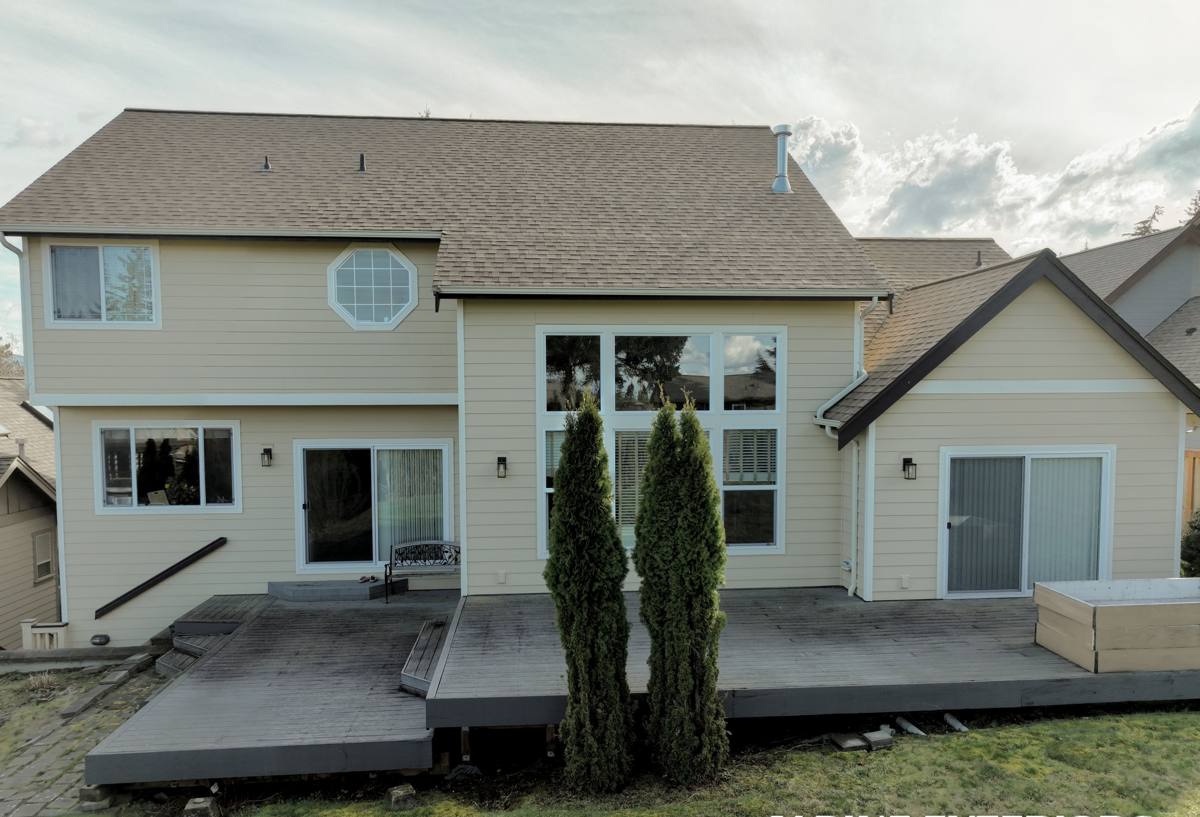
What a Happy Valley Deck Actually Needs
Shade and Tree Cover
Many Happy Valley lots have mature trees nearby, which is a big part of the neighborhood's character but also means decks often sit in partial shade for large parts of the day. Shaded, damp surfaces are where moss and mildew take hold fastest. A deck built without that in mind — tight board spacing, no airflow below, low sun exposure — will show moss within a season or two no matter what material it's made of.
Wind-Driven Rain
Rain that comes in at an angle finds its way into places vertical rain never would — under railings, behind ledger boards, into fastener heads. Flashing and sealing details that would be optional in a drier climate aren't optional here.
Ground Moisture and Soil
Whatcom County's soil holds water well into the dry months in low-lying areas, which affects how posts, footings, and ground-level framing need to be handled so they're not sitting in standing water after every storm.
Choosing the Right Decking Material
There's no single "correct" material for every deck — it depends on budget, how much upkeep the homeowner wants to do, and how much sun or shade the deck gets. Here's how the common options compare specifically against Whatcom County's wet, moss-prone conditions:
| Material | Upfront Cost | Maintenance Needed | Moisture/Moss Resistance |
|---|---|---|---|
| Pressure-treated lumber | Lowest | Regular cleaning, periodic staining/sealing | Fair — needs upkeep to stay ahead of moss and rot |
| Cedar | Mid-range | Annual cleaning and refinishing recommended | Good natural rot resistance, but surface still needs care |
| Standard composite | Mid to upper | Low — occasional washing | Good; won't rot, but surface can still grow algae/moss if shaded |
| Capped composite / PVC | Highest | Lowest — rinse as needed | Best — sealed surface resists moisture absorption and staining |
We'll walk through these trade-offs with you directly rather than pushing one product line. Real wood gives a warmer, traditional look and costs less to install, but it demands consistent maintenance to keep moss and gray weathering at bay in this climate. Capped composite costs more up front but holds up with far less homeowner effort over the life of the deck — which matters if the deck sits in shade for much of the day.
Framing and Structure: The Work You Don't See
A deck's surface material gets all the attention, but what's underneath determines whether it lasts. The framing has to be done right for the specific site:
- Ledger board attachment to the house is properly flashed so wind-driven rain can't get behind it and into the structure — this is one of the most common failure points on older decks we're asked to repair.
- Joist spacing accounts for the decking material chosen, since composite and wood have different span requirements.
- Post footings are set to reach stable, load-bearing soil below the seasonal wet layer, per what your local building department requires for the site.
- All structural hardware is rated for exterior, corrosion-prone exposure — not standard interior-grade fasteners.
Skipping or shortcutting any of this doesn't show up on day one. It shows up as soft framing, a wobbly railing, or a ledger board pulling away from the house a few years down the road — problems that cost far more to fix than to prevent.
Fasteners and Hardware Matter More Near the Water
This is one of the most overlooked details in deck building, and it's exactly where salt air does its damage. Standard galvanized fasteners that hold up fine in a dry inland climate can start corroding within a few years this close to Bellingham Bay. Corrosion around a fastener weakens its grip in the wood and can stain the surrounding board.
We use stainless steel or high-grade corrosion-resistant fasteners and structural connectors on decks in this area as our standard practice, not an upgrade option. It costs a little more than the minimum-code hardware, but it's the difference between hardware that outlasts the deck and hardware that becomes a maintenance problem in five years.
Moisture Management and Moss Prevention
Since moss and trapped moisture are the two biggest threats to a Happy Valley deck's lifespan, the build itself needs to work against both:
Airflow Underneath
Decking is installed with proper gapping and the substructure is kept clear of debris so air can move underneath the boards and dry them out between rain events. A deck built low to the ground with no ventilation underneath will stay damp far longer after every storm.
Drainage Below the Deck
Where grading allows water to pool under or near the deck, we address drainage as part of the build rather than leaving the homeowner to deal with standing water later.
Surface Slope
A very slight slope away from the house helps water shed off the deck surface instead of sitting in low spots — small in the framing, but it noticeably cuts down on the wet, mossy patches that show up on flat sections.
Our Deck Building Process
- Site walk and consultation — we look at sun exposure, tree cover, drainage, and how the deck will be used before recommending anything.
- Design and material selection — we go through the real trade-offs between wood and composite options for your specific site, honestly, based on shade and maintenance tolerance.
- Permitting — we handle the paperwork with the local building department so the structure is inspected and approved, not just built.
- Framing and structural work — footings, ledger flashing, joists, and corrosion-resistant hardware installed to hold up long-term in this climate.
- Decking, railing, and finish work — installed with proper spacing and detailing for drainage and airflow.
- Final walkthrough — we go over the finished deck and basic care with you before we consider the job done.
Maintenance Checklist for Happy Valley Deck Owners
A well-built deck still needs some seasonal attention in this climate. This is what we recommend to homeowners in the area:
- Sweep leaves and debris off the deck regularly, especially in fall — trapped organic matter is what feeds moss growth.
- Rinse or wash the surface a couple of times a year, more often in shaded areas, to keep algae and moss from establishing.
- Check fastener heads and railing connections annually for any early signs of corrosion or loosening.
- Keep gutters and downspouts near the deck clear so runoff isn't dumping extra water onto or under the structure.
- Re-stain or re-seal wood decking on the schedule recommended for the product — don't wait until it's visibly gray and dry.
- Trim back overhanging branches where possible to get more sun and airflow onto shaded sections.
Why a Crew That Already Works in Happy Valley Matters
Deck building rules and best practices don't change house to house, but the site conditions do — and a crew that already works this specific part of Whatcom County has seen how salt air, shade patterns, and wet soil actually play out on decks here, not just in a manual. That means fewer surprises during the build and a deck detailed correctly for this environment from the start, instead of learning the hard way after a callback.
We're also familiar with the local permitting process, which keeps the project moving instead of stalling on paperwork. And because we're not driving in from out of the area, follow-up if you ever have a question about your deck is straightforward.
If you're planning a new deck or replacing one that's showing its age, we're happy to walk the site with you and put together a straightforward, no-pressure estimate — just fill out the form below to get started.