 Whatcom County
 Blaine's Siding Problem Isn't Like Bellingham's
Blaine sits about as close to salt water and the Canadian border as a Whatcom County home can get, and that location changes what siding has to survive. Homes here take a combination that inland Whatcom County towns don't see nearly as much: salt-laden air off the Strait of Georgia and Semiahmoo Bay, wind-driven rain that hits siding sideways instead of running straight down it, and a wet, shaded season long enough for moss and algae to get a real foothold on north- and west-facing walls. Any one of those is manageable. All three, year after year, is what actually wears out the wrong siding material.
We install James Hardie fiber cement exclusively, and Blaine is one of the clearer cases in our whole service area for why that matters. This page is about what a correct Hardie installation looks like on a Blaine home specifically — not a generic rundown of the product.
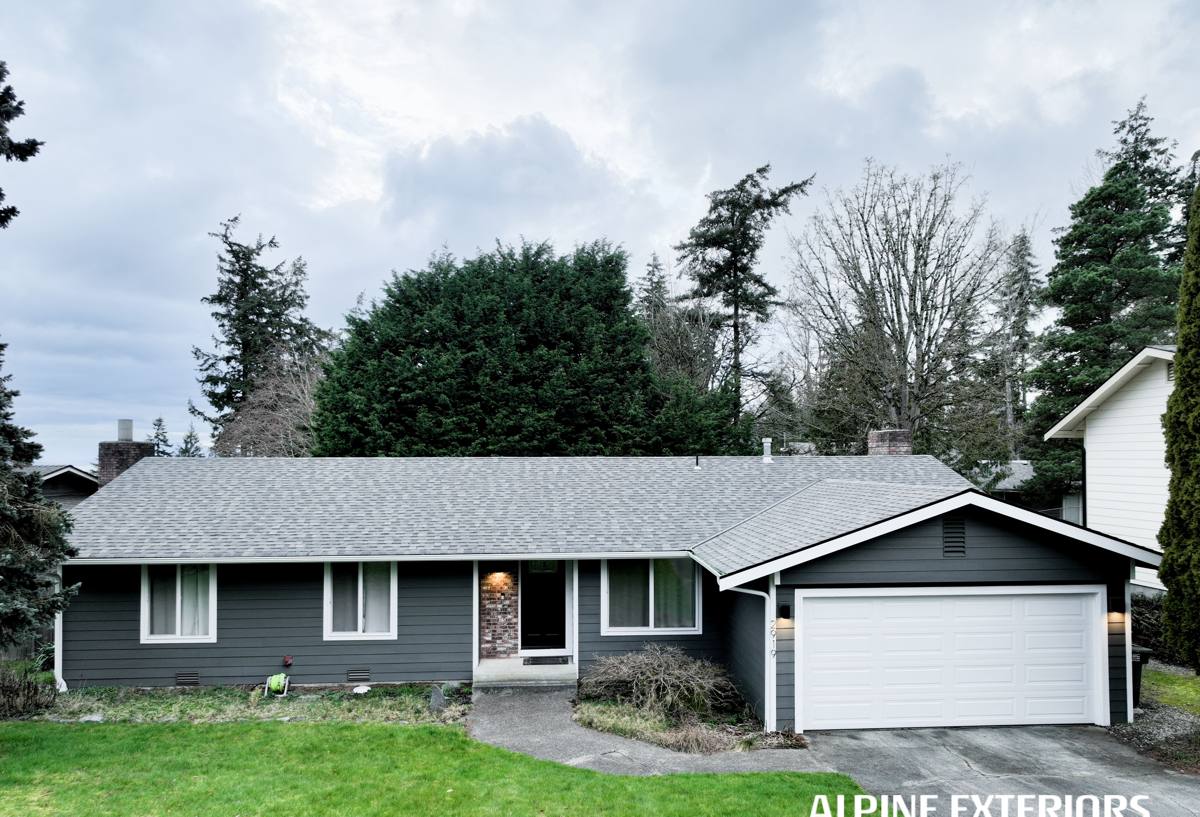
What Salt Air and Driving Rain Actually Do to Siding
Salt air
Airborne salt is corrosive to exposed metal fasteners and trim, and it's abrasive to painted finishes over time — it accelerates chalking and fading on lower-quality coatings. It doesn't rot fiber cement, but it does mean fastener choice and finish quality matter more in Blaine than they would forty miles inland.
Wind-driven rain
On an exposed lot near the water, rain doesn't just fall on siding, it's pushed into laps, seams, and butt joints. Any siding system that relies on caulk alone to keep water out of a joint will eventually let water in on a house exposed like this. The lap geometry, the flashing detail behind every joint, and the gap left for drainage matter more here than on a sheltered inland lot.
The long moss season
Whatcom County's wet season runs long, and Blaine's marine-influenced climate keeps humidity up even on days without rain. North and west elevations that stay shaded and damp for months are where moss, algae, and mildew take hold first. Siding that absorbs moisture — or that has a painted-on finish rather than a factory-cured one — feeds that growth. Siding that stays dimensionally stable and resists moisture uptake doesn't.
Why We Install James Hardie for This Environment
James Hardie fiber cement is engineered from cement, sand, and cellulose fibers — it's non-combustible and doesn't absorb water the way wood-based siding does, so it doesn't swell, cup, or rot from the kind of repeated wetting a Blaine exterior gets. Two things about the Hardie system line up directly with what this location needs:
- ColorPlus factory finish: baked on in a controlled environment, not brushed on-site — it holds color and resists the fading and chalking that salt air accelerates on field-painted products.
- HZ5 engineered product line: Hardie's climate-specific formulation for wetter, harsher-weather regions, built to hold up to repeated moisture exposure better than the standard HZ10 formulation meant for milder inland climates.
We don't install LP SmartSide, vinyl, Cemplank, Allura, primed spruce, or cedar. Each has legitimate uses elsewhere, but on a job like a Blaine coastal exterior, the trade-offs — wood-based products' moisture sensitivity, vinyl's tendency to warp and fade under UV and temperature swings, or the inconsistency of field-applied paint over engineered wood joints — are exactly the failure points this climate is built to find. We standardized on Hardie because it's the one product we can put on a home here and stand behind for the long haul.
What a Correct Installation Involves
The material is only half the equation. A Hardie installation done wrong will still leak, still stain, and still fail early — on a site like Blaine, sloppy installation gets exposed faster than almost anywhere else in the county.
Water management behind the siding
Correct installation starts with a drainable weather-resistant barrier and rainscreen gap, not siding fastened directly to sheathing. That gap lets any water that does get past the cladding drain and dry instead of sitting against the wall assembly — critical when wind is driving rain into every lap.
Flashing at every penetration
Windows, doors, hose bibs, light fixtures, and vents all need proper flashing integrated with the water-resistant barrier before siding goes on. On an exposed Blaine lot, a missed flashing detail at a window head is where water intrusion starts.
Fastener and clearance details
Corrosion-resistant fasteners, correct nailing patterns per Hardie's fastening schedule, and proper clearance from grade, roofing, and decks all matter more where salt air is in play. So does keeping the minimum gap between siding and any adjacent hardscape or roofline, so water and debris don't sit against the bottom edge.
Joint treatment
Butt joints get flashed or sealed per Hardie's published details, not just caulked and painted over. Caulk is a wear item; a properly flashed joint isn't dependent on it.
| Factor | Why it matters in Blaine |
|---|---|
| Rainscreen gap | Lets wind-driven rain that penetrates the cladding drain and dry instead of sitting against sheathing |
| HZ5 product formulation | Engineered for higher-moisture climates versus standard inland formulations |
| Factory ColorPlus finish | Resists salt-air fading and chalking better than field-applied paint |
| Flashing at penetrations | Prevents the leak points that show up first on exposed, wind-loaded walls |
| Corrosion-resistant fasteners | Salt air accelerates corrosion on the wrong fastener type |
Why Hiring a Crew That Already Works Blaine Matters
Siding installation quality is inconsistent industry-wide, and it's not usually the material at fault when a job fails early — it's installation shortcuts that don't show up until the first hard winter. A crew that works Blaine and the rest of Whatcom County's coastal edge regularly already knows which elevations on a typical local lot take the worst weather, how far to detail flashing given the wind exposure here, and what the moss and algae pattern looks like on homes that were sided correctly versus homes that weren't. That's not something a crew coming from outside the region reliably gets right on the first job.
It also matters for warranty follow-through. James Hardie's product warranty is strong, but it's paired with installation requirements — if the installation doesn't meet spec, warranty coverage can be affected. A contractor who installs Hardie as their standard product, day in and day out, is installing to that spec as a matter of habit, not as a one-off.
What to Expect From Our Process
- On-site assessment of your home's exposure — which elevations take the worst wind and rain, current moisture or moss issues, and condition of the existing wall assembly
- A clear scope covering water-resistant barrier, rainscreen strategy, flashing plan, and Hardie product line and profile recommendation
- Written estimate with no pressure to sign on the spot
- Installation to James Hardie's published fastening and flashing specifications, not shortcuts
- Final walkthrough before we consider the job done
Cost Factors for a Blaine Home
Every home is different, and we won't quote a number without seeing the site, but the same handful of factors drive most of the variation we see on coastal Whatcom County jobs:
- Total square footage and number of stories
- Condition of the existing wall assembly — whether sheathing repair or additional water-resistant barrier work is needed before siding goes on
- Number of windows, doors, and other penetrations requiring flashing
- Product line and profile chosen (lap siding, panel, shingle-style, trim package)
- Site access and exposure, which affects both labor and the level of flashing detail needed
Broadly, fiber cement siding is a mid-to-upper range exterior investment compared to vinyl, reflecting both material and correct-installation labor — but it's also the option built to actually hold up to what a Blaine exterior faces, which is the point.
Signs Your Current Siding Is Already Losing the Fight
If you're not sure whether it's time to plan a project, a few signs are worth checking for on a Blaine home specifically:
- Persistent moss or algae staining on north- or west-facing walls that comes back shortly after cleaning
- Paint that's chalking, fading, or peeling faster than it should, especially on walls facing the water
- Soft spots, bubbling, or visible warping, particularly near butt joints or trim
- Caulk lines that are cracked or pulling away at seams and penetrations
- Visible rust streaking from fasteners or trim
None of these mean you need to replace siding today, but they're worth having a professional look at before the next wet season adds to the damage.
If you're planning a siding project in Blaine, we're happy to walk your property, look at how it's actually being weathered, and put together a straightforward, no-pressure estimate for a James Hardie installation built for this coastline.