 Whatcom County
 Board & Batten in a Whatcom County Climate
Board and batten has deep roots in Whatcom County. It's on barns, farmhouses, and older homes throughout the Lynden area, and it's having a real moment again on new builds and remodels because of the clean, vertical look it gives a house. But the same climate that makes this part of Washington beautiful — damp winters, marine-influenced air moving in off the Strait, and a moss season that seems to run longer every year — is hard on exterior materials. Board and batten in particular has more seams, more edges, and more places for water to find a way in than a standard lap profile. Done right, it's a great fit for Lynden homes. Done wrong, it's one of the faster ways to end up with rot behind the siding.
This page covers what board and batten actually is, what correct installation looks like in this climate, why we only build it in James Hardie fiber cement, and what our process looks like on a Lynden project specifically.
What Board and Batten Siding Actually Is
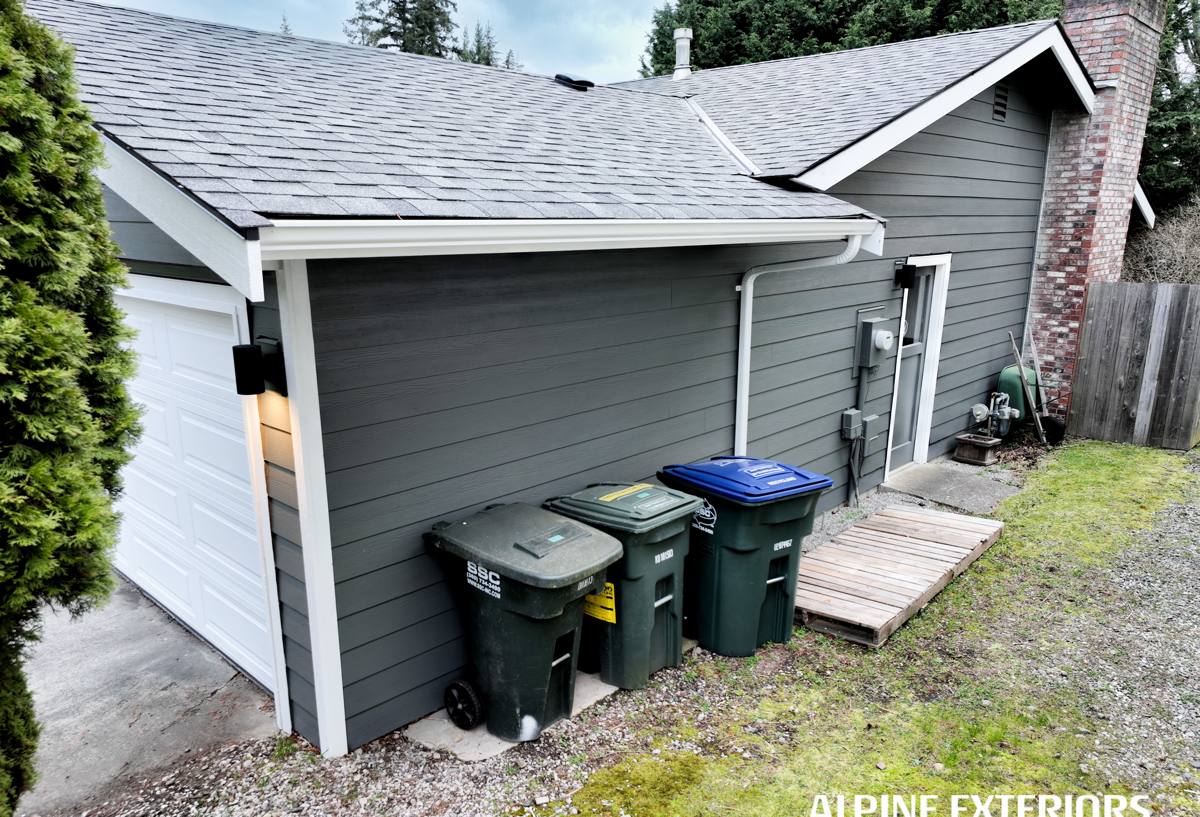
Board and batten is a vertical siding pattern: wide boards (or panels) run up the wall, and narrow strips — the "battens" — cover the seams between them. It reads as clean vertical lines instead of the horizontal shadow lines of lap siding, which is why it's popular on farmhouse-style, modern, and craftsman-influenced homes alike.
The Two Common Ways to Build It
- True reverse board and batten: wide vertical boards installed first, with narrower battens fastened over each seam. This is the traditional method and gives the deepest, most authentic shadow line.
- Panel-and-batten: large sheet panels installed vertically, with battens applied over the panel seams and often at regular intervals across the field for a consistent rhythm. This is faster to install and very common on new construction.
Both methods can be done correctly or incorrectly. The batten spacing, the fastening pattern, and — most importantly — what's happening behind the siding are what determine whether it lasts.
Why This Climate Makes Installation Quality Non-Negotiable
Every seam in a board and batten wall is a potential water entry point, and board and batten has a lot of seams by design. In a drier climate, a sloppy install might go years before it shows a problem. In Whatcom County, it won't. The marine-influenced air that moves through the region keeps humidity high for long stretches, driving rain regularly hits walls at an angle rather than straight down, and shaded north- and west-facing walls can stay damp for days after a storm passes. Add a moss season that can run from fall through spring, and any wall assembly that traps moisture instead of shedding it is going to show rot, staining, or paint failure faster here than almost anywhere else in the state.
The Mistakes We See Most Often
- Battens face-nailed straight through into the board below without any drainage gap, trapping water between the layers
- No weather-resistive barrier or improperly lapped house wrap behind the siding
- Missing or undersized flashing at window and door heads, where board and batten's vertical joints funnel water straight down onto the opening
- Butt joints between vertical boards left unflashed or uncaulked at the top
- Battens installed tight against the field board with no room for the wood or fiber cement to move seasonally, causing cracking and fastener pop
Every one of these is invisible on the day the siding goes up. They show up two, five, or ten years later as soft spots, streaking, or paint that won't hold — usually right around the time a homeowner is calling around asking why their "new" siding already looks tired.
Why We Only Install Board and Batten in James Hardie Fiber Cement
Board and batten can be built out of several materials, and each one has real trade-offs worth understanding before you commit to a look for your home.
Cedar Board and Batten
Cedar is the traditional choice, and it's genuinely beautiful — it's also the material this pattern was originally designed for. The honest trade-off is maintenance: real wood siding needs re-staining or repainting on a recurring cycle, and in a climate this wet, cedar left unmaintained for even a couple of years starts to gray, cup, and take on moisture at end grain and seams — exactly the joints board and batten has the most of. Homeowners who love the cedar look and are committed to the maintenance schedule can get decades out of it. Most homeowners underestimate that commitment.
Vinyl Board and Batten
Vinyl board and batten panels are inexpensive and low-maintenance in the sense that you never paint them, but the material itself is thin, flexes with temperature swings, and can crack in cold snaps. It also can't take an impact the way fiber cement can, and once a panel is damaged, color-matching an older run of vinyl to replace it is often difficult. It's not a structural fit for the kind of permanent, resale-focused siding job most Lynden homeowners are after.
LP SmartSide
LP SmartSide is an engineered wood product — wood strand substrate with a resin-saturated overlay. It performs reasonably well when installation is followed to the letter, but wood-based substrates are inherently more moisture-sensitive than fiber cement, and any breach at a cut edge, fastener hole, or seam gives water a path into the substrate itself. In a climate with this much sustained dampness and moss pressure, that's a risk we're not willing to build a Whatcom County home around.
Why Hardie Wins Out
James Hardie fiber cement is non-combustible, dimensionally stable across our temperature swings, and doesn't have a wood or vinyl substrate for water to exploit. Its ColorPlus factory finish is baked on under controlled conditions — more consistent and more durable than field-applied paint or stain — and it's backed by a strong, transferable manufacturer warranty. It's also engineered in climate-specific HZ product lines, which matters in a region that sees this much rain and humidity. For a siding pattern that already has more seams than most, starting with the most stable, least moisture-sensitive material available isn't a preference — it's the baseline we won't build below.
Comparing the Options Side by Side
| Material | Moisture Behavior | Maintenance | Typical Lifespan |
|---|---|---|---|
| James Hardie fiber cement | Non-combustible, does not rot or swell; stable in wet/dry cycling | Occasional wash; factory finish holds color for years | 30+ years with correct install |
| Cedar | Absorbs moisture at seams and end grain if unmaintained | Re-stain/repaint on a recurring cycle | 15-25 years, maintenance-dependent |
| Vinyl | Sheds surface water but can trap moisture behind if flashing fails | Low; but cracks/fades over time | 15-25 years |
| LP SmartSide | Wood-strand substrate is vulnerable at breaches (cuts, fasteners) | Periodic caulk/paint touch-up at seams | 20-30 years, install-sensitive |
What Correct Installation Looks Like on a Lynden Home
Behind the Siding First
Before a single board goes up, the wall needs a properly lapped weather-resistive barrier and, on board and batten specifically, a drainage plane — either a rain screen gap or furring strips — so any moisture that does get behind the siding has somewhere to go besides sitting against the sheathing. This is the step that gets skipped most often because it's invisible, and it's the step that matters most in this climate.
Flashing at Every Penetration
Windows, doors, and any wall penetration get proper head flashing before siding closes over it. On a vertical pattern, water traveling down a batten line has a straight shot at anything below it, so flashing details at openings carry more weight than they do on lap siding.
Fastening and Spacing Built for Movement
Battens are fastened per Hardie's specifications with room for material movement, not pinned tight in a way that stresses the fasteners and cracks the substrate over time.
Finish
Factory-applied ColorPlus finish means the color and coating go on under controlled conditions rather than in the field, which is one less variable in a climate where field-applied finishes struggle to cure and hold in damp weather.
Our Process for a Lynden Project
- On-site assessment: we look at wall orientation, existing moisture damage, and how much sun and shade each elevation gets — north- and west-facing walls in this area typically need extra attention.
- Moisture check of the existing wall: before anything comes off, we check for soft sheathing or existing rot so it's addressed, not covered up.
- Drainage plane and weather barrier install: the step that determines how the wall performs for the next 30 years.
- Hardie board and batten installation: to manufacturer spec, with correct flashing at every opening.
- Final walkthrough: we go over the finished work with you before we consider the job done.
What to Ask Any Contractor Before You Hire Them
- Will they show you the weather-resistive barrier and drainage plane before it's covered?
- Do they follow the manufacturer's published fastening and clearance specs, or "how we've always done it"?
- Are they James Hardie certified, and can they explain why they use the product line they use?
- Do they have experience with vertical siding specifically, not just lap siding?
- Is their warranty in writing, and does it cover labor as well as material?
What Drives the Cost
Board and batten generally costs somewhat more than lap siding to install because of the extra labor in fitting and fastening battens, but the spread on any given home depends on a few concrete factors.
| Factor | Why It Matters |
|---|---|
| Wall condition underneath | Rotted sheathing found during tear-off adds repair cost before new siding goes on |
| Number of openings | Every window and door adds flashing and trim labor |
| Batten spacing and pattern | Tighter batten spacing means more material and more fastening time |
| Wall height and access | Multi-story sections and steep lots add staging and labor time |
| Color and trim package | Custom ColorPlus colors and trim details affect material cost |
Living With Board and Batten in Whatcom County
Once it's installed correctly, board and batten in James Hardie fiber cement is genuinely low-maintenance for this climate. It won't rot, and it holds its factory finish far longer than field-painted wood. That said, moss and algae growth on north-facing or shaded walls is a fact of life anywhere in Whatcom County, board and batten included — an occasional gentle wash keeps it looking sharp and prevents organic growth from holding moisture against the surface long-term. It's a fraction of the upkeep cedar demands, but it's not zero-maintenance, and we tell homeowners that upfront rather than let them find out later.
Why a Crew That Already Works Lynden Matters
Board and batten done wrong doesn't fail everywhere the same way — it fails according to the specific climate it's in. A crew that's worked other parts of the state or country may build a technically sound wall for a drier region and not think twice about drainage details that matter far more here. Working in and around Whatcom County day in and day out means we've seen where board and batten holds up and where it doesn't, on homes with the same rain, the same moss pressure, and the same shaded walls yours has. That's not a marketing line — it's the difference between a crew that follows a spec sheet and a crew that understands why the spec sheet says what it says for this part of Washington.
If you're weighing board and batten for a Lynden home, we're happy to take a look at your walls, talk through what the job actually involves, and give you a straightforward, no-pressure estimate — no invented pricing, no pressure to sign anything on the spot. Fill out the form below and we'll get back to you.