 Whatcom County
 Siding Built for Lynden's Climate, Not Just Any Climate
Lynden sits in a part of Whatcom County that gets a particular mix of weather most siding products were never engineered for: long stretches of driving rain off the Pacific, heavy winter dampness that settles into shaded north walls and never fully dries, and a moss and algae season that can run most of the year on properties tucked near trees or waterways. Add in the salt-tinged air that reaches inland from the Strait of Georgia and Bellingham Bay on windy days, and you have a climate that's genuinely hard on exterior materials. Siding here isn't just cosmetic — it's the first line of defense against moisture intrusion, and the wrong product or the wrong install detail shows up as a problem within a few wet seasons, not decades.
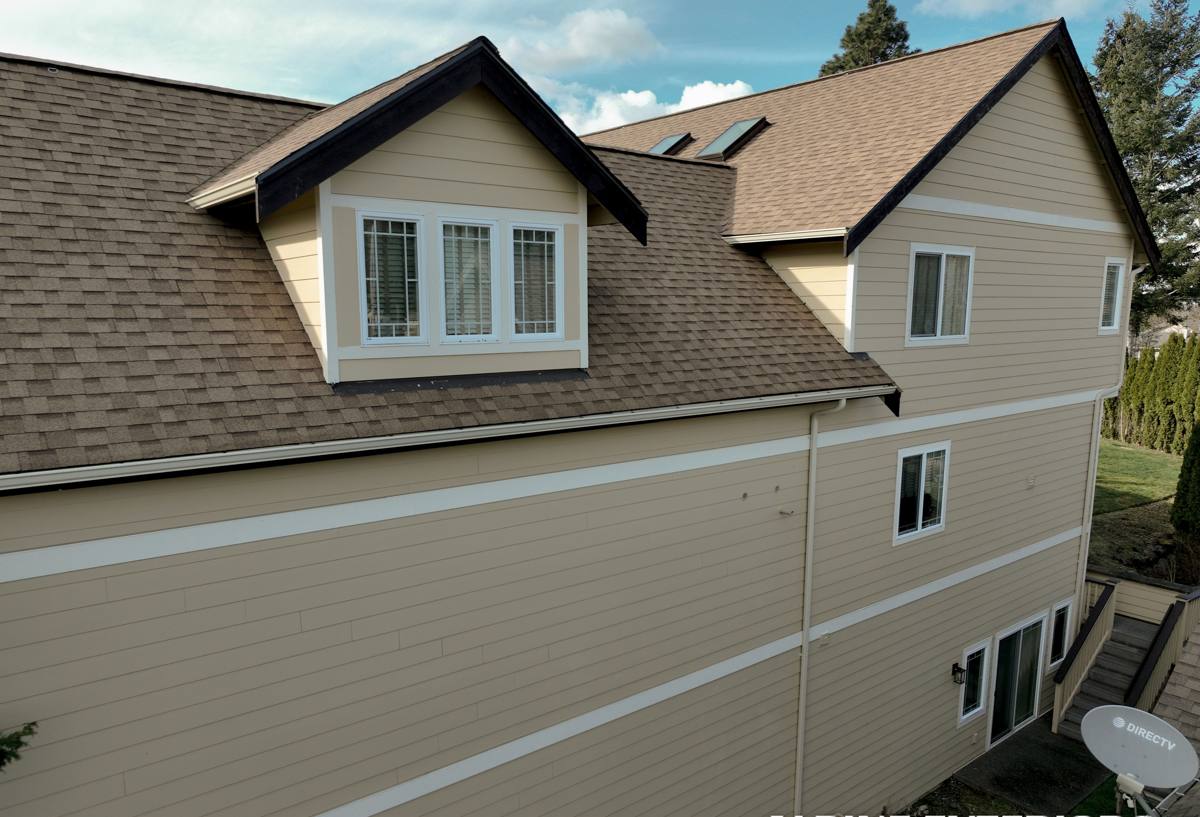
We install James Hardie fiber cement siding exclusively, and on homes in and around Lynden, that decision is about more than color options or curb appeal. It's about putting a material on the wall that resists moisture absorption, doesn't feed mold or moss growth, and holds a factory finish through repeated freeze-thaw and soak-dry cycles without cracking, warping, or delaminating.
What Lynden Homes Are Actually Up Against
Moisture That Doesn't Let Up
Whatcom County's rain pattern isn't just about total inches — it's about duration. Long, low-intensity rain events soak siding for days at a time, and shaded or north-facing walls can stay damp well after the sun comes back out. Any siding product that absorbs water, swells, or traps moisture behind it is going to underperform here. Wood-based and composite products in particular are vulnerable to swelling at seams and fastener points when they sit wet for extended periods.
Moss, Algae, and Organic Growth
Between tree cover, humidity, and shade, moss and algae are a fact of life on Lynden exteriors — not just on roofs, but creeping up siding from grade level, ledges, and anywhere water sits or drains slowly. Porous or wood-fiber siding gives organic growth something to hold onto. A dense, factory-finished fiber cement surface gives it far less to work with.
Salt Air and Wind-Driven Moisture
Lynden is inland, but Whatcom County as a whole gets enough marine influence that salt-laden air and wind-driven rain reach well past the immediate coastline. That combination accelerates corrosion on fasteners and trim, and it pushes moisture into any gap in the water-management layer behind the siding. Correct flashing and house-wrap detailing matter as much here as the siding material itself.
Why We Only Install James Hardie
We made a standing decision years ago to install James Hardie fiber cement siding and nothing else — no vinyl, no LP SmartSide, no Cemplank, no Allura, no primed spruce or cedar. That's not a marketing position; it's a professional standard based on what actually holds up in this climate.
- Non-combustible core. Fiber cement doesn't feed a fire the way wood-based products can, which matters for both safety and insurance considerations.
- Engineered for the Pacific Northwest. Hardie's HZ5 product line is formulated specifically for wet, moisture-prone climates like ours, with moisture and freeze-thaw resistance built into the manufacturing process, not added on-site.
- ColorPlus factory finish. The finish is baked on in a controlled environment, which gives far more consistent, durable color than field-applied paint — and it holds up against the fading and chalking that UV and salt air cause over time.
- Dimensionally stable. Hardie board doesn't swell, warp, or rot the way wood-based and some engineered wood products can when they take on repeated moisture cycles.
- Real warranty backing. Hardie's product warranty is transferable and substantial, which matters to homeowners planning to sell in a market where buyers increasingly ask what siding is on the house.
We're not going to tell you other products are junk — most of them do something well. Vinyl is inexpensive and low-maintenance in mild climates. Cedar looks great when it's new. But in a climate that punishes moisture absorption and organic growth the way Whatcom County's does, we've seen enough of those products fail early, or need more upkeep than a homeowner signed up for, that we stopped installing them. Fiber cement, installed correctly, is what we're willing to put our name on.
What a Correct James Hardie Install Actually Involves
The siding board itself is only part of the job. Most siding failures we get called to diagnose aren't a defect in the material — they're a gap in the water-management system behind it. On a Lynden home, that system has to work hard, so we don't cut corners on it.
The Sequence That Matters
- Remove old siding and inspect the sheathing for existing rot, soft spots, or prior water damage — this is where problems from an old install usually surface.
- Repair or replace any compromised sheathing before anything else goes on the wall.
- Install a weather-resistant barrier (house wrap) with correctly lapped and taped seams, so water sheds down and out rather than working its way in.
- Flash all penetrations — windows, doors, hose bibs, vents, and anywhere else something passes through the wall plane.
- Install rainscreen or furring strips where called for, giving the wall an air gap so any incidental moisture behind the siding can drain and dry instead of sitting against the sheathing.
- Hang the Hardie boards to manufacturer specification — correct fastener type, spacing, and penetration depth, correct clearances at grade and at trim.
- Caulk and seal per Hardie's published details, using materials rated for the exposure.
- Final inspection of butt joints, corners, and trim lines for tight, weather-sealed transitions.
Skip or rush any one of these steps and you can end up with a wall that looks fine for a year or two before a moisture problem shows up from the inside out — usually the most expensive kind to fix.
Common Install Mistakes We Fix or Avoid
- Fasteners driven too deep or too shallow, which compromises the board's structural attachment and warranty coverage
- Missing or improperly lapped house wrap seams that let water track behind the siding
- Siding installed tight to grade or hardscaping with no clearance, wicking ground moisture into the bottom courses
- Caulk used in place of proper flashing at windows and doors
- No rainscreen gap on walls that see heavy, sustained moisture exposure
Cost Factors for a Lynden Hardie Siding Project
Every home is different, and we won't quote a number without seeing the house, but these are the variables that actually move the price on a fiber cement re-side:
| Factor | Why It Matters |
|---|---|
| Sheathing condition | Rot or water damage found during tear-off adds repair scope before new siding can go on |
| Board profile | Lap siding, board-and-batten, and shingle-style panels have different material and labor costs |
| Trim and detail work | Homes with more corners, gables, and window trim take more precision cutting and flashing time |
| Rainscreen system | Adding a furring/rainscreen assembly improves drying performance but adds labor and material |
| Access and site conditions | Multi-story walls, tight lot lines, or landscaping obstacles affect scaffolding and staging time |
| ColorPlus vs. field paint | Factory-finished ColorPlus boards cost more upfront but remove the need for repainting for years |
Why a Crew That Already Works Whatcom County Matters
Installation quality is only half the equation — the other half is knowing how this specific climate behaves on a specific wall before the first board goes up. A crew that regularly works Lynden and the surrounding Whatcom County area already knows which orientations hold moisture longest, where moss pressure tends to be worst, and how local permitting and inspection processes work. That local pattern recognition shows up in small decisions — extra flashing at a north-facing dormer, a wider rainscreen gap on a shaded wall — that a crew unfamiliar with the area might not think to make.
It also matters for warranty follow-through. If something needs a look in year three or year eight, you want a contractor who's still working in your area and stands behind the install, not a company that did one job in the region and moved on.
Maintenance: What Ongoing Care Actually Looks Like
One reason we standardized on James Hardie is that it asks less of homeowners over time than most alternatives, but "low maintenance" doesn't mean "no maintenance." A simple annual routine keeps a Hardie installation performing the way it's designed to:
- Rinse the siding once or twice a year to clear pollen, dust, and early moss growth before it establishes
- Keep gutters clear so overflow doesn't run down and pool against siding at roof lines
- Trim back vegetation and tree cover that keeps walls shaded and damp longer than necessary
- Inspect caulk lines at windows, doors, and trim every couple of years and re-seal where it's cracked or pulled away
- Watch for any staining or discoloration at the bottom courses, which can signal a grade or drainage issue worth addressing early
None of this is heavy lifting, but it's the difference between a Hardie installation that looks good for decades and one that just looks good for a few years.
Get an Honest Look at Your Home
If your Lynden home's siding is showing moss staining, soft spots, peeling paint, or you're just planning ahead for a re-side, we're happy to come take a straightforward look and tell you what we actually see — no pressure, no upsell to a product we don't believe in. Request a free estimate using the form below and we'll walk the exterior with you and talk through what correct James Hardie installation would look like for your home.