 Whatcom County
 Repair Is a Different Job Than Installation
Most siding pages talk about full replacement — tearing off the old system and putting up new. Repair is a different discipline. It means diagnosing what's actually wrong with an existing wall, deciding what can be fixed versus what needs to come off, and matching the work to siding that's already been sitting on the house for years. On a Lynden home, that diagnosis has to account for what the local climate does to siding over time: salt air moving in off the water, driving rain that hits walls sideways instead of straight down, and a moss season that runs most of the year on shaded sides of the house. A repair that ignores those factors tends to fail again within a few seasons.
This page is specifically about siding repair for Lynden homes — what typically goes wrong, how to tell a cosmetic issue from a structural one, what a correct repair actually involves, and how our process works when a homeowner calls about a damaged section rather than a full re-side.
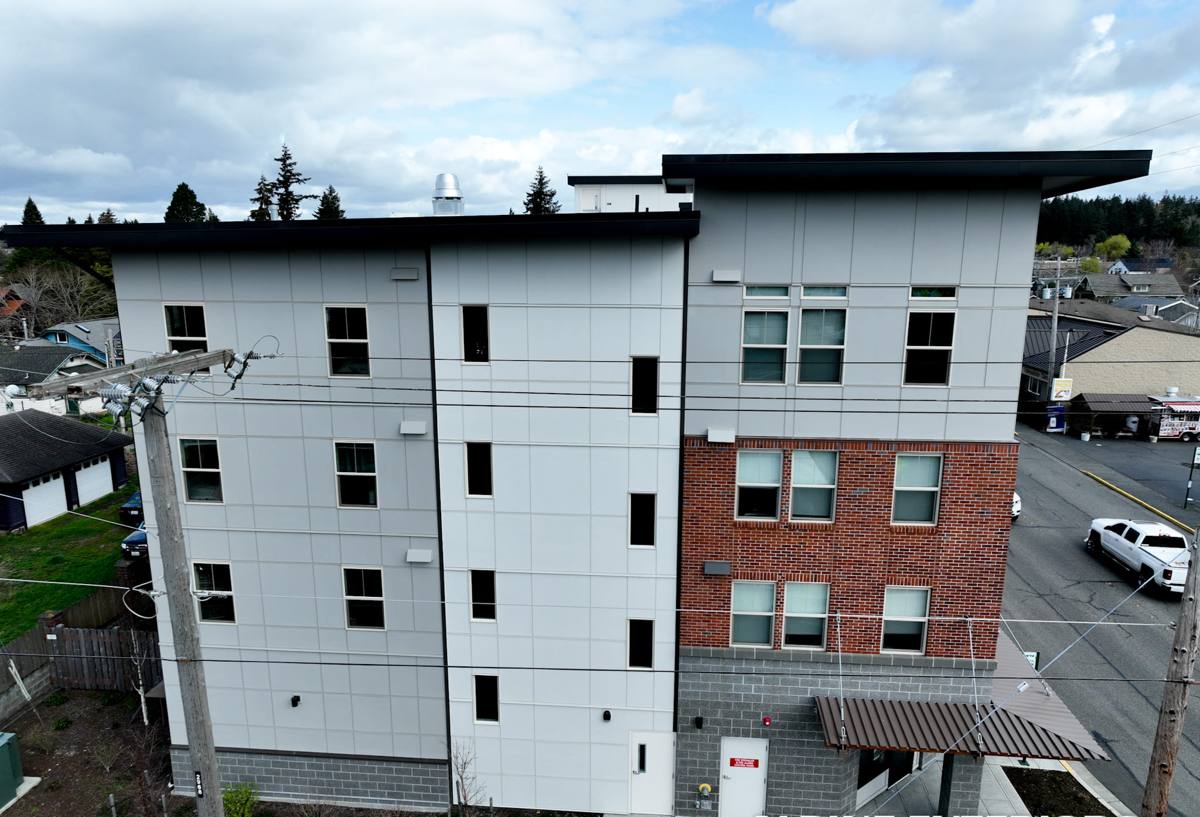
What Actually Damages Siding Around Lynden
Salt Air and Fastener Corrosion
Lynden sits inland from the immediate coastline, but marine air still moves across this part of Whatcom County and works on exposed metal over time. Corroding fasteners lose their grip on the siding, which creates small gaps that let water in behind the cladding. A section of siding that's started to work loose, or that shows rust streaking near nail heads, is usually a fastener problem before it's a siding-material problem — and it's a repair that needs to address the hardware, not just cosmetically patch the board.
Wind-Driven Rain at Seams and Trim
Storms coming through this region regularly push rain sideways into walls rather than letting it fall straight down and shed off. That sideways load finds its way into laps, butt joints, and trim lines that weren't detailed to handle water moving in from an angle. Repeated exposure like this is where caulk joints fail first, followed by the corner boards and window trim that depend on those joints staying sealed.
A Long Moss Season
Shaded and north-facing walls in this area stay damp for extended stretches, and mild temperatures keep moss and mildew active across most of the year. Organic growth on siding isn't just an appearance issue — it holds moisture against the surface longer than it would otherwise sit there, and on porous or damaged siding that extended dampness is what turns a small crack into a soft, failing section of wall.
Impact Damage and Ordinary Wear
Not every repair call is climate-driven. Lawn equipment, ladders, falling branches, and simple age all crack or dent siding boards. These are often the simplest repairs — but only if they're addressed before repeated wet-dry cycles get into the damaged area and start affecting what's behind it.
How to Tell a Patch Job From a Real Problem
Homeowners often call about one visible issue — a cracked board, a soft spot, a discolored patch — without knowing whether it's isolated or a sign of something larger happening behind the wall. Some signs point toward a straightforward, contained repair. Others suggest the damage extends further than what's visible from the outside.
- Isolated cracking or a single impact-damaged board: Usually a contained repair if it's caught early and the area behind it hasn't stayed wet long.
- Soft or spongy siding when pressed: A sign moisture has been sitting in the material or in the sheathing behind it — this needs to be opened up and inspected, not just patched over.
- Staining or discoloration spreading from a single point: Often traces back to a flashing or caulk failure somewhere above the stain, not the stained board itself.
- Bulging or visibly separated boards: Suggests the fasteners or the substrate underneath have already been compromised.
- Persistent moss or mildew that returns quickly after cleaning: Points to a moisture-retention problem in that section of wall, not just a surface-cleaning issue.
- Musty smell or interior staining on the wall opposite a damaged section: A sign water has already reached the sheathing or framing, and the repair scope is larger than the visible siding damage.
What a Correct Siding Repair Actually Involves
A repair that only addresses what's visible from the curb tends to be temporary. A repair that holds needs to follow the same logic as a proper installation, just applied to a smaller section of wall.
- Diagnose before opening anything up. We identify the likely water path — where it's getting in, not just where it's showing up — before deciding how much siding needs to come off.
- Remove enough material to see the real extent of the damage. Damaged siding almost always covers more than the visibly affected board or two. Pulling back adjacent siding is standard, not scope creep.
- Inspect the water-resistive barrier and sheathing underneath. If the house wrap is torn or the sheathing has gone soft, those get addressed before any new siding goes back up — patching over compromised sheathing just moves the problem a few years down the road.
- Correct the underlying detail, not just the symptom. If a flashing gap or a bad caulk joint caused the failure, that detail gets fixed as part of the repair, not left in place under new siding.
- Match the replacement material and finish. On Hardie siding, this means matching the plank profile and, where possible, the ColorPlus finish so the repaired section doesn't stand out as an obvious patch.
- Reseal and refasten to spec. Correct fastener spacing and sealant at the repaired joints matter as much on a repair as they do on a full installation — this is where a lot of DIY and lower-bid repairs cut corners.
When Repair Makes Sense — and When It Doesn't
Not every damaged section is worth repairing in isolation, and we'll say so plainly rather than selling a patch job that won't hold. The honest answer usually comes down to how contained the damage is and what condition the rest of the siding is in.
| Situation | Repair Usually Makes Sense | Full Replacement Usually Makes More Sense |
|---|---|---|
| Damage extent | One or a few isolated boards or sections | Damage scattered across multiple walls or elevations |
| Age of existing siding | Siding is mid-life and otherwise in good shape | Siding is near or past its expected service life |
| Underlying material | Existing Hardie or other sound fiber cement | Older wood, vinyl, or a product already showing widespread failure |
| Water intrusion history | First known issue, source clearly identified | Repeated repairs in the same area, or an unclear water path |
| Color match | Recent ColorPlus finish still available for close match | Discontinued color or significant fade making a seamless match unlikely |
When a home shows the pattern in that right-hand column, we'll say so directly. A string of repeat repairs on the same wall usually costs more over a few years than addressing the whole elevation once, correctly.
Why Repairing With Hardie Simplifies the Job
We install and repair James Hardie fiber cement exclusively — we don't work with LP SmartSide, vinyl, Cemplank, Allura, primed spruce, or cedar. On repair work specifically, that focus has a practical benefit: we know the plank profiles, fastening patterns, and ColorPlus finish options well enough to match an existing Hardie installation cleanly, rather than guessing at how an unfamiliar product will behave once it's opened up. Fiber cement's dimensional stability also matters for repairs — because it doesn't swell and shrink the way wood-based siding does, a properly matched repair section stays flush with the surrounding wall instead of telegraphing a seam as the seasons change.
If the existing siding on a Lynden home isn't Hardie, we'll still assess and repair what's there when it's a sound, contained fix. But if the damage is extensive enough that it's really a replacement decision, we'll walk through why we'd recommend Hardie for the new material — the same reasoning covered on our general siding pages: a non-combustible core, a factory-applied finish that holds up to this region's moisture and UV exposure, and HZ5 engineering built for climates like this one.
Our Repair Process for Lynden Homes
1. On-Site Assessment
We look at the damaged area, check adjacent siding and trim, and, where it's accessible, get a look at what's happening behind the wall before quoting anything. This is also when we flag whether a repair is realistic or whether the honest recommendation is a larger scope.
2. A Clear, Written Scope
The estimate spells out what's being removed, what's being inspected underneath, and what the repair includes — sheathing work, flashing correction, and refinishing, not just "patch siding."
3. The Repair Itself
We handle the removal, any sheathing or barrier correction, replacement siding installed and fastened to spec, and finish work to match the surrounding wall as closely as the existing material allows.
4. A Straight Answer on What Comes Next
If the repair reveals damage beyond the original scope, we tell you before proceeding, not after the fact. And if the rest of the siding is aging out, we'll say that too rather than repairing the same wall again in a couple of years.
Signs a Lynden Homeowner Shouldn't Ignore
- Siding that flexes or feels soft when pressed by hand
- Visible gaps opening up at butt joints or corner trim
- Paint or finish that's peeling or bubbling in one concentrated area
- Moss or mildew that returns within weeks of being cleaned off
- Rust streaking below fastener heads
- A musty smell near an exterior wall, especially after a stretch of wet weather
Any one of these is worth a call before it's addressed with paint or caulk alone. Cosmetic fixes over an active moisture problem tend to hide the issue rather than solve it, and the repair gets more expensive the longer water keeps reaching the same spot.
Why Local Experience Matters for Repair Work Specifically
Repair work rewards familiarity with how a specific climate ages a specific material. A crew that mostly works drier inland regions, or that installs a wide mix of siding brands, doesn't necessarily have a feel for what a few Whatcom County winters do to a fastener line or a caulk joint on a Lynden wall. Working this area regularly means we've seen the failure patterns repeat — which walls take the worst of the wind-driven rain, which sides of a house hold moss longest, where corrosion tends to start first — and that pattern recognition is a big part of diagnosing a repair correctly instead of guessing.
If you're dealing with a damaged, soft, or failing section of siding on a Lynden home, we're happy to take a look and give you a straight assessment — repair, or something larger — with no pressure either way. A free estimate is a good place to start.