 Whatcom County
 Why Storm Damage Behaves Differently on Nooksack Roofs
Nooksack sits out in the Whatcom County river valley, where Pacific weather systems come through with real force. That combination — wind funneling through the valley, driving rain that hits roofs at an angle instead of falling straight down, and moisture carried inland from the Salish Sea — means storm damage here rarely looks the way it does in drier climates. A roof that would shrug off a summer thunderstorm in another state can take on real damage from a Whatcom County windstorm, especially if it already has a few years of wear on it.
The other factor that separates this area from most of the country is how long the moss season runs. In much of Whatcom County, roofs stay damp enough, long enough, that moss and algae get a real foothold on north-facing slopes and shaded valleys. Moss doesn't just look bad — it holds water against shingles and flashing, and it lifts shingle edges enough that wind-driven rain can work its way underneath during the next storm. A roof that's already carrying moss going into storm season is a roof that's more likely to leak from wind and rain damage that a cleaner roof would have handled fine.
Salt air is the quieter problem. It doesn't announce itself the way a missing shingle does, but over years it accelerates corrosion on exposed fasteners, flashing, and any metal roofing components. When storm damage repair turns up rusted nails or pitted flashing, that's usually the salt air and moisture doing slow damage long before the storm made it visible.
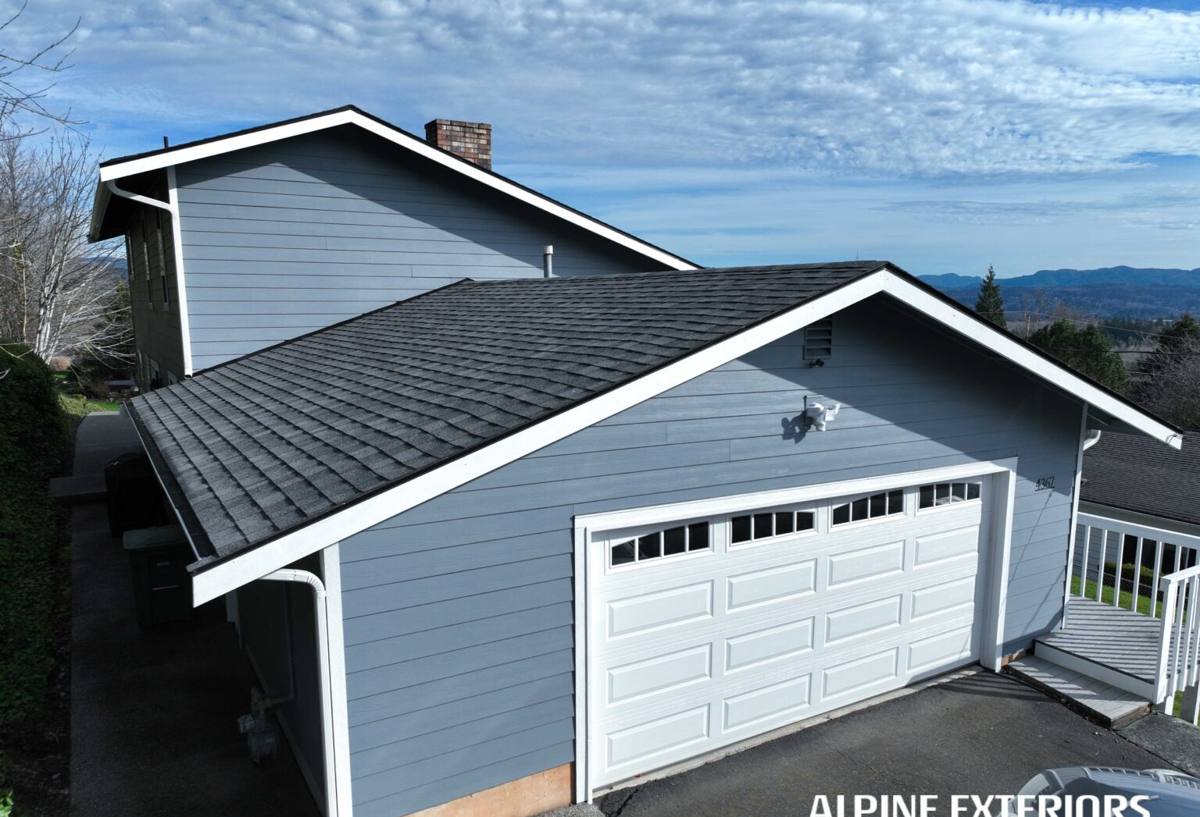
How to Tell Your Roof Has Storm Damage
What You Can Usually Spot From the Ground
Most homeowners notice storm damage indirectly — a stain on a ceiling, a draft in the attic, or debris in the gutters that shouldn't be there. Those are worth acting on quickly, because a small entry point for water gets worse every time it rains again, and in this part of Washington that's often within days.
What Usually Requires a Closer Look
A lot of real storm damage isn't visible from the driveway. Lifted shingle tabs, cracked seals, and bent flashing often only show up on an actual roof walk. That's why we do a full inspection rather than just patching the one spot a homeowner called about — the visible damage is frequently the smallest part of the problem.
- Shingles that are cracked, curled, creased, or missing entirely after a windstorm
- Granules collecting in gutters or at downspout outlets, a sign of impact or wind abrasion
- Flashing around chimneys, vents, or skylights that's bent, lifted, or separated
- Soft or discolored ceiling patches, especially after a heavy rain event
- Visible daylight through the roof deck when viewed from inside the attic
- Moss buildup on shingle edges combined with any of the signs above
- Debris — branches, needles, gravel from roofing granules — collecting in valleys
- Gutters or downspouts pulled loose or dented from wind or falling limbs
What a Correct Storm Damage Repair Actually Involves
Assessing the Full Scope, Not Just the Obvious Spot
The mistake we see most often with rushed repairs is fixing the one leak a homeowner reported and missing two or three other spots the same storm damaged. A correct repair starts with a full-roof inspection — every slope, every penetration, every valley — because wind and rain damage rarely limits itself to a single square foot.
Matching Materials the Right Way
If your roof is a few years old, an exact shingle match may not exist anymore — manufacturers change product lines and color runs over time. A correct repair accounts for this honestly: we tell you up front whether a close match is realistic, whether a slightly visible patch is the trade-off of a spot repair versus a slope replacement, and we don't pretend a mismatch will blend in when it won't.
Flashing, Decking, and the Parts Homeowners Don't See
Storm damage that's gone unaddressed for even a season can mean the roof deck underneath has softened from repeated moisture exposure. A repair that only replaces shingles over rotted decking isn't a repair — it's a roof that will fail again at the same spot. Any deck damage we find gets flagged and replaced as part of the job, not left for the next storm to expose.
Our Process, Start to Finish
- Emergency response: if water is actively getting in, we prioritize a tarp or temporary seal to stop further damage before anything else.
- Full inspection: we walk the entire roof, not just the reported problem area, and document what we find with photos.
- Honest scope and estimate: you get a clear breakdown of what's storm damage versus pre-existing wear, and what repair options actually make sense.
- Insurance documentation: if you're filing a claim, we provide the photo documentation and written scope your adjuster will need.
- The repair itself: matched materials where realistic, proper flashing and underlayment work, and deck replacement if we find soft spots.
- Final walkthrough: we go over the completed work with you before we consider the job done.
Repair or Replace? What Actually Drives That Decision
Not every storm-damaged roof needs to come off. But some do, and the honest answer depends on a handful of factors rather than a single rule of thumb.
| Factor | Repair Usually Makes Sense | Replacement Usually Makes Sense |
|---|---|---|
| Roof age | Under roughly 10-12 years old | Nearing or past the material's expected service life |
| Damage extent | Isolated to one or two slopes or a single storm event | Spread across multiple slopes, or repeated damage over several storms |
| Deck condition | Solid decking under the damaged area | Soft, rotted, or previously water-damaged decking |
| Moss/algae history | Minor, treatable moss on an otherwise sound roof | Heavy, long-term moss growth that's degraded shingles broadly |
| Typical cost range | Roughly a few hundred to a couple thousand dollars | Several thousand dollars and up, depending on size and material |
These ranges are broad on purpose — actual cost depends on roof size, pitch, material, and how much decking (if any) needs to be replaced. We'll give you real numbers after we've actually looked at your roof, not before.
Working With Your Insurance Company
Storm damage is one of the more common reasons Whatcom County homeowners file a roofing insurance claim, and adjusters generally want to see clear documentation: photos of the damage, a written scope of what needs repair, and a timeline tying the damage to a specific storm event. We provide that documentation as a standard part of our inspection, whether or not you end up filing a claim. We're not a public adjuster and we don't negotiate your policy for you, but we make sure you're not walking into that conversation with less information than the insurance company has.
Why Hiring a Crew That Already Works in Nooksack Matters
Storm damage repair rewards local knowledge in ways that are easy to underestimate. A crew that regularly works in and around Nooksack knows how Whatcom County wind and rain patterns tend to hit roofs in this valley, which slopes and orientations take the worst of it, and how moss and salt air typically show up on roofs that have gone a season or two without attention. That's the difference between a repair that addresses what actually happened to your roof and one that treats every job the same regardless of climate.
There's also a practical side: after a regional storm, roofing crews get busy fast, and homeowners who wait on an out-of-area contractor often wait longer for a response than the leak can afford. Working locally means faster inspection turnaround, familiarity with permitting through Whatcom County when a job requires it, and a crew that's still reachable next season if a repair needs a warranty follow-up.
After the Repair: Reducing the Odds of a Repeat
Fixing the damage is half the job — the other half is making the roof less likely to take the same hit next time. A few things matter more in this climate than in drier regions:
- Keep gutters and downspouts clear so wind-driven rain has somewhere to go instead of backing up under the roof edge
- Address moss early each season rather than letting it build up through a full wet season
- Have flashing and fasteners checked periodically, since salt air and moisture accelerate corrosion faster here than in many parts of the country
- Trim back overhanging branches that can drop limbs during windstorms
- Get a post-storm inspection after any significant windstorm, even if nothing looks obviously wrong
None of this is complicated, but it's the kind of maintenance that gets skipped until a storm makes it unavoidable — and by then it's a repair instead of a five-minute fix.
If a recent storm has left you with a leak, missing shingles, or just questions about what shape your roof is really in, we're happy to take a look. The estimate is free, there's no pressure attached to it, and you'll get a straight answer about whether you're looking at a repair or something bigger — just fill out the form below to get started.