 Whatcom County
 Roof Repair Built for Everson's Weather, Not a Generic Fix
Everson sits in the part of Whatcom County where weather off the Salish Sea and the surrounding lowlands funnels straight through the Nooksack Valley — long stretches of drizzle, heavier winter storms, and moisture that lingers in the air for months at a time. Roofs here don't fail because of one dramatic event. They fail slowly, from months of standing dampness, shaded north-facing slopes that never fully dry out, and moss that gets a foothold before anyone notices it. A roof repair done right in Everson has to account for that pattern, not just patch whatever is leaking today.
We work on homes across Whatcom County, and Everson roofs tend to show a consistent set of problems: moss and algae staining on shaded or low-slope sections, flashing that's worked loose around chimneys and vent pipes, and gutters that back up during heavy rain and push water under the roof edge. None of that is unusual for this part of the county — it's just what happens when a roof sits under a wet climate year after year without the right attention.
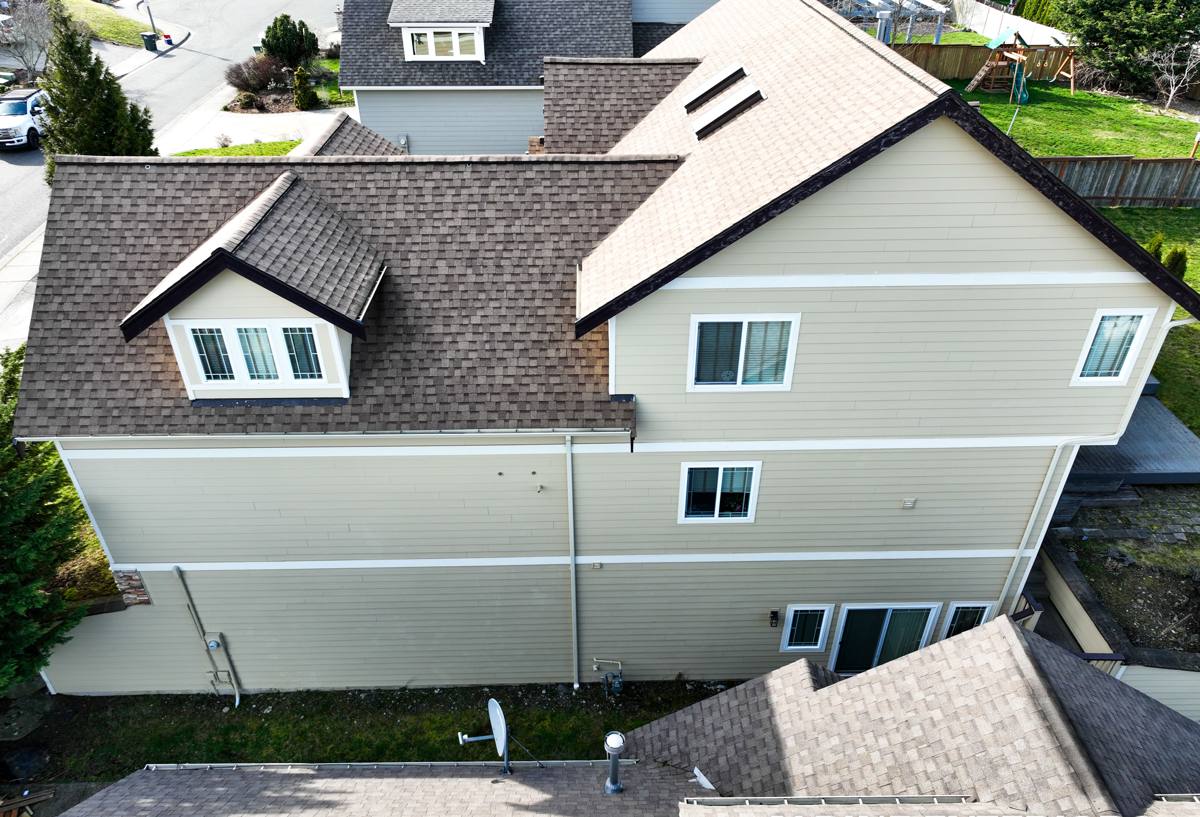
What Driving Rain and a Long Moss Season Do to a Roof
Moss and Organic Growth
Moss doesn't just sit on top of shingles looking bad — it holds moisture against the roofing material for weeks at a time, which is exactly the condition that breaks down asphalt granules and rots wood decking underneath. In Whatcom County's climate, moss season isn't really a season; it's most of the year, with growth accelerating anywhere a roof gets shade from trees or a neighboring structure. Once moss establishes on a north-facing slope, it tends to spread toward the ridge and work its way under shingle tabs, lifting them just enough for water to get in.
Driving Rain and Wind-Driven Water
Storms that come through with sustained rain and gusty wind push water sideways, not just straight down. That matters at every penetration point on a roof — chimneys, skylights, plumbing vents, and the transitions where a roof meets a wall. Flashing that's adequate for light rain can still leak under driving rain if it's undersized, poorly lapped, or has started to corrode. This is one of the most common repair calls we get: a homeowner has a leak that only shows up during heavy storms, and it traces back to flashing that's been marginal for a while.
Freeze-Thaw and Standing Moisture
Everson doesn't see extreme cold most winters, but it does get cold snaps mixed with wet conditions, and that combination is hard on roofing materials that are already saturated. Water that's soaked into moss, moss-damaged shingles, or compromised underlayment can freeze and expand, accelerating cracks and granule loss that were already starting.
Common Repair Issues We Find on Everson Roofs
- Moss and algae growth on shaded or low-slope sections, often with lifted or curling shingle tabs underneath
- Corroded or improperly lapped flashing around chimneys, skylights, and roof-to-wall transitions
- Nail pops and cracked shingles from age, wind, or foot traffic during past repairs
- Clogged or undersized gutters causing water to back up under the roof edge
- Soft or discolored decking discovered once damaged shingles are pulled back
- Deteriorated pipe boots and vent seals — a frequent, often-overlooked leak source
- Ice-and-water shield missing or failing at valleys and eaves on older roofs
What an Honest Roof Repair Actually Involves
Diagnosis Before Anything Gets Touched
A roof leak rarely shows up directly above the water stain inside the house — water travels along decking and framing before it drips. A proper repair starts with tracing the leak to its actual source, checking flashing, underlayment, and decking condition, not just replacing the shingles closest to the stain. Skipping this step is how homeowners end up paying for the same leak twice.
Matching Materials, Not Just Covering the Spot
Shingle color and profile change over the years, so a patch that doesn't reasonably match the surrounding roof stands out and can also perform differently in wind and rain. Where a close match isn't available, we're upfront about that trade-off rather than pretending it won't be noticeable.
Flashing and Underlayment Get Fixed, Not Just Sealed Over
Caulking over failed flashing is a short-term cover-up, not a repair — in a climate with this much sustained moisture, sealant alone breaks down fast. Correct flashing repair means removing the compromised material, checking the decking underneath for rot, and reinstalling flashing with proper laps so water sheds the way it's supposed to.
Moss Treatment That Doesn't Damage the Roof
Scraping moss off aggressively can strip granules and shorten the life of otherwise sound shingles. We remove growth carefully, treat the area to slow regrowth, and address the underlying cause — usually shade, debris buildup, or poor drainage — rather than just knocking the moss off and leaving the conditions that grew it in the first place.
Repair or Replace? How We Help You Decide
Not every roof problem in Everson calls for a full replacement, but not every leak should be treated as a quick patch either. The right call depends on the roof's age, how widespread the damage is, and what's happening underneath the surface.
| Factor | Usually Points to Repair | Usually Points to Replacement |
|---|---|---|
| Roof age | Under 15-20 years, materials still sound | Nearing or past manufacturer lifespan |
| Damage extent | Isolated to one section or penetration | Spread across multiple slopes |
| Decking condition | Solid, no rot found | Soft, rotted, or repeatedly repaired decking |
| Moss/algae staining | Surface growth, shingles intact underneath | Granule loss and shingle deterioration widespread |
| Leak history | First occurrence or single clear cause | Recurring leaks in different spots |
We'll always tell you honestly which category your roof falls into. If a repair will genuinely hold up, that's what we recommend — replacement isn't the default answer just because it's more work.
Our Roof Repair Process in Everson
- On-site inspection. We get on the roof (weather permitting) and check it from both outside and, where accessible, inside the attic for water tracking, staining, or soft decking.
- Straight explanation of what we find. You get a clear picture of the cause, not just a list of symptoms — including photos of anything that needs your sign-off before we proceed.
- Written scope and estimate. What's being repaired, what materials are used, and what it costs, before any work starts.
- The repair itself. Damaged shingles, flashing, decking, or moss-affected areas are addressed to match the surrounding roof as closely as possible, with attention to how water will move across that area afterward.
- Cleanup and final check. Debris and old materials are cleared, and we walk the area with you if you'd like to see the finished work.
Why It Matters to Hire a Crew That Already Works in Everson
A roofing crew that only sees a handful of jobs in Whatcom County a year doesn't have the same read on how local weather patterns actually behave — which slopes hold moss longest, how quickly gutters clog under fall leaf drop, or how driving rain finds its way into marginal flashing. Crews who work Everson and the surrounding Whatcom County communities regularly see the same failure patterns repeat across similar homes, which means less guesswork diagnosing your roof and fewer surprises once the work is underway.
There's also a practical side: local crews can get to a leaking roof faster during a storm event, and they're accountable to the same community they're working in — not driving in from out of the area for a single job and moving on.
What to Ask Before Hiring Anyone for Roof Repair
- Are you licensed and insured to work in Washington State, and can you provide proof?
- Will the estimate be in writing, with materials and scope spelled out?
- Who is actually doing the work — your crew, or subcontractors?
- What happens if you find rotted decking once the old roofing is pulled back?
- Do you offer any warranty on the repair labor itself, separate from material warranties?
Keeping a Repaired Roof in Good Shape
A repair holds up longer when it's not fighting the same conditions that caused the original problem. A few habits make a real difference in a climate like this one:
- Clear gutters and downspouts at least twice a year, more often if there's overhanging tree cover
- Trim back branches that keep a section of roof shaded and slow to dry
- Have moss treated before it spreads, not after shingles are already lifting
- Check attic ventilation — poor airflow traps moisture and speeds up decking and shingle wear
- Get a roof looked at after any major windstorm, even if nothing looks obviously wrong from the ground
If you're dealing with a leak, moss buildup, or storm damage on your Everson roof, we're happy to take a look and give you a straight answer about what it needs. Reach out for a free, no-pressure estimate using the form below.