 Whatcom County
 Why Siding Fails Faster in Ferndale
Ferndale sits close enough to Bellingham Bay and the Salish Sea that salt-laden air is a real factor in how exterior materials age here, not just a coastal-town cliché. Salt air accelerates corrosion on fasteners and trim, and it works into any crack or seam in a siding system faster than dry inland air does. Layer on the driving rain that comes through Whatcom County during fall and winter frontal systems — often blowing sideways against west- and south-facing walls — and you have a climate that punishes any siding system with weak seams, poor flashing, or materials that absorb moisture.
Then there's moss. Whatcom County's combination of shade, moisture, and mild temperatures gives moss and mildew a long growing season on north-facing walls, under eaves, and anywhere siding stays damp longer than a few hours after rain. On wood-based products, that moisture sits against the surface and slowly breaks down paint film and substrate. On poorly installed fiber cement, it just looks bad and holds grime. None of this means Ferndale homes are doomed to constant siding problems — it means the material and the installation have to be matched to the climate, not just to a catalog photo.
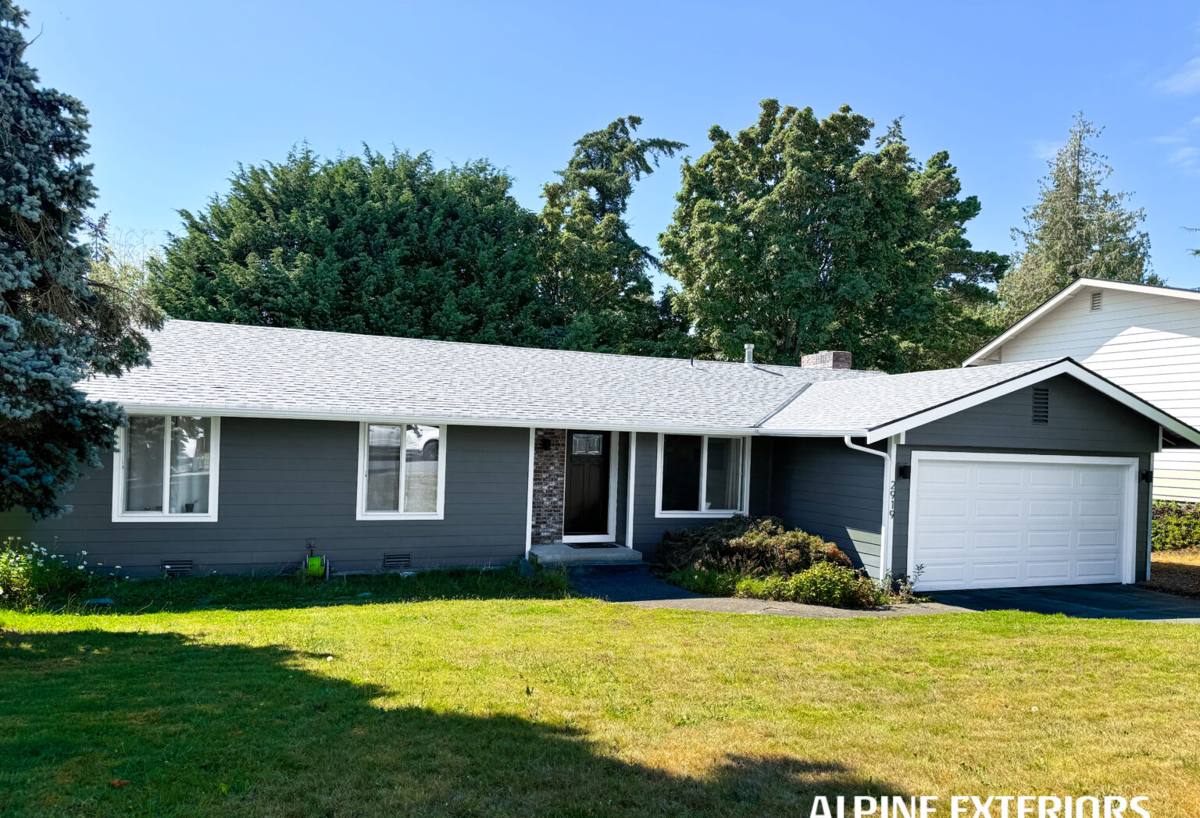
Replacement vs. Recover: Why the Difference Matters Here
A lot of "siding jobs" in Whatcom County are actually recovers — new siding installed directly over the old layer. That's faster and cheaper, and it's sometimes the right call on a home with no underlying issues. But recovering over existing siding also means sealing in whatever moisture damage, soft sheathing, or failed weather barrier is already behind that old material. In a climate with this much driving rain, that's a real risk, not a formality.
A true replacement means removing the old siding down to the sheathing, inspecting what's underneath, repairing anything compromised, and installing a new weather-resistive barrier before a single piece of new siding goes up. That's the only way to actually know what condition your walls are in, and it's the standard we work to on every full replacement.
Signs Your Home Is Telling You It's Time
Most homeowners don't wake up one day and decide to replace siding — the house tells them first. Common signs we see on Ferndale homes include:
- Soft or spongy spots when you press on the siding, especially near the bottom courses or under windows
- Paint that keeps failing in the same spots within a year or two of repainting
- Persistent moss or dark streaking on shaded walls that comes right back after cleaning
- Visible cupping, warping, or gaps opening up between boards
- Rising heating bills that can't be explained by anything else, suggesting air and moisture are getting through the wall assembly
- Caulk lines that have cracked or pulled away at trim, corners, and window edges
Any one of these on its own might just need a repair. Several at once, especially combined with an older home, usually points to a wall assembly that's due for a real look underneath the siding.
Why We Only Install James Hardie Fiber Cement
We install James Hardie fiber cement siding exclusively. We don't install vinyl, LP SmartSide, Cemplank, Allura, primed spruce, or cedar, and we think homeowners deserve an honest reason why, not just a sales pitch for what we do sell.
Vinyl is inexpensive and low-maintenance, but it's a thin plastic product that can crack in cold snaps, fade unevenly over time, and it isn't going to hold up structurally the way a cementitious product does over decades of Pacific Northwest weather. Wood products like cedar and primed spruce look great initially, but they require real ongoing maintenance — repainting, caulking, moisture monitoring — to keep water out, and Whatcom County's damp shoulder seasons make that maintenance schedule tighter than most homeowners want to commit to. LP SmartSide is an engineered wood product with real strengths, but it's still wood-based at its core, meaning cut edges and any breach in the factory coating are moisture entry points that matter more in a wet climate. Other fiber cement brands like Cemplank and Allura are legitimate competitors to Hardie, but we've standardized on one product line so our crews install it the same correct way every time, and so our warranty and product knowledge stay consistent.
James Hardie fiber cement is non-combustible, dimensionally stable, and available in HZ5 formulations engineered specifically for climate zones like ours that see a lot of moisture cycling. The ColorPlus factory finish is baked on under controlled conditions, which holds color and resists fading far better than field-applied paint, and it comes with a real transferable limited warranty. It isn't the cheapest siding option on the market, but it's the one we're willing to put our name behind on a Whatcom County home.
What a Correct Installation Actually Involves
Fiber cement is only as good as the installation behind it. A rushed or spec-cutting crew can put Hardie board on a wall and still leave you with moisture problems inside of a few years. On every job we do a full tear-off to sheathing, then repair any damaged sheathing or framing we find before anything new goes up. From there:
- A weather-resistive barrier is installed and properly lapped, shingle-style, so water sheds outward instead of working its way behind the barrier
- Flashing is installed at every window, door, and horizontal trim transition — the majority of siding leaks start at these transitions, not in the field of the wall
- Boards are fastened according to Hardie's published installation specifications for our exposure and climate zone, not generic "close enough" spacing
- Butt joints and field cuts are sealed and caulked correctly, and factory-cut edges are used wherever possible since they hold paint and seal better than field cuts
- Proper clearance is left between siding and grade, decks, and roof lines so water has somewhere to go instead of wicking up into the board
None of this is exotic. It's the manufacturer's own installation standard. But skipping steps here is exactly how you end up with a house that looks fine for two years and then starts showing problems at year five.
Our Process, Start to Finish
We start with an in-person inspection of your siding, trim, and the areas most exposed to wind-driven rain, so we can give you an honest read on what you're dealing with before any contract is signed. From there we measure the home, walk you through Hardie's board profiles and ColorPlus color options, and put together a detailed written estimate — not a vague ballpark.
Once work begins, we tear off the old siding, inspect and repair sheathing as needed, install the weather barrier and flashing, then install the new Hardie siding and trim. We handle caulking and any touch-up painting at cut ends, do a full walkthrough with you before we consider the job done, and clean up the site thoroughly. We also handle the permitting that Whatcom County requires for exterior work of this scope, so that's not something you have to manage yourself.
What Drives the Cost of a Ferndale Siding Replacement
Every home is different, and we'd rather give you real numbers from an on-site estimate than a misleading flat rate. But these are the main factors that move the price up or down:
| Factor | Why It Matters |
|---|---|
| Home size and wall complexity | More square footage and more corners, gables, and dormers mean more material and labor |
| Existing siding material | Tear-off of multiple old layers or asbestos-containing material takes more time than a single-layer removal |
| Sheathing condition | Rot or water damage found underneath the old siding adds repair work before new siding can go on |
| Siding profile | Lap siding, shingle-style panels, and vertical panel siding all install differently and price differently |
| Trim and accent work | Extensive trim, fascia, or accent-band details add labor beyond the flat wall area |
| Color choice | Factory ColorPlus finishes cost more up front than field-primed boards but eliminate repainting for years |
What to Check Before You Hire
Whatcom County has plenty of contractors who'll quote a siding job. Not all of them are set up to do it right. Before you sign anything, it's worth confirming:
- The contractor is licensed, bonded, and insured to do exterior work in Washington State
- They can speak specifically to Hardie's installation requirements, not just "we do siding"
- The written estimate breaks down tear-off, repair allowances, materials, and labor separately
- They're clear about who pulls permits and handles inspections
- They can show you examples of completed work in the local area
- The warranty terms — both manufacturer and workmanship — are explained in writing, not just verbally
Why a Local Whatcom County Crew Matters
A crew that works Ferndale and the surrounding parts of Whatcom County regularly knows which walls take the worst of the wind-driven rain, which yards stay shaded and damp long enough to grow moss fast, and how to schedule tear-offs around our wetter months so your walls aren't sitting exposed longer than they need to be. They also know the local permitting process and aren't learning it for the first time on your project. That local familiarity doesn't replace a correct installation, but it does mean fewer surprises and a crew that's still around and accountable after the trailer leaves.
If your Ferndale home is showing signs it's due for new siding, or you just want an honest read on its current condition, we're happy to come take a look. The estimate is free, there's no pressure, and you'll get a straight answer about what your home actually needs.